Chapter 16 of 17
The False Prophet
The false prophet of the end times is described in (Revelation) 13:11-15. He is also referred to as the “second beast” (Revelation 16:13, 19:20, 20:10.) Together with the Antichrist and Satan, who empowers both of them, the false prophet is the third party in the unholy Trinity.
The apostle John describes this person and gives us clues to identifying him when he shows up. First, he comes out of the earth. This could mean he comes up from the pit of hell with all the demonic powers of hell at his command. It could also mean he comes from lowly circumstances, secret and unknown until he bursts on the world stage at the right hand of the Antichrist. He is depicted as having horns like a lamb, while speaking like a dragon. The horns on lambs are merely small bumps on their heads until the lamb grows into a ram. His arguments will be subtle, convincing, and appealing. His oratory will be hypnotic, for he will be able to move the masses to tears or whip them into a frenzy. He will control the communication media of the world and will skillfully organize mass publicity to promote his ends. He will be the master of every promotional device and public relations gimmick. He will manage the truth with guile beyond words, bending it, twisting it, and distorting it. Public opinion will be his command. He will mold world thought and shape human opinion like so much potter’s clay. His deadly appeal will lie in the fact that what he says will sound so right, so sensible, so exactly what unregenerate man has always wanted to hear.
During the time of Great Tribulation, people will still need to buy and sell to earn a living for their families and themselves. The Antichrist and the False Prophet will strike their most severe and horrific blow at the level of basic necessities. The False Prophet will institute the Mark of the Beast which will be a system associated with the number 666. If you do not take the mark of the beast you will be killed. The book of Revelation describes a cashless society in the last days. In order to buy or sell, it will be necessary to possess a certain number (666) which is the Mark and Number of the Beast (the Antichrist) (Revelation 13: 16-18).
He also forced everyone, small and great, rich and poor, free and slave, to receive a mark on his right hand or on his forehead, so that no one could buy or sell unless he had the mark, which is the name of the beast or the number of his name. This calls for wisdom. If anyone has insight, let him calculate the number of the beast, for it is man's number. His number is 666.
This was an astonishing and improbable prophecy when John proclaimed it in the first century. Think that’s still just not possible? The US government in World War II used a rationing system for food and other items. It was not enough to have money sufficient enough to pay for an item. It did not matter how much money you had, if you didn’t have the stamps you couldn’t purchase the item. How could one number be the key to allow a person to transact business, to obtain commodities, or to complete any financial transactions? Today, not only is it possible, it’s easy to implement and the technology is already in use. Already North Americans live in a 97% cashless society. Less than 3 percent of the money in our economy exists as either paper currency or coin. John, in the book of Revelation, prophesies that the number 666 will be placed beneath the skin of people on the right hand or on the forehead as a way to enforce people’s allegiance to the Antichrist as their God and to control people throughout the Antichrist’s world empire.
The new VeriChip, a beneath-the-skin radio frequency chip, can be implanted beneath the skin and contain comprehensive information about an individual. This chip together with a GPS locator system will allow any interested party or institution not only to locate an individual but to identify a person with his financial, medical, and even criminal records. If you find yourself at this time period, having missed the Rapture, you must not take this mark. All who take this mark will be lost to God forever. This point cannot be stressed enough!
Revelation 14:9-11 9 Then another angel, a third one, followed them, saying with a loud voice, "If anyone worships the beast and his image, and receives a mark on his forehead or on his hand, 10 he also will drink of the wine of the wrath of God, which is mixed in full strength in the cup of His anger; and he will be tormented with fire and brimstone in the presence of the holy angels and in the presence of the Lamb.
11 "And the smoke of their torment goes up forever and ever; they have no rest day and night, those who worship the beast and his image, and whoever receives the mark of his name."
Life to the Image
Part of the deception perpetrated by the False Prophet will be his power to give life to the “image of the beast” (Revelation 13:15). The Bible uses the word eikon (“icon”) for “image”. It means a representation derived from a prototype or a “perfect likeness”. It looks like the real thing but it isn’t.
Sometime after the midway point of Tribulation, after the Antichrist has been slain and resurrected, the False Prophet will have an image of the Antichrist created and demand that it be worshiped (If you do not, you will be killed (Revelation 20:4). By some mysterious means, unknown in the previous history of the world, he will give life to the image. What characteristics it will have we are not told. Possibly the characteristic it will manifest is the ability to speak and interact. With the technology of today, that is certainly possible, even easy to-do. Mix in with that, close circuit video monitoring and GPS tracking via the mark of the beast, authorities will certainly know if you are or aren’t worshiping these “images”.
We do not know exactly how the False Prophet will do this, but looking at the current technology in place right now, it’s not hard to see the possibilities. A company named LM3Labs has created an interactive hologram technology named Air Strike. In watching their demonstration of it, it is not hard at all to use your mind’s eye and see the false prophet standing in front of the screen and bringing the hologram of the Antichrist to life:
The Antichrist and the False Prophet will be judged by God
Daniel tells us “ten thousand times ten thousand stood before him: the judgment was set…. I beheld even till the beast [the antichrist] was slain, and his body destroyed, and given to the burning flame. As concerning the rest of the beasts, they had their dominion taken away; yet their lives were prolonged for a season and time." (7:10-12)
Some Bible commentators have suggested that Daniel's vision of judgment refers to the Great White Throne Judgment. However, the scripture evidence rules out this conclusion. (Revelation 20) confirms that the Great White Throne Judgment will involve the individual judgment of all unrepentant sinners and will occur in Heaven at the end of the thousand-year Millennium Reign. In Daniel’s prophecy, he mentions judgments that will be pronounced by God. These judgments are the judgments of the Gentile nations for their treatment of the Jewish people throughout history, as well as the tribulation period. Jesus foretold that this judgment will occur on earth following the battle of Armageddon and Christ’s establishment of the kingdom of God on earth (Matthew 25:31-46).
The final judgment of the Antichrist and the False Prophet (which will occur after the battle of Armageddon) is to be the first ones thrown into the lake of fire (Revelation 19:11-21). Keep in mind, that Satan and all those who have rejected Jesus throughout all time, will not enter the lake of fire until the Great White Thrown judgment which won’t occur until after the Millennial Reign of Christ (1,000 years) ends (Revelation 20) which will then be followed by a new Heaven and new Earth (Revelation 21).
What is important to know here is that this person, the False Prophet, will be working under and in conjunction with the Antichrist to bring about the evil desires of Satan. Never forget though, the King of Kings and Lord of Lords is, was, and forever will be in complete control. Nothing Satan does will happen without the permission of God.
The following article is taken from SoundChristian.com
Identifying the Mark of the Beast
Beyond the Microchip
The book of Revelation describes the "mark of the beast" as a symbol of loyalty to the Antichrist. There are fears the mark will be forced upon everyone, and a microchip will be the method used as implementation. Neither of those statements are true according to the Bible. Fear-mongering and conspiracy theories have led to confusion about the mark of the beast.
Below is a description of where on the body the mark will be, how the mark is applied, what the mark likely is, and the ultimate penalty for those who willingly accept the mark.
- The mark is not symbolic, but a literal mark placed on the forehead or on the hand. Bible passages that describe the mark of the beast are found in the book of Revelation:
"He required everyone–small and great, rich and poor, free and slave–to be given a mark on the right hand or on the forehead. And no one could buy or sell anything without that mark, which was either the name of the beast or the number representing his name." Revelation 13:16-17 (NLT)
"A third angel followed them and said in a loud voice: 'If anyone worships the beast and his image and receives his mark on the forehead or on the hand, he, too, will drink of the wine of God's fury, which has been poured full strength into the cup of his wrath.'" Revelation 14:9 (NIV)
"The first angel went and poured out his bowl on the land, and ugly and painful sores broke out on the people who had the mark of the beast and worshiped his image." Revelation 16:2 (NIV)
"Then I saw thrones, and they sat on them, and judgment was given to them. And I saw the souls of those who had been beheaded because of their testimony of Jesus and because of the word of God, and those who had not worshiped the beast or his image, and had not received the mark on their forehead and on their hand; and they came to life and reigned with Christ for a thousand years. Revelation 20:4 (NASB)
- What does the original Greek say about the mark? Note that in every instance where the word on is in bold, it is a literal translation of the original Greek word "epi," a primary preposition meaning "on" or "upon" (see Strong's Concordance, index #1909). Definitions include:
- upon, on, at, by, before
- of position, on, at, by, over, against
- to, over, on, onto, at, across, against
The Greek "epi" is also related to the Greek "epheco" meaning to hold upon or to mark.
3. Is the mark placed on the skin? In each of the Revelation passages describing the mark of the beast, we are told the mark is placed on the forehead or hand, not in or under. No Greek words are used to suggest the mark is placed in, beneath or under the skin. The Greek word for in is "en", and is also a primary preposition that has a more distinct meaning, denoting position (Strong's #1722). What is not referenced is the Greek primary preposition "hupo" meaning under or beneath (Strong's #5259), further indicating the mark is literally placed on the skin.
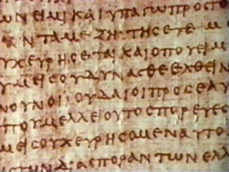
We can derive from scripture that the mark of the beast will not be a microchip or other type of implant placed under the skin.
There is further scriptural evidence that Satan's mark will be placed on the skin, and will be a mockery of God's protective mark given to His servants during the tribulation period. Satan will mark those who choose him, just as God marks those who have chosen Him:
"Do not harm the land or the sea or the trees until we put a seal on the foreheads of the servants of our God." Revelation 7:3 (NIV)
"They were told not to harm the grass of the earth or any plant or tree, but
only those people who did not have the seal of God on their foreheads." Revelation 9:4 (NIV)
In the above passages, again the same Greek word, "epi" is used, meaning on in English.
- How will the mark be applied? When considering advancements in technology, prophecy scholars and students alike understand that data collection technologies will be critical to the implementation of the mark, which may be applied by a laser tattoo using permanent invisible RFID ink.
RFID (Radio Frequency Identification) ink can be read through the hairs of animals for tracking and other purposes. In 2007 the ink was first made available in the marketplace with a tattoo made up of numbers separated by markers like bar codes. The application process was developed by Somark Innovations, and is applied by a geometric array of micro-needles and an ink capsule, used to tattoo animals in a matter of seconds. A spokesman said the company had created a synthetic biometric fake fingerprint with biocompatible chip less RFID ink, that could also be used to track and rescue soldiers.
Future applications of the ink could be with laser-etch machines which apply tattoos on the surface of the skin. The use of infrared light, bar code readers and various wireless communications are other rapidly developing technologies. Experts in the field of nanotechnology consider RFID ink groundbreaking. Research on neural interfaces that provide a two-way connection between the human nervous system and computers is rapidly expanding. Merging technologies such as "ambient intelligent environments"
open the way for the use of Nano-scale devices placed on the human body. This "molecular computing" allows biological and artificial components to communicate physical and psychological information received by scanners and sensors which are rapidly decoded and acted on.
Other experts suggest this artificial communications technology can be telepathic, and could lead to the creation of an advanced internet where everyone is permanently connected by a "global brain" leading to a myriad of mind controls. A chip less RFID tattoo being used as a wireless (Wi-Fi) direct neural interface has endless possibilities. For example, Nano-scale electronic components can now be printed on various substances, including skin, using "electronic ink."
Automatic Identification and Mobility (AIM) technologies, plus the Automatic Identification and Data Capture (AIDC) industry are a diverse family of technologies that share the common purpose of identifying, tracking, recording, storing and communicating essential business, personal, or product data. In most cases, AIM technologies serve as the front end of enterprise software systems, providing fast and accurate collection and entry of data. AIM has developed a "standard emblem" to prevent fraud and to properly track items. These technologies are integrating with RFID to enhance reliability. This technology is already being used in passports.
Biochips and National IDs: The largest undertaking of a national ID is taking place in the country of India, having the world's second largest population after China. Called the "Unique ID Project" which falls under the "Unique Identification Authority of India," every citizen will have one Aadharcard (Multipurpose National Identity Card or MNIC [biometric ID]) containing a photo and biometric information. Each citizen will be required to complete a fingerprint scan of all fingers, plus an optical scan which records the unique iris patterns in the eye, and a photograph. More than 630 million of 1.2 billion residents have already
enrolled and received their unique 12-digit identification number. There is a proposed financial inclusion program that aims to bring 75 million additional households into India's banking system by 2018.
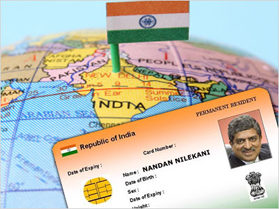
Biochips in ID cards are another rapidly expanding technology being commercialized. Biosensors using DNA probes (DNA biochips) are being used in the medical and pharmaceutical fields. This is a molecular area of science that will certainly play a role in RFID ink and similar technologies. Biometric
IDs (national ID cards) are another example of simplifying the process of keeping track of billions of people. The U.S. (and a number of other countries) are planning the implementation of a "National Worker ID Card"(biometric Social Security card), in hopes of fixing the immigration (undocumented worker) problem in the U.S. and other countries. With a goal of full implementation by 2015, it would require all workers in the United States to carry an ID card complete with identifying biometric information, such as their fingerprints.
Every person who seeks a job in the U.S. (citizens and non-citizens) would be required to present a biometric ID card to potential employers verifying one's eligibility to work. Some states are calling this an "e-verify" system. This technology can also be used to store an individual's personal health information, which some suggest will be used as a means of identifying, segregating and controlling populations during the tribulation period (via the mark).
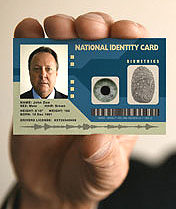
The technology is being developed by a number of companies, including Direct E-Secure Inc., a leading developer of biometric facial recognition and biometric RFID security systems. If you ever had any doubt about a national (or global) identity system with government-mandated biometric tracking, just keep an eye those changing technologies.
The failure of REAL ID Act in 2009 was a similar attempt to force a national ID card on American citizens by using the war on terrorism as an excuse to monitor everyone. Not missing a beat, the government modified the REAL ID act and renamed it the PASS ID Act ("Providing for Additional Security in States' Identification Act of 2009") which contained a provision requiring proof of lawful status to get an approved ID.
The Act is still in the proposal stage. Micro-Electronics Technologies:
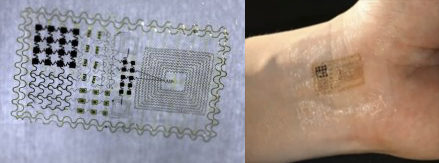
What is remarkable about this technology is that the devices are less than 50- microns thick (slightly thinner than a human hair), and are as soft as skin. The developers claim the hair-thin electronic patch technology will have many uses in the medical field, and could transform medical sensing, computer gaming and even spy operations.
Other Technologies: In 2004 The Food and Drug Administration (FDA) approved implantable chips that would provide easy access to individual medical records. Applied Digital Solutions, based in Delray Beach, Florida manufactures what it calls "VeriChip," claiming their chips saves lives and limit injuries from errors in medical treatment. They also expressed hope that such medical uses would accelerate the acceptance of under-the-skin ID chips as "security and access-
control devices." A New York based company, Lightning GPS, claims to offer "the next-generation in GPS tracking solutions" which includes injectable GPS tracking systems (currently used for short-term tracking of animals).
Researchers claim the U.S. government has developed an advanced GPS technology called the "Wide Area Augmentation System" (WAAS) which is used specifically for precision tracking. This system thought to be several times more accurate than any commercial product in the marketplace. Digital Angel, a company that produces Global Positioning Systems (GPS) and RFID microchips, claims its products are utilized around the world to "save lives, ensure the safety of our food supply, reunite loved ones and improve the quality of life." The company says it has become "a leading developer of technologies that enable the rapid and accurate identification, location tracking, and condition monitoring of what is important to people." Applications of their products include identification and monitoring of livestock, pets and fish. This includes chips, tags, and bracelets for people.
Each of these items can be removed, and are certainly not the method of implementation for a permanent "mark". In fact, prophecy teachers suggest these are precursors to the actual mark. These technologies continue to be widely used, particularly in pets and livestock, and many people regularly have chip implants for medical and other purposes. Has technology "left behind" chip implants?
- More Bible passages describing a mark:
The earliest Bible reference to a mark is that placed on Cain: "The Lord replied, 'No, for I will give a sevenfold punishment to anyone who kills you.' Then the Lord put a mark on Cain to warn anyone who might try to kill him." Genesis 4:15 (NLT)
Ezekiel chapter 9 speaks of a mark of God on the foreheads of the righteous. This parallels the mark (also called the "seal" of God) seen elsewhere in the book of Revelation: "He said to him, 'Walk through the streets of Jerusalem and put a mark on the foreheads of all who weep and sigh because of the detestable sins being committed in their city.' Then I heard the Lord say to the other men, 'Follow him through the city and kill everyone whose forehead is not marked. Show no mercy; have no pity! Kill them all–old and young, girls and women and little children. But do not touch anyone with the mark. Begin right here at the Temple.' So, they began by killing the seventy leaders." Ezekiel 9:4-6 (NLT)
When the Israelites were delivered out of Egypt, God told them to tell their children, and to celebrate annually with a seven-day feast, called the "Feast of Unleavened Bread" (unleavened bread reflected the fact that the Israelites had no time to put leaven in their bread before their hurried departure from Egypt). The feast takes place during the Hebrew month of Nisan (March–April on the Gregorian calendar) immediately after Passover. Additionally, the Israelites were told to memorialize the law during the festival: "And it shall serve as a sign to you on your hand, and as a reminder on your forehead, that the law of the LORD may be in your mouth; for with a powerful hand the LORD brought you out of Egypt. Therefore, you shall keep this ordinance at its appointed time from year to year." Exodus 13:9-10 (NASB)
This symbolized the mark of the Lord; an Israelite's thinking and works were to be according to the law, or the Word of God. The law was binding by placing the word of God on the hand and forehead. To this day, the Jews put scripture in little boxes and tied them on the backs of their hands and on their foreheads. The mark of the beast is just the opposite, thinking and works are according to the world, the flesh, and the devil.
- The Bible does not reveal the type of mark.
There are some prophecy commentators who suggest the mark will be an emblem of the kingdom of the Antichrist. The mark will be a symbol of irrevocable allegiance to the Antichrist. There are those who are convinced the mark will be a simple barcode or UPC symbol containing specific data on every person. The next generation of barcodes are two dimensional, called QR (Quick Response)

codes used for product tracking in manufacturing, quick URL entry, advertising
and much more. They are showing up in just about every venue people are needing information. Smart phone applications provide subscribers easy scanning of these codes. Could this be a component of the mark?
Others think the mark could have electronic (Nano) capabilities that could allow the Antichrist's world government to control thoughts and moods. Some experts say that controlling moods could sufficiently control thoughts. Whether the mark will be visible is unclear, though the Antichrist will likely boast of his mark which suggests it would be visible. If we consider two places most accessible on the human body, then the hand and forehead are places usually not covered by clothing.
- Does the Bible indicate the mark will be a choice, or forced? An overwhelming majority of scholars say the mark cannot be forced, though scriptures state the mark will be necessary to buy or sell. The mark may contain a unique emblem or symbol that identifies each individual as an "authorized"
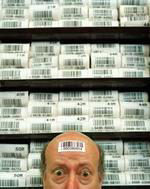
citizen, and therefore purchases of goods, finding jobs, travel and other necessities may be simplified. Likely some kind of global ID system (biometric IDs) will be put in place before the mark is established. It is likely that many of those who do not possess the mark (who aren't already killed) will die of starvation. Still, millions will survive. What of the tribulation saints? Will they be forced to take the mark? Many Bible authorities suggest it is impossible, and there are a growing number of prophecy teachers who believe the tribulation saints will also have the mark of God. Can a person reject both the Lord and the mark of the beast? Not according to scripture:
"All inhabitants of the earth will worship the beast–all whose names have not been written in the book of life belonging to the Lamb that was slain from the creation of the world." Revelation 13:8 (NIV)
All those without that mark will be killed or forced into hiding, but they will not be forced to receive it:
"He was given power to give breath to the image of the first beast, so that it could speak and cause all who refused to worship the image to be killed." Revelation 13:15 (NIV)
The exceptions are the 144,000 witnesses. They are already marked. They can't be killed. Thus, the mark of the beast is given to those willing to accept it. Again, it cannot be forced. This involves a willful rejection of God, something a true Christian could never do.
- The penalty for accepting the mark. Could the mark be incompatible with human DNA? Some prophecy experts think so. In Revelation 16:2,11 we are told the mark becomes grossly infected, then spreads causing the whole body to break out in painful sores. The long-term effect is that skin all over the body is compromised. Because human skin is an organ, the implication is that the body rejects the mark, as if it doesn't belong, like those who suffer organ rejection after a transplant. As the body becomes engrossed in agonizing sores, the mark is rendered useless, having the secondary effect of collapsing the Antichrist's economic system.
Receiving the mark is also idolatry, and is an act of worship (in this case, a form of devil-worship). Remember, the Antichrist will enter the temple and proclaim he is God, and will demand worship. Worship of other gods is idolatry, and is repeatedly forbidden in the Bible, notably in the second of the Ten Commandments:
"You shall have no other gods before Me. You shall not make for yourself an idol, or any likeness of what is in heaven above or on the earth beneath or in the water under the earth. You shall not worship them or serve them; for I, the LORD your God, am a jealous God, visiting the iniquity of the fathers on the children, on the third and the fourth generations of those who hate Me." Exodus 20:3-5
We know from scripture that anyone who accepts the mark will not be able to
reverse it. The mark will be binding (permanent), and it will represent permanent separation from God, much like sin causes eternal separation from God for those who refuse to accept the salvation offered by Jesus Christ. There is no turning back. That's the final penalty.
SoundChristian.com ...
Artificial Intelligence
Revelation 13:15
“The second beast was empowered to give life to the image of the first beast so that it could speak, and could cause all those who did not worship the image of the beast to be killed.
On march 9, 2017 I came across an interesting article on A2, of “The wall street Journal. “Scientists say they have discovered a new state of matter, dubbed a time crystal, a find that opens new avenues of research and potentially paves the way for the eventual development of quantum computers.
Companies developing quantum computers say they will have future applications in artificial intelligence and cybersecurity. Two different teams of scientists reported the discovery in the journal nature on Wednesday. They are the first to directly create and observe time crystals, the long-theorized quantum systems that spin at their own pace independently of their environment, seemingly breaking the rules of normal timekeeping.
Traditional computers use binary bits of information, whose values alternate between 0 and 1 to store data. Quantum computers use smaller units- “qubits”-that can simultaneously be 0 and 1
By Daniel Hernandez.
What is AI?
From SIRI to self-driving cars, artificial intelligence (AI) is progressing rapidly. While science fiction often portrays AI as robots with human-like characteristics, AI can encompass anything from Google’s search algorithms to IBM’s Watson to autonomous weapons.
Artificial intelligence today is properly known as narrow AI (or weak AI), in that it is designed to perform a narrow task (e.g. only facial recognition or
only internet searches or only driving a car). However, the long-term goal of many researchers is to create general AI (AGI or strong AI). While narrow AI may outperform humans at whatever its specific task is, like playing chess or solving equations, AGI would outperform humans at nearly every cognitive task.
Why research AI safety?
In the near term, the goal of keeping AI’s impact on society beneficial motivates research in many areas, from economics and law to technical topics such as verification, validity, security and control. Whereas it may be little more than a minor nuisance if your laptop crashes or gets hacked, it becomes all the more important that an AI system does what you want it to do if it controls your car, your airplane, your pacemaker, your automated trading system or your power grid. Another short-term challenge is preventing a devastating arms race in lethal autonomous weapons.
In the long term, an important question is what will happen if the quest for strong AI succeeds and an AI system becomes better than humans at all cognitive tasks. As pointed out by I.J. Good in 1965, designing smarter AI systems is itself a cognitive task. Such a system could potentially undergo recursive self-improvement, triggering an intelligence explosion leaving human intellect far behind. By inventing revolutionary new technologies, such a superintelligence might help us eradicate war, disease, and poverty, and so the creation of strong AI might be the biggest event in human history. Some experts have expressed concern, though, that it might also be the last, unless we learn to align the goals of the AI with ours before it becomes super intelligent.
There are some who question whether strong AI will ever be achieved, and others who insist that the creation of super intelligent AI is guaranteed to be beneficial. At FLI we recognize both of these possibilities, but also recognize the potential for an artificial intelligence system to intentionally or unintentionally cause great harm. We believe research today will help us better prepare for and prevent such potentially negative consequences in the future, thus enjoying the benefits of AI while avoiding pitfalls.
How can AI be dangerous?
Most researchers agree that a super intelligent AI is unlikely to exhibit human emotions like love or hate, and that there is no reason to expect AI to become intentionally benevolent or malevolent. Instead, when considering how AI might become a risk, experts think two scenarios most likely:
- The AI is programmed to do something devastating: Autonomous weapons are artificial intelligence systems that are programmed to kill. In the hands of the wrong person, these weapons could easily cause mass casualties. Moreover, an AI arms race could inadvertently lead to an AI war that also results in mass casualties. To avoid being thwarted by the enemy, these weapons would be designed to be extremely difficult to simply “turn off,” so humans could plausibly lose control of such a situation. This risk is one that’s present even with narrow AI, but grows as levels of AI intelligence and autonomy increase.
- The AI is programmed to do something beneficial, but it develops a destructive method for achieving its goal: This can happen whenever we fail to fully align the AI’s goals with ours, which is strikingly difficult. If you ask an obedient intelligent car to take you to the airport as fast as possible, it might get you there chased by helicopters and covered in vomit, doing not what you wanted but literally what you asked for. If a super intelligent system is tasked with a ambitious geoengineering project, it might wreak havoc with our ecosystem as a side effect, and view human attempts to stop it as a threat to be met.
As these examples illustrate, the concern about advanced AI isn’t malevolence but competence. A super-intelligent AI will be extremely good at accomplishing its goals, and if those goals aren’t aligned with ours, we have a problem. You’re probably not an evil ant-hater who steps on ants out of malice, but if you’re in charge of a hydroelectric green energy project and there’s an anthill in the region to be flooded, too bad for the ants. A key goal of AI safety research is to never place humanity in the position of those ants.
Why the recent interest in AI safety
Stephen Hawking, Elon Musk, Steve Wozniak, Bill Gates, and many other big names in science and technology have recently expressed concern in the media and via open letters about the risks posed by AI, joined by many leading AI researchers. Why is the subject suddenly in the headlines?
The idea that the quest for strong AI would ultimately succeed was long thought of as science fiction, centuries or more away. However, thanks to recent breakthroughs, many AI milestones, which experts viewed as decades away merely five years ago, have now been reached, making many experts take seriously the possibility of superintelligence in our lifetime. While some experts still guess that human-level AI is centuries away, most AI researches at the 2015 Puerto Rico Conference guessed that it would happen before 2060. Since it may take decades to complete the required safety research, it is prudent to start it now.
Because AI has the potential to become more intelligent than any human, we have no surefire way of predicting how it will behave. We can’t use past technological developments as much of a basis because we’ve never created anything that has the ability to, wittingly or unwittingly, outsmart us. The best example of what we could face may be our own evolution. People now control the planet, not because we’re the strongest, fastest or biggest, but because we’re the smartest. If we’re no longer the smartest, are we assured to remain in control?
FLI’s position is that our civilization will flourish as long as we win the race between the growing power of technology and the wisdom with which we manage it. In the case of AI technology, FLI’s position is that the best way to win that race is not to impede the former, but to accelerate the latter, by supporting AI safety research.
Timeline Myths
The first myth regards the timeline: how long will it take until machines greatly supersede human-level intelligence? A common misconception is that we know the answer with great certainly.
One popular myth is that we know we’ll get superhuman AI this century. In fact, history is full of technological over-hyping. Where are those fusion power plants and flying cars, we were promised we’d have by now? AI has also been repeatedly over-hyped in the past, even by some of the founders of the field. For example, John McCarthy (who coined the term “artificial intelligence”), Marvin Minsky, Nathaniel Rochester and Claude Shannon wrote this overly optimistic forecast about what could be accomplished during two months with stone-age computers: “We propose that a 2 month, 10 man study of artificial intelligence be carried out during the summer of 1956 at Dartmouth College […] An attempt will be made to find how to make machines use language, form abstractions and concepts, solve kinds of problems now reserved for humans, and improve themselves. We think that a significant advance can be made in one or more of these problems if a carefully selected group of scientists work on it together for a summer.”
On the other hand, a popular counter-myth is that we know we won’t get superhuman AI this century. Researchers have made a wide range of estimates for how far we are from superhuman AI, but we certainly can’t say with great confidence that the probability is zero this century, given the dismal track record of such techno-skeptic predictions. For example, Ernest Rutherford, arguably the greatest nuclear physicist of his time, said in 1933 — less than 24 hours before Szilard’s invention of the nuclear chain reaction — that nuclear energy was “moonshine.” And Astronomer Royal Richard Woolley called interplanetary travel “utter bilge” in 1956. The most extreme form of this myth is that superhuman AI will never arrive because it’s physically impossible. However, physicists know that a brain consists of quarks and electrons arranged to act as a powerful computer, and that there’s no law of physics preventing us from building even more intelligent quark blobs.
There have been a number of surveys asking AI researchers how many years from now they think we’ll have human-level AI with at least 50% probability. All these surveys have the same conclusion: the world’s leading experts disagree, so we simply don’t know. For example, in such a poll of the AI
researchers at the 2015 Puerto Rico AI conference, the average (median) answer was by year 2045, but some researchers guessed hundreds of years or more.
There’s also a related myth that people who worry about AI think it’s only a few years away. In fact, most people on record worrying about superhuman AI guess it’s still at least decades away. But they argue that as long as we’re not 100% sure that it won’t happen this century, it’s smart to start safety research now to prepare for the eventuality. Many of the safety problems associated with human-level AI are so hard that they may take decades to solve. So, it’s prudent to start researching them now rather than the night before some programmers drinking Red Bull decide to switch one on.
Controversy Myths
Another common misconception is that the only people harboring concerns about AI and advocating AI safety research are luddites who don’t know much about AI. When Stuart Russell, author of the standard AI textbook, mentioned this during his Puerto Rico talk, the audience laughed loudly. A related misconception is that supporting AI safety research is hugely controversial. In fact, to support a modest investment in AI safety research, people don’t need to be convinced that risks are high, merely non-negligible — just as a modest investment in home insurance is justified by a non-negligible probability of the home burning down.
It may be that media have made the AI safety debate seem more controversial than it really is. After all, fear sells, and articles using out-of-context quotes to proclaim imminent doom can generate more clicks than nuanced and balanced ones. As a result, two people who only know about each other’s positions from media quotes are likely to think they disagree more than they really do. For example, a techno-skeptic who only read about Bill Gates’s position in a British tabloid may mistakenly think Gates believes superintelligence to be imminent. Similarly, someone in the beneficial-AI movement who knows nothing about Andrew Ng’s position except his quote about overpopulation on Mars may mistakenly think he doesn’t care about AI safety, whereas in fact, he does. The crux is simply that because Ng’s timeline estimates are longer, he naturally tends to prioritize short-term AI challenges over long-term ones.
Myths About the Risks of Superhuman AI
Many AI researchers roll their eyes when seeing this headline: “Stephen Hawking warns that rise of robots may be disastrous for mankind.” And as many have lost count of how many similar articles they’ve seen. Typically, these articles are accompanied by an evil-looking robot carrying a weapon, and they suggest we should worry about robots rising up and killing us because they’ve become conscious and/or evil. On a lighter note, such articles are actually rather impressive, because they succinctly summarize the scenario that AI researchers don’t worry about. That scenario combines as many as three separate misconceptions: concern about consciousness, evil, and robots.
If you drive down the road, you have a subjective experience of colors, sounds, etc. But does a self-driving car have a subjective experience? Does it feel like anything at all to be a self-driving car? Although this mystery of consciousness is interesting in its own right, it’s irrelevant to AI risk. If you get struck by a driverless car, it makes no difference to you whether it subjectively feels conscious. In the same way, what will affect us humans is what super intelligent AI does, not how it subjectively feels.
The fear of machines turning evil is another red herring. The real worry isn’t malevolence, but competence. A super intelligent AI is by definition very good at attaining its goals, whatever they may be, so we need to ensure that its goals are aligned with ours. Humans don’t generally hate ants, but we’re more intelligent than they are – so if we want to build a hydroelectric dam and there’s an anthill there, too bad for the ants. The beneficial-AI movement wants to avoid placing humanity in the position of those ants.
The consciousness misconception is related to the myth that machines can’t have goals. Machines can obviously have goals in the narrow sense of exhibiting goal-oriented behavior: the behavior of a heat-seeking missile is
most economically explained as a goal to hit a target. If you feel threatened by a machine whose goals are misaligned with yours, then it is precisely its goals in this narrow sense that troubles you, not whether the machine is conscious and experiences a sense of purpose. If that heat-seeking missile were chasing you, you probably wouldn’t exclaim: “I’m not worried, because machines can’t have goals!”
The robot misconception is related to the myth that machines can’t control humans. Intelligence enables control: humans control tigers not because we are stronger, but because we are smarter. This means that if we cede our position as smartest on our planet, it’s possible that we might also cede control.
The Interesting Controversies
Not wasting time on the above-mentioned misconceptions lets us focus on true and interesting controversies where even the experts disagree. What sort of future do you want? Should we develop lethal autonomous weapons? What would you like to happen with job automation? What career advice would you give today’s kids? Do you prefer new jobs replacing the old ones, or a jobless society where everyone enjoys a life of leisure and machine-produced wealth? Further down the road, would you like us to create super intelligent life and spread it through our cosmos? Will we control intelligent machines or will they control us? Will intelligent machines replace us, coexist with us, or merge with us? What will it mean to be human in the age of artificial intelligence? What would you like it to mean, and how can we make the future be that way? Please join the conversation!
