Chapter 13 of 17
World History from Darius to the Time of the End John Walvoord
“The long introduction of chapter 10 is followed by the fourth and final vision given to Daniel. These important events begin with Darius the Mede (539 B.C) and extend to the last Gentile ruler in the time of the end. Chapter 11 naturally divides into two major sections. The first, verse 1-25, describes the major rulers of the Persian empire, and then provides in great detail some of the significant events of the third empire following Alexander the Great, and concludes with Antiochus Epiphanes (175 – 164 B.C). Much like chapter 8, this section highlights the Gentile rulers whose actions impacted the Jewish people. The entire period from the death of Antiochus Epiphanes to the time of the end is skipped over, with no reference to events of the present church age. The second section, verses 36-45, deals with the last Gentile ruler who will be in power when Christ comes at His second advent”.
The events of chapter 11 are followed in chapter 12 by additional revelation concerning the last 1,335 days leading up to and coinciding with Christ’s return, a period including the Great Tribulation, the Second Advent itself, and the beginning of the Millennial Kingdom.
Interestingly enough, it was in Daniel 11, with its detailed prophecy of about two hundred years of history, which prompted the pagan philosopher Porphyry (third century- A.D) to attack the book of Daniel as a forgery. Porphyry established the fact that history corresponded closely to the prophetic revelation of Daniel 11:1-35, and the correspondence was so precise that he was persuaded no one could have prophesied these events in the future. Accordingly, Porphyry took the position that Daniel was written after the events occurred, that is, in the second century B.C. This attack prompted Jerome to defend the book of Daniel and to issue his own commentary, which for over one thousand years was considered the standard commentary on Daniel.
Daniel 11:1-35 is either one of the most precise and accurate prophecies of the future, fully demonstrating its divine inspiration, or as Porphyry claimed, it is a dishonest attempt to present history as if it were prophesied centuries earlier. There are other prophesies in the scripture similar to this account. A case in point is the subject of the Messianic prophecy that predicted the coming of Christ with hundreds of details. Ezekiel 12:13 predicted that King Zedekiah would be taken captive to Babylon and die there “yet he shall not see it”, which was fulfilled when he was blinded before being taken into captivity as a prisoner (2 Kings 25:7). Other illustrations include Isaiah’s prediction of the specific cities to be captured by the Assyrians on their way to Jerusalem, only to have God halt their advance before they could attack it (Isa 10:28-32). In a similar way, prophesies concerning Syria, Phoenicia, Tyre, Gaza, Ashkelon, Ashdod, and the Philistines are given in Zechariah 9:1-8. However, proof texts are not needs, as the issue is a clear-cut question of whether God is Omniscient about the future.
11: 1-2 Four Important Kings of Medo – Persia
The opening verse of chapter 11 is often considered the closing verse of chapter 10. In it, the angel seen in 10:18, declared his support to confirm and strengthen Darius the Mede from the very beginning of his reign in Babylon.
The story of chapter 6 demonstrates that efforts were made in the first year of Darius to make him hostile toward Israel. But God sent his angel and shut the lion’s mouth. (Dan: 6:22). The miraculous deliverance by the angel cursed Darius to reverse his policies to favor Israel (6:24-27). The beginning of the second great empire, with the fall of Babylon in chapter 5, was then more than a military conquest or triumph of the armies of the Medes and Persians. It was a new chapter in the divine drama of angelic warfare behind the scenes, and the change was by divine appointment.
The survey of history provided in the opening verses of chapter 11 fixes the prophecy as dealing with a period later than Nebuchadnezzar’s dream, but coinciding with the prophecy of chapter 8 of the ram and the male goat.
Norman Porteous explains: “The survey of history begins at a slightly later point than in Nebuchadnezzar’s dream (ch.2) and in Daniel’s vision of the ram and the he-goat (ch.8). In fact, we are now given the amplification in detail of the vision, the various kings appearing in Propria Persona (adj. from Latin "for one's self," acting on one's own behalf, generally used to identify a person who is acting as his/her own attorney in a lawsuit. The popular abbreviation is "in pro per.") and no longer disguised as horns of heraldic beasts. Like Macbeth in the witch’s cave, Daniel is supposedly permitted to see the king after the king appeared on the stage of history, strutting out his part and making way for his successor.
With the passing of Babylon, the natural question arose concerning the future of the Medo-Persian Empire. So the angel announced, “Now I will show you the truth” that is, the truth of what could come to pass in the future (the book of truth, 10:21). Daniel was informed that there would be three kings in Persia, followed by a fourth and greater king who would use his riches and strength to “stir up all against the kingdom of Greece”.
The identity of these four kings has been disputed. The most natural explanation, however, is that the “three more kings” refer to the next three Persian rulers who followed Cyrus to the throne (10:1). The three kings would then be Cambyses (529-522 B.C ; not mentioned in the Old Testament); and Darius 1 Hystaspes (521-486 B.C; Ezra 5-6). These three kings would be followed by “a fourth far richer than all of them”, which must refer to Xerxes 1 (486-465 B.C; Ezra 4:6). This identification has the advantage of taking the Persian kings in order, climaxing with Xerxes 1 who led the great expedition against Greece. Xerxes 1 used his great riches and a period of four years to gather a great army amounting to hundreds of thousands, one of the largest armies in the ancient world. The expedition that he launched in 480 B.C against Greece was disastrous, however, and Xerxes never recovered. The Ahasuerus of Esther may be identified with Xerxes 1 and 2 of Esther. Details on the Persian Empire were not given here because they were covered adequately in the book of Ezra, Nehemiah and Esther, in so far as they related to the people of Israel and the plan of God, and these records were supplemented by the prophetic book of Haggai, Zechariah and Malachi.
Having mentioned “Greece”, Daniel’s revelation turned immediately to details of this third empire, which was not given elsewhere in the word of God.
The Rise and Fall of Alexander the Great (11:3-4)
One of the by-products of the attack on Greece by Xerxes I is that he incurred the undying hatred of Greece. Alexander the Great conquered Persia as a repayment to Persia for the attack of Xerxes I. Alexander was a mighty king and the remaining description fits him perfectly. He had great dominion and was an absolute ruler who did as he wished.
As previously revealed (Dan: 8:8), Alexander died prematurely. The expression in verse 4, “as soon as he has arisen” may be translated “while was growing strong”, that is, while still ascending in power (Walvoord).
The angel predicted that Alexander’s kingdom would be broken and divided toward the four winds of heaven. This was fulfilled literally in that his kingdom was shattered after his death and divided among his four generals instead of given to his posterity. His half-brother Philip Arrhidaeus was not mentally competent and was murdered in 317 B.C. His older son Hercules, born to Barsina, was illegitimate and therefore not accepted as heir to the throne; and his youngest son, Alexander born posthumously to Roxana, was murdered in 310 B.C. The empire of Alexander the Great eventually fell into the hands of his four generals and did not preserve the glory and power it had in his day. The strong central rule that had characterized it passed with his death. This event, recorded in Daniel’s prophecy written about 539 B.C, was fulfilled between the time Alexander died in 323 B.C and 301 B.C.
Daniel 11:5 – Ptolemy 1 and Seleucus 1 Nicator
Beginning in verse 5, the struggle between the various kings of the south, namely Egypt, and the kings of the north, namely Syria, began and was traced by Daniel in this prophecy to the time of Antiochus IV Epiphanes (175 – 164 B.C), a period of about 150 years. In verse 8, the king of the south is identified as Egypt, and the Septuagint translates “south” as “Egypt” throughout this passage. Syria is not mentioned by name, as at the time of Daniel’s writing no
such nation existed and such a reference would be confusing. In tracing the struggles between Egypt and Syria the prophecy is selective, and not all the rulers are mentioned, but usually the identification is clear.
The king of the south in verse 5 was probably Ptolemy 1 Soter (323 – 285 B.C). The one referred to as “stronger than he” is the king of Syria, Seleucus 1 Nicator (312- 281 B.C). These rulers took the title of king in 306 B.C. Seleucus had fled from Antigonus of Babylon and was temporarily associated with Ptolemy 1. They combined their strength and defeated Antigonus, thus paving the way for Seleucus to gain control of the entire area from Asia Minor to India; and in time, he became stronger than Ptolemy who ruled Egypt.
Hence the scripture says that Seleucus “shall be stronger than he (Ptolemy) and shall rule, and his authority shall be a great authority”. This is qualified by the statement in the preceding verse “nor according to the authority with which he ruled”. The emergence of Ptolemy as ruler of Egypt, and Seleucus as ruler of Syria, and the surrounding territory laid the basis for these two lines of rulers in their respective countries, and also set up a situation where they became rivals. The king of the South was also strong, as verse 5 indicates. “One of his “princes” probably refers to Seleucus, described in the clause that follows. A possible translation is “and one of his princes shall be stronger than he”.
11:6 – Marriage of the Daughter of Egypt to the King of Syria
The expression “after some years” means “after a lapse of several years” (2 Chro: 18:2; Dan 11:8, 13). In the passage of time, it was natural that there would be intermarriage for political reasons between Egypt and Syria, and such is pictured in verse 6. The participants were the king of the south, Ptolemy 11 Philadelphus (285 – 246 B.C) and his daughter, Bernice, who was married to Antiochus II Theos (261 – 246 B.C) about 252 B.C passed over without mention is Antiochus I Soter (281 – 261 B.C). The marriage was consummated at the demand of Ptolemy Philadelphus, who required Antiochus to divorce his own wife, Laodicea (or Laodice) in order to facilitate this marriage.
Ptolemy Philadelphus’s intent was to provide a basis of agreement between the two nations. As verse 6 indicates, however, the union was not successful in that “she shall not retain the strength of her arm” that is, physical or political power, and neither of the male participants prospered. “He who supported her in those times” means “he who obtained her in marriage”. Within a few years of the marriage, Ptolemy died, and Antiochus then took back his wife, Laodicea murdered her husband as well as his Egyptian wife, Bernice, and the infant son of Antiochus and Bernice. The reference to “he who fathered her” is, of course, to Ptolemy 11 whose death precipitated the murders that followed.
Daniel 11:7-9 Ptolemy Euergetes and SeleucusCallinicus
“And from a branch from her roots once shall arise in his place. He shall come against the army and enter the fortress of the king of the north, and he shall deal with them and shall prevail. He shall also carry off to Egypt their gods with their metal images and their precious vessels of silver and gold, and for attacking the king of the north. Then the latter shall come into the realm of the king of the south, but shall return to his own land”.
Subsequently to the events of verse 6, a new king of Egypt known as Ptolemy III Euergetes (246-221 B.C) prevailed military over the king of the north, SeleucusCallinicus (246-226 B.C) and as the prophecy indicates, he entered “the fortress of the king of the north”, and carried into Egypt princes as hostages, some of their idols, and their precious vessels of silver and gold. The expression “from a branch from her roots”, literally “the sprouting of her roots”, signifies lineage, the immediate ancestry of Bernice. The person referred to is her own brother, Ptolemy III Euergetes, the successor of Ptolemy Philadelphus.
The Hebrew word translated “gods” in 11:8 can be rendered “molten images”, and the transportation of the idols indicates the total subjugation of the northern kingdom (Isaiah-14:1-2; Jeremiah-48:7: 49:3; Hosea-10:5). In commemoration of his deed, Ptolemy Euergetes erected the monument marmoradulitanum, which boasts that he subjugated Mesopotamia, Persia,
Susiana, Media, and all the countries as far as Bactria. The actor in verse was the king of the north, just mentioned in the previous verse, rather than the king of the south. Jerome provides the description of the conquest by Ptolemy Euergetes; “he came up with a great army and advanced into the province of the king of the north, that is SeleucusCallinicus, who together with his mother Laodice was ruling in Syria, and abused them, and not only did he seize Syria, but he also took Cilicia, and the remoter regions beyond the Euphrates and nearly all of Asia as well. And then, when he heard that a rebellion was afoot in Egypt, he ravaged the kingdom of Seleucus and carried off as booty forty thousand talents of silver, and also precious vessels and images of the gods to the amount of two and a half thousand. Among them were the same images which Cambyses had brought to Persia at the time when he conquered Egypt. The Egyptian people were indeed devoted to idolatry, for when he had brought back their gods to them after so many years, they called him Euergetes (benefactor) and he himself retained possession of Syria, but he handed over Cilicia to his friend, Antiochus, that he might govern it, and the provinces beyond the Euphrates he handed over to Xanthippus, another general”.
The precise accuracy of the prophecy written by Daniel, 300 years before it happened, has occasioned the attack of the critics, but actually its detailed fulfillment is a support for the accuracy of scriptural prophecy as a whole.
Verse 9 seems to imply that the king of the south returned to his own land. According to John Walvoord “a better translation, however, would indicate that he, SeleucusCallinicus, is the subject of the phrase “shall come into the realm of the king of the south”. This could refer to the fact that several years after the Egyptian invasion, Seleucus sought to mount a return attack on Egypt, possibly about 240 B.C; but was soundly defeated and forced to “return into his own land”. This was the beginning of the seesaw battle between the two nations. The inclusion of this background material leads up to the important point, the burden of the prophecy in verse 10-19, which is the ascendancy of Syria over Egypt and the return of the Holy Land to Syrian control. This set the stage for the persecution of Israel under Antiochus Epiphanes, which is the major concern of verses 21-35 of this prophecy.
Daniel 11:10-12 The Struggle BetweenSeleucus and Antiochus III the Great against Ptolemy Philopator (11: 10-19)
Although Seleucus II Callinicus was unsuccessful in his attack on Egypt, his successors described as “his sons” proved to be more successful. Seleucus III (226 – 223 B.C) came to an untimely end, having perished in battle in Asia Minor, but the task was ably carried on by Antiochus III the Great (223 – 187 B.C). Because of the passing of Seleucus, the plural of the first part of verse 10 is changed to the singular. Antiochus the Great was able to mount several campaigns against Egypt, largely because of the indolence of the Egyptian ruler, Ptolemy IV Philopator (221- 204 B.C). Antiochus restored to Syria the territory as far south as Gaza.
The approach of the armies to Egypt proper aroused the Egyptian ruler, who assembled a large army to combat Antiochus (11:11). In 217 B.C, Antiochus met the Egyptian army that was directed by Ptolemy IV, and his sister-wife, Arsinoe. Each army possessed about 70,000 soldiers. The battle resulted in a complete victory for Egypt (11:11-12), and as Jerome comments, “Antiochus lost his entire army and was almost captured as he fled to the desert”. The prophecy was fulfilled that the multitude of the Syrians was given the land of the Egyptians. However, a peace had to be arranged because Antiochus had managed to escape. As verse 12 indicates, the Egyptian monarch was too indolent to pursue his advantage; and although the battle was disastrous for the Syrians, it tended to bring peace between the two nations, at least temporarily.
Meanwhile, Antiochus turned his attention to conquests in the east, in which he was quite successful, gathering strength and wealth. In the period 212-204 B.C, he advanced east to the boarders of India and as far north as the Caspian Sea. Ptolemy IV Philopator and his queen died mysteriously in 203 B.C and were succeeded by their infant son, Ptolemy V Epiphanes.
Dan 11:13-17
In 201 B.C, Antiochus managed to assemble another great army and again began a service of attacks on Egypt, as described in verses 13-16. The
expression “the violent among your own people” (v 14) refers to persons who violated law and justice; hence, they were “robbers” or “men of violence”.
The reference “to fulfill the vision” is probably a prophecy of the afflictions the Jews suffered under Antiochus Epiphanes, as recorded in Daniel 8. These troubles were appropriately regarded as a consequence of the retaliation of the Egyptians against Syria. Encouraged by the rising power of Rome that threatened Syria, Egypt fought back. The Egyptian armies led by Scopas were defeated at Paneas, near the head waters of the Jordan River. Antiochus III subsequently forced Scopas to surrender at Sidon, referred to as “a well-fortified city” which the Seleucid king captured in 198 B.C.
This victory resulted in the Syrian occupation of all the land of Israel as far south as Gaza. The allusion to “the forces of the south shall not stand” is to the unsuccessful attempt by three Egyptian leaders, Eropas, Menacles, and Damoyenus, to rescue the besieged Scopas from Sidon. Threatened by Rome, however, Antiochus effected a diplomatic settlement with Egypt by marrying his daughter Cleopatra to the young king, Ptolemy V Epiphanes, in 197 B.C. In doing so he fulfilled the prophecy of verse 17. The expression “to destroy the Kingdom” may mean “to ruin the land” that is, Antiochus the Great purposed this betrothal of his young daughter to the seven-year old Ptolemy to ruin his former opponent and present ally. As Young states, “In this stratagem, however, Antiochus fails, because Cleopatra constantly sides with her husband against her father”.
Dan 11:18-19
In this series of events, Antiochus the Great began to suffer reverses. The “commander” refers to the Roman consul Lucius Scipio Asiaticus, who, as Young expresses it, “brought about the defeat of Antiochus”. The reference to “his insolence” refers to Antiochus’s scornful treatment of the Roman ambassadors at a meeting in Lysimachia, when he said contemptuously, “Asia did not concern them, the Romans, and he was not subject to their orders”.
Antiochus’s defeat came about in the following manner. Having successfully sustained his conquest against Egypt by defeating Scopas, Antiochus then turned his attention to the threat from the west and attempted to equal the conquests of Alexander the Great by conquering Greece. But he was notably unsuccessful, being defeated in 191 B.C. at Thermopylae, north of Athens, and again in 189 B.C. at Magnesia, on the Maeander River, southeast of Ephesus, by soldiers of Rome and Pergamum under the leadership of the Roman general Scipio. This fulfilled the prophecies of verses 18-19, and from a historic viewpoint, was important in removing the control by Asiatic governments from Euope. This paved the way for Rome’s later expansion.
Antiochus the Great, who could have gone down in history as one of the great conquerors of the ancient world, if he had been content to leave Greece alone, instead fulfilled the prophecy of verse 19 in that he had to return to his own land, defeated and broken. He was killed trying to plunder the temple of Bel in Elam. From the standpoint of the history of Israel, this was important because Antiochus IV Philopator (187 – 175 B.C), was in turn succeeded by Antiochus IV Epiphanes (175 -164 B.C), the notorious persecutor of the Jews, which was described in detail in Daniel (11:21-35). In these prophesies, properly interpreted, is an accurate prophetic picture of this period, which would be remarkable even if it was just history, as prophecy, it bears the unmistakable imprint of divine inspiration.
Dan 11:20 - SeleucusPhilopator, the Raiser of Taxes
The Seleucid king ruling between the times of Antiochus the great and Antiochus Epiphanes, Seleucus IV Philopator, is mentioned here for his oppression by taxation of the people of Israel. Because of the rising power of Rome, he was forced to pay the Romans a tribute of a thousand talents annually. In order to raise this large amount of money, Seleucus had to tax all the lands under his domain, including special taxes from the Jews secured by a tax collector named Heliodorus (2 Macc, 3:7), who took treasures from the temple at Jerusalem. As Zockler points out “soon after Heliodorus was dispatched to plunder the temple SeleucusPhilopator was suddenly and mysteriously removed. This explains the statement, “within a few days he shall be broken” (11:20) possibly by poison administered to him by the same
Heliodorus. This set the stage for the terrible persecution by Antiochus Epiphanes which followed.
Dan 11:21-23 – The Rise of Antiochus IV Epiphanes
Beginning with verse 21, a major section of this chapter is devoted to a comparatively obscure Syrian ruler who was on the throne from 175 to 164 B.C, previously alluded to as the “little horn” (Dan: 8:9-14, 23-25). He reigned in the days of the decline of the Syrian power and only his death in 164 B.C prevented his humiliation by Rome. From the standpoint of scripture, and the revelation by the angel to Daniel, this was the most important feature of the entire third empire. The reason for the prominence of Antiochus IV Epiphanes was his desecration of the Jewish temple and altar, and his bitter persecution of the Jewish people. As is true of the entire section beginning with chapter 8, the Gentile domination is viewed primarily from its relationship to the progress of the Jewish nation. By comparison with Seleucus IV Philopator, his predecessor, Antiochus was “a contemptible person”. He gave himself the title Epiphanes, meaning “glorious” in keeping with his desire to be regarded as a god. The description here is God’s viewpoint of him because of his immoral life, persecution and hatred of God’s people. His life was characterized by intrigue, expediency, and lust for power in which honor was always secondary.
The expression on “to whom royal majesty has not been given” has reference to the fact that Antiochus seized the throne rather than obtaining it honorably. At the time that his predecessor died, there were several possible candidates for the throne. Probably the most legitimate ruler would have been Demetrius, the young son of his brother Seleucus IV, who at the time was being held in Rome as a hostage. There was also a younger son of Seleucus IV, also by the name of Antiochus, who was still a baby in Syria. Antiochus IV, was in Athens at the time of his brother’s death. There he received word that his brother Seleucus had been murdered by Heliodorus, as prophesied in Daniel 11:20.
Posing as the guardian of young Antiochus who was in Syria, Antiochus IV Epiphanes proceeded to Antioch where by various intrigues, described as “he shall come in without warning and obtain the kingdom by flatteries”, he secured the throne. Meanwhile, young Antiochus was murdered by Andronicus, whom Antiochus IV then put to death, although it was possible that Antiochus IV himself had laid the whole plot. Heliodorus, who had murdered Seleucus IV, was notable to secure the throne but disappeared.
Antiochus IV was therefore secure on his throne and began an active life of military conquest and intrigue in his struggle for power against both Egypt and Rome. Verse 22 speaks of military activity, including several campaigns against Egypt. The prophecy does not attempt to be specific, but describes in general how armies on various occasions were destroyed as by a flood and “utterly swept away”. The forces that Antiochus overwhelmed include, as Zockler states, “in part the troops of Heliodorus, whom Antiochus routed with the assistance of his Pergamenian allies, and in part by the Egyptian forces which sought to deprive him of Coele – Syria soon after his accession to the throne”. When Antiochus learned that the Egyptians were about to attack him, he invaded Egyptians in a battle that occurred between Mt. Casius and Pelusium, an area on the south-east seacost of the Mediterranean Sea, halfway between Gaza and the Nile delta.
The reference to the “prince of the covenant” prophesied the deposing and eventual murder of high the priest Onias, which was ordered by Antiochus in 172 B.C., and indicated the troublesome times of his reign. The high priest bore the title “Prince of the covenant” because he was de facto head of the theocracy at that time. In 11:28 and 11:32 the term “covenant” is used for the Jewish state. Antiochus sold the office of high priest to Onias’ brother, Jason, who sought to Hellenize the Jewish state.
Verse 23 describes Antiochus’s various alliances with other nations-especially with Egypt, which involved considerable intrigue and deceit. At the time, there was a contest for power between two of Antiochus’s nephews. Ptolemy IV Philometor and Ptolemy Euergetes, for control of Egypt. Antiochus supported Ptolemy IV Philometor, but only for his own gain. Out of it, Antiochus became strong himself.
Dan 11:24-26 Antiochus’s Growth in Power
Always seeking to enlarge his kingdom, either through military devices or intrigue, Antiochus, like his fathers, robbed the richest places of the country under his control (v 24). He attacked his enemies “without warning” in a time of security or peace when the enemy did not expect him. Unlike his father, Antiochus IV did not use his wealth secured in this way for personal advantage so much as to buy favor with others and to secure their cooperation. The expression “scattering among them plunder, spoil, and goods” indicates this distribution of the wealth he had secured. According to I Maccabees 3:30 “he feared that he might not have such funds as he had before for his expenses and for the gifts which he used to give more lavishly than preceding kings”.
Among his military maneuvers were several expeditions against Egypt, which are indicated in verse 25. The account of these several expeditions don’t have much importance as this prophecy simply described in general the characteristics of Antiochus’s reign. The king of Egypt was defeated as indicated in the statement “but only for a time”, referring to the king of the south. Even those who should have supported him conspired against him as revealed in verse 26. The result was that, generally speaking, Antiochus was victorious over the Egyptians.
Dan 11:27-28 The Evil of Antiochus
The struggle between Syria and Egypt led to various agreements that did not prosper. Neither the rulers of Egypt nor Syria were honorable in their agreements. As the last part of verse 27 makes clear, in spite of all his intrigue, Antiochus was fulfilling prophecy on God’s timetable. Returning from Egypt with great riches, he began to manifest his hatred against the people of Israel and his covetousness in relation to the wealth of the temple. This is indicated in the statement, “his heart shall be set against the holy covenant”.
Dan 11:29-31 Antiochus Persecutes the Jews
In his final expedition against Egypt, “at the time appointed”-that is, by God-Antiochus’s success was not as great as it was in former expeditions. This seems to be what is meant by “but it shall not be this time as it was before”. The invasion grounded to a halt when Antiochus was met near Alexandria by the Roman consul Gaius PopilliusLaenas, who summarily demanded that Antiochus leave Egypt at the pain of being attacked by Rome. The Roman consul is reported by Polybius to have drawn a circle about the king and told him that his decision had to be reached before he stepped out of the circle. Rather than risk a war with Rome, Antiochus, although greatly displeased, withdraw from Egypt immediately and conceded Egypt to Roman power. Prophetically this was indicated in verse 30 by the statement “for ships of Kittim shall come against him”, usually taken as a symbolic representation of Roman power that came from the west past Kittim, the island of Cyprus, which was to the west of his kingdom. The fleet of Laenas sailed to Egypt after the Roman Victory over Perseus of Macedon near Pydna, south of Thessalonica (June 22, 168 B.C). In the Septuagint, the expression “ships of Kittim” is translated “the Romans”, giving the meaning, if not the exact translation, of the prediction.
Disgruntled in his defeat in Egypt at the hands of Rome, Antiochus Epiphanes seems to have vented his wrath upon the Jewish people. The history of the period is given in the 1 and 2 Maccabees. The added statement “shall turn back and pay attention to those who forsake the holy covenant” indicates Antiochus’s affiliation with those who sided with him, who became his favorites and protégés (1 Macc-2:18; 2 Macc-6:1). In the process of his opposition to the Jews, Antiochus polluted the holy altar in the temple by offering a sow upon the altar and forbidding the continuance of the daily sacrifices (1 Macc- 1:44-54). He also issued orders that the Jews should cease their worship, and erected in the Holy place an idol, probably the image of
Zeus Olympus. This represents placing “the abomination that makes desolate” (v 31), which Christ referred to in Mathew-24:15. The parallel prophecy in Daniel-8: 23-25 covers the same series of incidents.
The desecration of the temple in opposition to the Jewish faith, precipitated the Maccabean revolt that was cruelty suppressed by Antiochus, where tens of thousands of Israelites perished. The entire series of incidents, however including the persecution of Israel, the desecration of the temple, and the stopping of the daily sacrifice- although fulfilled historically in Antiochus’s persecution of Israel, is also prophetic of the future persecution of Israel that will result during the Great Tribulation. In Matt: 24:15, where Christ described the beginning of the tribulation, He linked that still- future event to the desecration of the temple, indicating it is similar in kind to the past desecration of Antiochus. Antiochus thus became a type of the future man of sin (2 Thess: 2:3-4), and his activities foreshadow the final blasphemous persecution of Israel and desecration of their temple.
Dan 11:32-35 The Resulting Persecutions of Israel
The continued opposition of Antiochus to the Jewish faith is prophesied in verse 32, indicating how he would attempt to corrupt them; but the Jews strong reaction is shown in the expression “the people who know their God shall stand firm and take action”. The resulting conflict however, brought much harm on the people of Israel, and though it ultimately brought about a spiritual revival, many were killed. Some of the Jews succumbed to the flattery of the king and sided with Antiochus against their fellow Jews. It was a time of purging and separation of the true from the false, of the courageous from the fainthearted.
In verse 35, the purging process is said to continue “until the time of the end”. It is clear that the persecutions of Antiochus were not the time of the end, even though they foreshadowed it. The mention of “the end”, however, served a transition. From verse 36 on, the prophecy leaps the intervening centuries to predict events related to the last generation prior to God’s judgment of Gentile power and its rulers, a prophecy that has to be fulfilled.
The amazing detailed prophecies of Daniel 11:1-35 contain approximately 135 prophetic statements that have all now been fulfilled. These verses serve as an impressive introduction to the events that are yet future. Those critics who assail this chapter as being so accurate that it could not possibly be written before the events, and yet also attempt to find discrepancies that support their contention that this “pseudo- Daniel” is a poor historian, are actually arguing on both sides of the question at the same time. The fact is that there is no supported evidence that can contradict any statement made in these verses. The contention that it cannot be prophetic because of its accuracy, involves assumptions that would undermine the entire prophetic scriptures. The accuracy of this prophetic word is one more supporting evidence that prophecy yet unfulfilled will have the same precise fulfillment in the future.
Dan 11:36 the King of the End Time
Beginning in verse 36, Daniel described events that have never been fulfilled historically. Bible expositors differ as to the identity of the king to whom reference is made in the remaining verses of the chapter. Some believe it to be Antiochus Epiphanes ; others, that it is the Anti-Christ of future time. The expression “the time of the end” (v 35) marks the sharp break in the prophecy. Up to this point, the prophecy dealing with the Persian and Grecian empires has been fulfilled minutely and with amazing precision. Now, however, we are in an entirely different situation. No commentator claims to find precise fulfillment in the remainder of this chapter.
Dan 11:36-38
The prophecy concentrates on three things: The Anti-Christ’s royal pride, his religious policy, and his real purpose.
First, we see the Anti-Christ’s royal pride (11:36). There can be little doubt that this one, who is bluntly labeled “the king” is the “Anti-Christ”. His shadow has been before us in the story of Antiochus. He now appears on the page himself, in all of his pride and arrogance. He will be the last of all of the Caesars, Borgia’s, Machiavelli’s, Hitler’s, Mussolini’s, Polpot’s, Fidel Castro’s,
Mao’s, Stalin’s, Khomeini’s who have cursed this earth.
Second Thessalonians 2 casts further light on this dreadful person. In this passage, he is described as “that man of sin” and the son of perdition. He is the beast out of the sea in Revelation 13; the dreadful scion of Satan; the lord of the west; the final Caesar; the head of the revived Roman Empire; and gifted, brilliant, lawless, cruel and faithless. He will be supported by his soul twin, “the beast out of the earth”, the false prophet, the Jewish apostle of the Beast. In Revelation 17, he is described as the Beast whose deadly wound was “healed” and as “the Beast out of the Abyss”, signifying that, in the latter stages of his career, having been killed, he will be brought back to life again and thereafter will be a supernatural being, one utterly devoted to evil.
In his arrogance and pride, the Anti-Christ, in full control of the west, will exalt himself and magnify himself against every god and will blaspheme the true and only God. Paul expanded on this aspect of the Anti-Christ’s career (2 Thessalnians 2: 4). The Anti-Christ will oppose Pagan deities just as much as he does the true God, but he rants and raves chiefly against God himself. The expression ‘marvelous things” can, perhaps, better be translated “monstrous things” (11:36).
He will carry everyone before him. He will go from one success to another, uniting the west, deceiving Israel, manipulating the Arabs, baiting Russia, and for a while, taking over the whole earth. He will be either persuasive and charming or terrifying and treacherous as the occasion demands.
Wickedness will get worse and worse, because he is “the man of sin”, the promotion of sin will be his chief aim. He will gratify lust and glorify sin. He will appear as the Messiah of the Jews, the Mahdi of the Muslims, the Kalki, the last (10th) incarnation of Vishnu of the Hindus. He will be the ideal of the humanists, the Christ of apostate Christendom, and the mantra of the eastern mystics. A war-weary, famine-ravished, disease-ridden, plague-infested, panic-stricken world will hail him “till the indignation be accomplished”.
He will think that he is doing his own will, but he actually will be accomplishing God’s will. The ‘indignation’ referred to here is God’s indignation against the nation of Israel, the nation that has persistently rejected Jesus as their Messiah and called down God’s curse on itself.
(Matthew-27:25). “Then answered all the people, and said, His blood be on us, and on our children”.
The rejection of Christ, which was culminated in the cry, “let him be crucified”, has been endorsed by nearly 2000 years of Christ’s rejection by the Hebrew people. It will take the horrors of the Great Tribulation to finally open their eyes as a people, so that they will recognize in Jesus their rejected Messiah.
Then the prophecy mentions the Anti-Christ’s religious policy (11:37). John Nelson Darby states that “the king of Daniel 11:36 is none other than the Anti-Christ, an unregenerate Jew living in the land of Israel at the end time, who is in league with the Roman World ruler”. Arno C. Gaebelein offers the same interpretation with specific emphasis on the Jewish character of this ruler as a false Messiah who is acceptable to the Jewish people. The principal support for this is found in the expression in verse 37. “He shall pay no attention to the gods of his fathers”, who these interpreters believe must be identified as the God of Israel. Further, it is assumed that the Jewish people will not even accept a false Messiah unless he is Jewish in background. As an apostle, he disregards his father’s God and the hope of the Messiah and instead honors the Roman World dictator as God.
Dr. John Walvoord says “a better identification of this king, however, is to relate him to the Roman World ruler, the same individual as the little horn of Daniel 7, and the beast out of the sea of Revelation 13:1-10. Upon careful consideration, the evidence in support of Darby’s identification is seen to be insufficient”.
Walvoord continues “Darby and Gaebelein, and others are upholding this view, however, overlook a most decisive fact that the word for “God” here is “Elohim”, a name for God in general, applying both to the true God and to false gods. If the expression had used the name Yahweh in referring to the gods of Israel, the identification would be unmistakable. Frequently in
Scripture, the God of Israel is described as Yahweh, “the Lord God” of their fathers. Although Daniel used “God (Elohim) of my fathers” in 2:23, in view of the more common usage elsewhere in scripture, for Daniel to omit the word Yahweh or Lord in a passage where a specific name for God would be necessary, is significant. The expression should be rendered “the gods of his fathers”-that is, any god”.
And in keeping with his disregard for former deities, he does not pay respect to what is called “the one beloved by women”. This expression has been regarded as a reference to a specific pagan goddess such as Ewald’s identification with Tammuz-Adonis, a cult that had been popular in Syria from time immemorial, especially among women (Ezekiel- 8:14).
Walvoord says “a plausible explanation of this passage in the light of Daniel’s Jewish background is that this expression is the natural desire of Jewish women to become the mother of the promised Messiah, the seed of the woman promised in Genesis-3:15. The expression then becomes a symbol of the Messianic hope in general. As Gaebelein expresses it, “still more interesting is the statement “he shall not regard the one beloved by women”. The Lord Jesus Christ is here in view. The word ‘beloved’ is in the same construct form in Hebrew (hemdar) as in Haggai-2:7 and 1 Samuel-9:20, indicating that the noun following “beloved” is subjective not objective; hence it means “beloved by women”; not a desire for women. Pious Jewish women in Pre-messianic times had one great desire, they wanted to be mothers, with a view to him, who is the promised seed of the woman. His birth was beloved by these godly mothers of Israel. This king then hates God and hates his blessed son, the Lord Jesus Christ.”
There is another possible explanation for this scripture passage. I personally lean toward the following theory.
We are told in several prophecies that in the last days there would be a great increase in homosexuality. Jesus said that it would be as it was at Sodom. We are seeing this alarming rise in sexual perversion to the extent that marriages between members of the same sex are becoming common.
On April 9, 2012 president Obama declared his support for Gay marriage. In 2008, he said: “I believe marriage is between a man and woman. I am not in favor of Gay marriage.”
On April 9, 2012 by contrast, he said: “I have just concluded that for me, personally, it is important for me to go ahead and affirm that I think same sex couples should be able to get married.”
The US Supreme court ruled Friday (June 26, 2015) that same sex couples have a right to marry nationwide, in a historic decision that invalidates Gay marriage bans in more than a dozen states. Speaking in the Rose garden, as he did a day earlier after the high court upheld a key component of his healthcare overhaul, president Obama called the ruling a “victory for America”. Europe legalized same sex marriage decades ago.
By the time the Anti-Christ appears, Homosexuals may be considered to be more normal than Heterosexuals. It is almost that way today. Television and newspaper advertisements depict same sex marriages as normal and healthy. Homosexual lobbyists slowly brainwash young children from school to universities. This life style is depicted in all aspects of our day to day lives. On March 1. 2017, the American News Media reported the inclusion of gay and lesbian couples in Disney cartoons.
“The Disney Channel aired its first same-sex cartoon kiss this week during the animated adventure show “Star vs. The Forces of Evil.”
The subtle yet groundbreaking moment comes when the show’s characters attend a boy band concert and a diverse array of concertgoers are shown sharing kisses ― including two men”.Therefore, the prophecy that the Anti-Christ will not regard the “desire of women” could simply mean that he will be a sexual pervert.
Dan. 11:37
LEON WOOD
In their place; the Hebrew has “its place” rather than “their place” apparently taking as its antecedent specifically “any god” of the last phrase in verse 37.
God of fortresses: this word for “fortresses” is used six other times in this chapter (vs 1, 7, 10, 19, 31, 39) either in the singular or plural, and each time to mean a strong place, which calls for the same meaning here. The thought is not, then, that the Anti-Christ will accept force or power as his god, as is sometimes held, for this would be contrary to the prior statement that he will accept no god at all; but rather the thought is that he will find his goal in fortresses, strongholds, and military programs, in place of such religious belief. A god whom his fathers did not know. From earliest days, Rome has been religious, but this future ruler will be different, denying all deity and pursuing warfare instead. Military activity will take the place of god for him. Gold and silver and precious stones and desirable things: Pagans have always honored their gods by making images of precious metals and stones, but the Anti-Christ will honor his by the expenditure of these valuables. Warfare has always been expensive, and this will be as true as ever for this ruler.
Dan. 11:39
Strongest fortresses; literally translated, this reads, “strongholds of fortresses.” The Anti-Christ will not hold back from attacking any stronghold, as he puts his reliance in his war machine. Those who recognize him, he will highly honor; that is literally, “who recognizing he will multiply honor.” Because “recognizing” is an infinitive construct (not an imperfect), the subject must be “who” referring to those conquered and not the Anti-Christ, which makes the Anti-Christ the implied object. The thought then, is that among those whom he conquers, he will honor those who readily give obeisance. “To rule over many”: they will be given positions of leadership. “Allotting land as a reward”. Literally this states that “he will allot land in connection with a reward”.
The thought is that the amount of land over which any subruler would be given authority would be granted as a reward, and that it would vary with the degree of obeisance rendered and the sub ruler’s potential as an aid to the Anti-Christ.
Dan. 11:40
The “time of the end” introduced in verse 35 is again mentioned to make clear that the military struggle here is that which will characterize the end of the age. The general nature and location of the warfare is also specified. The king mentioned in verses 36-39, is now attacked by kings from the south and the north. Earlier in this chapter, the king of the south uniformly referred to Egypt and to the warfare of the third and second centuries B.C that has already been fulfilled. Hence the king of the south is clearly the leader of a political and military force that comes from south of the holy land, but the probability is that it involves an Islamic alliance under the leadership of Egypt.
The Timeline of World War-3
EGYPT’S ROLE
On July 3, 2013, army chief general Abdel Fattah el-Sisi removed the Muslim Botherhood president Mohammed Morsi and established a secular rule. However, this would not last very long. Egypt will be taken over by the Muslim Brotherhood again. Ultimately, Egyptian leadership will violate its 1979 peace treaty with Israel and wage war as mentioned in Psalm 83. This may create a serious civil crisis within Egypt, because not all Egyptians will be in favor of this aggression. Those not likely to support this war could comprise today about 10 million Coptic Christians, along with an untold number of Egyptians, that maintain a healthy fear of Israel because of Egypt’s war defeat in 1948, 1956, 1967, and 1973. Isaiah-19:17 spoke of this fear by stating “the land of Judah will be a terror to Egypt; everyone who makes mention of it will be afraid in himself”. In this battle, Egypt will face a bitter defeat. Subsequently as the victors, the state of Israel will annex five cities east of the
Nile River that are presently located in modern day Egypt. This would fulfill Isaiah 19:18, which predicts that five cities in Egypt will speak Hebrew.
As Egypt recovers from the Psalm 83, war, and Israel potentially acquires these five cities, the Jewish state eventually gets involved in the seven-year peace treaty, which Daniel 9:26 declares is confirmed by the Antichrist with many. As a result of Israel’s involvement in this treaty, the Jewish state assumes that it can dwell securely, and begins to let its guard down somewhat. Three and half years into the seven years of peace, Israel’s military becomes so complacent that the Antichrist can easily enter into the Jewish temple, which exists at the time, in order to commit the “abomination of desolation” and upon committing this act, the Antichrist embarks upon his campaign of Jewish genocide.
The First Stage The Islamic Alliance Psalm 83
Psalm 83 describes a climactic, concluding Arab-Israeli war that was prophesied by Asaph the seer, about three thousand years ago. This psalm identifies an inner circle of Arab states that share common borders with modern day Israel. This is in stark contrast to an outer-ring of nations listed in a second coalition described in Ezekiel 38. Although some eschatologists attempt to merge the two prophetic episodes together, these appear to be two differing Middle East wars.
The Arab coalition of Psalm 83 forms a collective strategic war plan to destroy Israel. Their ultimate goal is to eradicate the Jewish state and confiscate all the land it presently possesses. This would include the land captured by Israel in the Six-Day War of June, 1967. Presently, most of the international community and the Arabs are pressuring the Israelites to forfeit much of this land, in order to form an independent Palestinian state. Psalm 83 suggests that the Arabs will someday abandon diplomatic efforts and opt for war instead. The Muslim brotherhood former president Mohammed Morsi said, “The Koran is our constitution, the prophet is our leader, Jihad is our path, and death in the name of Allah is our goal”. This will be the motto of all Muslims at the end of the age.
Psalm 83 describes a blatant Arab attempt to confiscate this Promised Land. The final Arab-Israeli war will be won by the Jews. The guiding principle to this understanding is found in Jeremiah 31:35-37. Psalm 83:3-5, 12 informs us that the Arabs will confederate for the explicit purpose of destroying Israel and capturing their promised land once and for all, something Jeremiah 31:35-37 states is utterly impossible. According to the connecting prophecies in Obadiah Chapter 1: 18, Ezekiel 25:14, 37:10, Jeremiah 49:1-6, and elsewhere, the Israel defense forces prevail in the Psalm 83 war. The Psalm 83 Arabs, by their own choice, ignore the foundational understandings contained in Jeremiah 31:35-37, and the fundamental precepts in Genesis 12:3. They seek to destroy the Jews, which means they will extract lethal judgment upon themselves.
The Syrian Civil war
As a part of the Arab spring, Pro-democracy protests erupted in March 2011 in the southern city of Deraa. President Basheer Assad used extreme force to quell the rebellion. Violence escalated and the country descended into civil war. The conflict is now more than just a battle between those for or against Mr. Assad. It has acquired sectarian goals, pitching the country’s Sunni majority against the President’s Shia Alawite sect. The ISIS also captured many cities. So far, half a million Syrians have been killed and seven million refugees have fled Syria. According to the UN ,14 million people received humanitarian assistance until 2016.
Isaiah chapter 17:1 predicts that Damascus will someday be reduced to a ruinous heap of rubble. Some scholars believe that this prophecy was historically fulfilled by the Assyrian conquest of Damascus in 732 B.C. Jeremiah 49:23-27 also confirms the future destruction of Damascus. Since Damascus exists today this prophecy remains unfulfilled. The Isaiah 17:9 verse informs us that “strong cities” are displaced. “In that day, their strong cities will be like forsaken places in the forest, or like branches which they
abandoned before the sons of Israel; and the land will be a desolation.”
The Psalm 83 Confederates
| 1 | Tents of Edom | Palestinians and southern Jordanians |
|---|---|---|
| 2 | Ishmaelites | Saudis. (Ishmael father of Arabs) |
| 3 | Moab | Palestinians and central Jordanians |
| 4 | Hagarenes | Egyptians (Hagar Egypt matriarch) |
| 5 | Gebal | Hezbollah & Northern Lebanese |
| 6 | Ammon | Palestinians & Northern Jordanians |
| 7 | Amalek | Arabs of the Sinai Area |
| 8 | Philistia | Hamas of the Gaza strip |
| 9 | Tyre | Hezbollah and southern Lebanese |
| 10 | Assyria | Syrians and Northern Iraqi’s |
The above Psalm 83 nations present the first coalition attempt to destroy Israel.
Second Stage King of the North Coalition
Some scholars believe that the King of the North is Syria. With the psalm 83 described war, Syria will no longer be a great power. Two views have been presented by expositors as to who this might be. One is that it is the Antichrist himself, and for this view two main arguments are that since he has been the subject of the section, he is the most likely candidate; and the other is that it is logical to identify him, since he was typified by Antiochus Epiphanes, one of the former kings of the North.
The other view is that this replacement is the leader of the present nation of Russia. This author prefers this view. A Russian ruler fits well, however, since Russia is directly north, with Moscow being almost on a direct north-south line with Jerusalem. Positive evidence in favor of a Russian ruler may be taken from a parallel passage found in Ezekiel 38 and 39.
The Lord gave the prophet Ezekiel a prophetic warning directed to the nations of the “Far North”. Ezekiel was raised near the Temple in Jerusalem and had studied to be a Priest. He was among the Jewish captives from Jerusalem who were taken to Babylon when Nebuchadnezzar conquered Israel. He wrote, “On July 31 of my thirteenth year, while I was with the Judean exiles beside the Kedar River in Babylon, the heavens were opened and I saw visions of God”. (Ezekiel 1:1). These prophecies written in Babylon from about 593 B.C to 570 B.C were directed to Ezekiel’s fellow captives and to those Jews still living in Jerusalem, as well as to the generations that would follow.
Ezekiel was given an astonishingly accurate prophetic vision about the rebirth of the nation of Israel that would occur in the spring of 1948, as detailed in chapter 3. He foretold that Israel would arise miraculously from the graveyard of the nations, where she was buried with the ruins of Jerusalem in A.D.70, by the Roman army led by Titus. Incredibly God promised that the Jews, after almost 2000 years of exile, would return to the Promised Land. The ancient prophets also foretold that the Jewish exiles would become “a mighty army” in her ancient homeland. In 1948, Israel triumphed against an invasion by six well-armed Arab armies. Israel’s military forced consisted of a small, voluntary citizen army composed of unskilled farmers and scholars who were equipped with inadequate weapons, a few Jeeps, and two small airplanes. Israel’s armored force consisted of several vehicles captured from her enemies, including trucks with improvised steel plate. Yet, like David’s miraculous victory over Goliath, God supernaturally intervened to allow a weak Israel to survive and prosper, defeating her Arab enemies against
incredible odds.
Ezekiel’s amazing vision depicted the Jewish people as a “Valley which was full of dry bones”. This certainly described the fate of Israel after its destruction by Rome in 70 A.D. and the centuries of persecution that followed. Israel was buried in the graveyard of the ancient nations. Anyone who has seen the sickening scenes of the huge pits full of emaciated, skeletal remains of victims from Nazi death camps can imagine that this might have formed part of the vision that the prophet saw twenty-five centuries ago. The Lord asked him, “Can these bones live? And I answered “O Lord God, you know”. (Ezek: 37:3). Yet God told Ezekiel to watch a miraculous resurrection of these “dry bones”.
“So, I prophesied as I was commanded, and the breath came into them; they lived and stood on their feet, an extremely great army”. Ezekiel: 37:10
Today, Israel is the 4th largest military power in the world. Israel learned the supreme tactics from their great teacher Orde Charles Wingate. Orde Wingate is the founder of the Israel’s army. For more information about Wingate you can order the biography of Wingate on Amazon.com by this author.
Geographically, Israel occupies an area of land smaller than the state of New Jersey, and only half the size of the tiny state of Kerala in South India. Yet, despite its insignificant size, and a population of only nine million, Israel has attained a position of Prime importance in the global struggle between the nations.The prophet Zechariah prophesied 2500 years ago, “Behold, I will make Jerusalem a cup of drunkenness to all the surrounding peoples, when they lay siege against Judah and Jerusalem. And it shall happen in that day that I will make Jerusalem a very heavy stone for all peoples; all who would heave it away will surely be cut in pieces, though all nations of the earth are gathered against it” (Zech: 12:2-3)
More than 2500 years ago, Ezekiel prophesied about an invasion by Russia (Called Magog) and her allies that would occur during the last days, “after many days”. He said that after Israel was reborn as a nation, Russia and her allies would attack her in a violent attempt to completely annihilate the Jewish state. Naturally, Ezekiel did not describe the present nations of Russia, Germany, Syria, Iran and Iraq by their modern names. Rather, he referred to them by the names of the ancient tribes that occupied the geographical territories of the present nations at the time of his writing.
Many of the tribal names in Ezekiel 38 are recorded in the book of Genesis. Following the flood, Noah’s sons and grandsons dispersed to various parts of Asia, Europe and Africa. Genesis 10 records the ancient genealogy of the nations, naming the tribes descended from Noah’s children, later referred to by Ezekiel. Ancient historians, including Herodotus and Flavius Josephus in his Antiquities of the Jews, tell us where most of these tribes ultimately settled. Many Jewish and Christians scholars conclude that the tribes referred to by Ezekiel are those listed, which show the ancient name of each tribe and the modern nation that now occupies that particular territory.
The nations of Ezekiel 38:1-6
| The Ancient nations | The modern nations |
|---|---|
| The land of Magog | Russia |
| Meshech and Tubal | Part of Russia |
| Persia | Iran, Iraq, Afghanistan |
| Ethiopia | Ethiopia and Sudan |
| Libya | Libya |
| Ashkenaz | Austria and Germany |
| Gomer | Eastern Europe |
| Togarmah Many people with thee | South Eastern Europe and Turkey Various other nations allied with Russia |
The Islamic nations under the former Soviet Union were: 1. Uzbekistan 2. Tajikistan 3 Azerbaijan 4. Kazakhstan and 5. Kirghizstan. Even in the Russian Federation there are a few Muslim majority provinces.
The Identification of Gog and Magog as Russia
The names “Gog and Magog” are famous in Biblical prophetic literature and in Jewish rabbinical writings because of their future role in the great war of Gog and Magog predicted by the prophet Ezekiel (Chapter 38 and 39). The book of Revelation chapter 20 also records that an army of millions will once again join with the nations represented by “Gog and Magog” in a final attack, led by Satan, against the “beloved city” and the “camp of saints” at the end of the Millennium. This final war will be the last battle in human history. Biblical prophecies indicate that four enormous wars will convulse the planet during the apocalyptic period known as “the last days”.
The timing of these wars is certainly open for debate. The alignment of the nations against Israel is different in each of these wars. In Psalm 83 an Arab coalition comes against Israel to cut her off from being a nation. In the war of Ezekiel chapter 38 and 39 a nation with a leader called Gog comes from the north, acting as a protector of some Islamic nations. According to the prophecy, God puts a hook in Gog’s jaw and brings them down and an evil thought comes into Gog’s mind to plunder Israel of her goods. Ezekiel’s prophecy indicates it has to be at a time when Israel is at rest and dwelling securely in the land. That could only happen after there is peace established in that area.
The peace necessary to fulfill the Ezekiel prophecy has led some to believe that the war of Psalm 83 occurs first before the tribulation and allows Israel to defeat her inner ring Arab nations and have peace until the time appointed for the Gog war. Some prophecy scholars say the war of Ezekiel is at or just a few days before the start of the seven-year tribulation, but that timing seems to leave no time for Israel to be dwelling securely before the covenant is confirmed by the Antichrist for seven years. They make the first 3 ½ years of a seven-year covenant foretold by Daniel to be the entire length of this peace in Israel.
Some other scholars say Ezekiel’s war occurs in the middle of the tribulation, but that is when Israel is told to flee to the mountains for 1260 days. How then can they also burn the weapons of war for seven years and bury the dead after seven months in Israel as the prophecy in Ezekiel declares? How do they do this while the greatest tribulation ever is taking place on the earth? Still others claim the war of Ezekiel is at the end of the tribulation at the second coming of Jesus, but Ezekiel’s description does not fit the nations that come against Israel at the end of the tribulation. These armies come from all nations deceived by the Antichrist. The Ezekiel war mentions only specific nations and they are led by Gog. The destruction of the armies is different in both wars, and Gog’s armies are buried, but the armies led by the Antichrist are not.
The only possibility that this author sees is that the war in Ezekiel is prior to the seven-year covenant, and the war sets the stage for a peace treaty that is later confirmed by the Antichrist. That means a treaty had been in existence and the Antichrist will confirm the existing treaty at the beginning of the tribulation. So Israel was living in peace even before the confirmation by the Antichrist. It is clear that after the total defeat of Psalm 83, the Islamic alliance with Israel would make a peace treaty with her neighbors and the Antichrist will confirm that treaty. Israel will be burning the weapons of war for seven years. They would have to stop after seven years because the arrival of the beast will force them to flee to the mountains or be killed . So the actual war starts a few years before the Rapture and the Tribulation.
MAGOG
The comprehensive commentary of the Holy Bible, edited by Dr. William Jenkins, provides some fascinating information regarding the identity of Magog. Magog was the son of Japheth. (Genesis-10:2) from whence the Scythians are generally supposed to be derived. The Mogul Tartars, a people of the Scythian race, are still called so by the Arabian writers. The Jews thought Magog to be the Scythian nations, vast and innumerable, who are beyond Mount Caucasus and the PalusMaeotics, and near the Caspian Sea stretching even to India. When Russia and other Muslim countries attack Israel, the prophet declared that God will intervene with supernatural earthquakes, hail, and pestilence to defeat the combined forces of Russia, Iran, and other former Soviet Islamic countries.
This miraculous deliverance by the hand of God may set the stage for Israel to build the third Temple as described in Daniel-9:24-27. These awesome prophetic events concerning the defeat of Russia, will prepare the way for the fulfillment of the prophecies of the rise of the Anti-Christ to rule the earth and his seven-year treaty with Israel. This treaty with the Anti- Christ will commence a seven-year countdown to the return of the Messiah at the battle of Armageddon to establish his eternal kingdom on earth. We must live each day watching for His return.
When the “Gog and Magog” invasion occurs, it appears that the only response from the western democracies will be a diplomatic protest. Ezekiel- 38:13 says that “Sheba, and Dedan and the merchants of Tarshish with all the young lions (may be UK and USA) thereof, shall say to you, are you come to take a spoil? Tarshish, Sheba, and Dedan were ancient trading nations and are believed by many Bible Scholars to refer to Spain or Britain and their former colonies. It will not be the Western democracies that respond to this attack. The superpower who intervenes to save Israel in its greatest hour of need will be their great defender, the God of Abraham. God declares through his Prophet Ezekiel that he will defeat Russia and her Muslim allies in the greatest military disaster in history. According to Ezekiel-39:2, five-sixths of the Russian and Islamic armies (85 percent) will be annihilated by God upon the mountains of Israel. The Lord will trigger the greatest earthquake experienced thus far in history, centered in the mountains of Israel, but affecting the cities around the globe. In addition, the supernatural destruction will be accompanied by Gods additional judgments, including “pestilence, overflowing rain, great hailstones, fire, and brim stone (38:22). The Lord will send such confusion and chaos, upon the enemy that “every man’s sword shall be against his brother” (verse 21). The devastation and loss of human life will be so great that “seven months shall the house of Israel be burying of them” [Ezekiel-39:12]. The captured weapons and fuel supplies will provide fuel for the towns and villages of Israel for seven years following the supernatural victory (verse 9).
Grant R. Jeffry reveals the following facts. “In my research, I have found that some new Russian weapons have been produced. These weapons are manufactured using a new material known as lignostone, prepared from a compressed wood-product, this material was developed in Holland to be used as fuel. However, Soviet weapons laboratories discovered that this unique substance, called lignostone, is as strong as steel, light, pliable and almost invisible to radar. These unique characteristics encouraged the Russian military to utilize this material in many military vehicles and weapons. One of the characteristics of lignostone is that it burns at very high temperature and can be readily used as an alternative fuel”.
Daniel 11:41
The Antichrist, having triumphed over the two allied coalitions, will move on into “the glorious land”, meaning Palestine. The battles will transpire near Megiddo, an ancient site of great battles, and from which the name of the climactic battle of Armageddon (Rev: 16:16) is taken. The Antichrist will command the support of most of the western nations, led by his inner circle of ten European and Mediterranean nations. He will consolidate his armies in Israel, moving his headquarters to the Mount of Olives opposite Jerusalem (Dan: 11:45), knowing that the final war will be fought there. He shall enter also into the glorious land, and many countries shall be overthrown. But these shall escape out of his hand, even Edom, and Moab, and the chief of the
children of Ammon. (Dan: 11:41-42). Edom, Moab, and Ammon (in present day Jordan) will somehow escape. It is possible that they will willingly ally themselves with the Antichrist. The Antichrist will conquer Libya and Ethiopia as his armies consolidate his control over North Africa (Dan: 11:43).
The valley of Megiddo
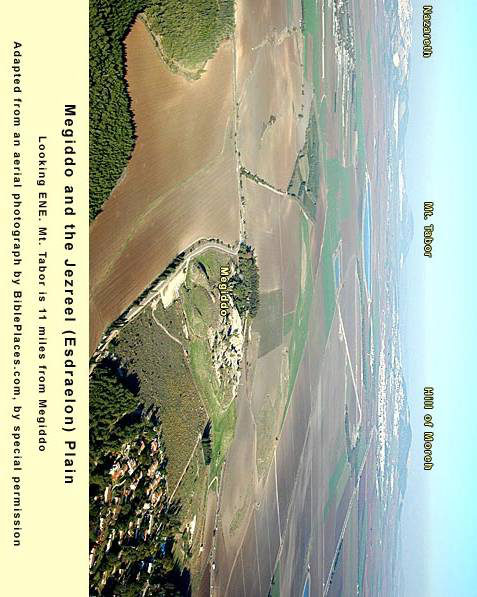
The Battle of Armageddon
For thousands of years the word “Armageddon” has instilled fear, yet inspired the imagination of millions. While the word itself only appears once in the entire Bible, there are hundreds of passages throughout the scriptures that refer to the cataclysmic battle between the forces of the East and the West (Rev: 16:16). The great Armageddon will occur in northern Israel and extend down the great valley of Jezreel, below Mt. Carmel and the ancient city of Megiddo. The name Armageddon comes from the Hebrew word ‘Har’ for mountain and Megiddo, the name of the ancient city built by king Solomon 3,000 years ago, that overlooks this enormous plain. It is also known as the valley of Jehoshaphat meaning “the valley of God’s Judgment”. According to Revelation 16:16, this ancient battleground will be the scene of the most devastating military confrontation in human history. While this horrendous world war will involve intense conflict between the armies in Europe, Africa, and Asia, the final battle will occur in the northern Israel.
The final battle between the armies of the Eastern alliance from Asia against the Western armies of the nations still loyal to the Antichrist will be focused on a two-hundred-mile long valley that extends southward from the ancient ruins of Megiddo toward Jerusalem. The battle carnage will be so terrible that horses will sink into the resulting mire of blood, bodies, and mud until the blood reaches “to the horse’s bridles” (Rev: 14:19-20). (180 miles or 290 km long X 4’5” or 1.3 meters)
Russia will not likely be a major military force at the battle of Armageddon, due to the fact that its armies will be destroyed in the earlier battle of Gog and Magog, which is prophesied in detail in Ezekiel chapters 38 and 39.
The Armies of the East
The nations of the eastern world (Rev: 16:12-14) will unite in a desperate attempt to secure their political freedom by attacking the Antichrist’s armies. Enormous armies of a size never seen before in human history will arise from several nations of Asia. The armies will march westward toward the Middle East, where they will engage in a cataclysmic struggle with the western armies of the Antichrist. An alliance between Japan, China, India, and the developing nations of Asia could produce the armaments and manpower for such an unprecedented army from the East.
The prophet John wrote “I saw three unclean spirits like frogs come out of the mouth of the dragon, and out of the mouth of the beast, and out of the mouth of the false prophet. For they are the spirits of devils, working miracles, which go forth unto the kings of the earth and of the whole world, to gather them to the battle of that great day of God Almighty (Rev: 16:13-14, 16). The satanic spirits will call the “kings of the earth” to gather their massive armies to march toward Israel to engage in the final conflict of the age against the armies of the Antichrist.
The Antichrist will receive intelligence reports that an enormous army is mobilizing far to the east and north in Asia (Daniel 11:44-45). These reports will create a disturbance, because the huge army of the kings of the east will contain 200 million soldiers (Rev: 9:16; Daniel 11:40-44).
Naturally, the number of soldiers mentioned, 200 million, astonished John and his readers because the population of the entire Roman Empire in the first century was nowhere, near this number. Indeed, the world’s entire population at that time was approximately 200 million people. At no time in ancient history was a nation, or even a large confederation of nations, capable of raising an army numbering 200 million men. But in the last days, it is entirely possible. The total population of the nations of Asia as of September 10, 2016, is 4,444,443,751, based on the United Nations estimates. The Asian population is equivalent to 59.78% of the total world population. With China, having inadvertently encouraged the birth of sons through government directives, including its one child policy, the kings of the east will have more than enough men of military age to join such a massive force. The total population of china at present is 1,367,485,388, with available manpower of, 750, 000,000. Fit for service: 619, 000, 000.
(China and India abort many baby girls in the hope of having a son later
on.)
The Western world will face its final crisis when the military brilliance, technology, and the engineering accomplishments of Japan are joined to the huge manpower and natural resources of China and India.
Weapons Used in War
The weapons used in the battle of Armageddon will be the most destructive ever employed in the history of warfare. Jesus warned that only His return to earth at the conclusion of the battle of Armageddon would make it possible for humanity to survive. The Advanced weapons technology now being developed, will be unleashed in the cataclysmic wars at the end of this age. The United States, Britain, Russia, China and Israel have designed advanced neutron atomic bombs that will kill every living creature within an eight-city block area without damaging buildings or equipment. EMP (Electro Magnetic Pulse) can disable electricity and the modern civilization will end as we know it.
Genetic Weapons
The remarkable DNA discoveries in recent years, resulting in mapping the incredibly complex human genetic code, have now been extended to the development of genocidal weapons systems. Such weapons can target a particular ethnic or racial group for death.
Data generated by genetic research is being perverted to develop a new class of weaponry that will target limited populations of victims. These weapons are similar to the more familiar biological weapons that use disease-causing spores, bacteria, and other pathogens. However, this new class of weapons will use DNA to select victims based on race.
These developments are so horrifying. Unfortunately, genetic research is now so advanced that even morally responsible nations, such as the United States and Israel, have been force to develop defensive research programs in an attempt to protect their national populations from genetic weapons. Think about the terrible conflict that the Bible warns will occur in the final years of this age, leading to the battle of Armageddon and Christ’s return. In light of the genocidal potential of DNA weapons, we begin to understand why Jesus declared, “and except those days should be shortened, there should no flesh be save’ but for the elect’s sake those days shall be shortened”. (Matt: 24:22).
Fortunately, Jesus will supernaturally intervene during the battle of Armageddon to prevent the utter destruction of human populations.
The Asian armies will Cross the Euphrates
For thousands of years the Euphrates River has stood as a military barrier between the East and West. The river runs for more than a thousand miles from its headwaters in the mountains of Turkey. It flows south through the territory of ancient Babylon until it empties into the Persian Gulf. Its width varies from a few hundred feet to more than a mile. John the apostle, foretold that this great river will someday dry up to allow the army of the east to march across Asia toward northern Israel. John prophesied, “and the sixth angel poured out his vial upon the great river Euphrates; and the water thereof was dried up, that the way of the kings of the East might be prepared.” (Revelation-16:12)
The Euphrates river flows from Turkey to Syria and then through Iraq. During the 1980’s and 1990’s TurgutOzal, Turkey’s president, built a series of 22 dams on the Tigris and Euphrates river systems. The huge Ataturk Dam, the fifth largest dam on earth, is part of the $32 billion south eastern Anatolia project, which was designed to produce electricity and to double the irrigation capacity to approximately thirty thousand square miles of semiarid land. This series of dams was intended to allow Turkey to produce ample food for the growing population of the Middle East. The Ataturk Dam is estimated to provide irrigation to more than four million acres of land, enabling Turkish farmers to grow cotton, tobacco, sugar, beets and soybeans.
What is most notable about the Ataturk Dam, which is more than a mile long and six hundred feet high, is that it is capable of blocking the headwaters of the Euphrates River. In 1990, at the opening of the dam, the president of
Turkey pressed a button, the dam closed, and the water level in the Euphrates dropped by 75 percent. Never before in history had this been possible. The great Euphrates River could now be dried up, exactly as prophesied by John, to allow an Asian army to march toward Israel across the battlefields of ancient Mesopotamia. This army will destroy untold millions as it marches across Asia .
14” saying to the sixth angel who had the trumpet, “Release the four angels who are bound at the great river Euphrates.” 15 So the four angels, who had been prepared for the hour and day and month and year, were released to kill a third of mankind. 16 Now the number of the army of the horsemen was two hundred million; I heard the number of them” (Rev: 9:14-16).
This was a news report on June 11, 2014 from the “Trumpet Publication”. Can Turkey dry up the Euphrates?
The Syrian civil war has once more taken a direct turn for the worse. Turkey has altered its strategy against its opponents, the forces of Syrian president Bashar Assad. The crisis revolves around the Euphrates River, which quickly became the Euphrates creek when Turkey completely cut off the water flow upstream of Syria, reported Al Akbar on May 30. The Euphrates hydrates a large part of Syria.
NASA studies recently have indicated that the Fertile Crescent region in the Middle East is losing fresh water at a rapid rate. The Tigris and Euphrates Rivers are drying up, and these are the very rivers that were once a critical part of the cradle of civilization in ancient Mesopotamia 2000 years before Christ.
The Last Battle
The two-hundred – million-man army of the kings of the East will fight its way across Asia as it travels to do battle with the huge Western military forces of the Antichrist, mobilized in the valley of Jezreel in northern Israel. This final battle between the kings of the east and the armies of the Antichrist will determine who will rule the world. However, the total defeat of both armies will establish the government of Jesus Christ during the next thousand years.
The battle of Armageddon will be focused on the large plain known as the valley of Jezreel in northern Israel. The name Armageddon (the mount of Megiddo) is derived from the ancient city of Megiddo, a fortified city built by King Solomon. The city’s ruins lie on a plateau overlooking the enormous valley.
Throughout the history of Israel, more than a dozen critical battles have been fought here, including the defeat of the armies of Judah and the death of King Josiah. Significantly, when the conqueror Napoleon visited this battleground in 1800, he remarked with a general’s viewpoint that “all the armies on earth could maneuver their forces on this vast plain. Although the final stages of this battle will take place in northern Israel, the war will engulf all of Asia, North Africa, Europe, and the Middle East. Hundreds of millions will die as the advanced weapons systems now being developed will be put into use by both East and West to slaughter enemy armies. Nothing will be held back,as nations seek the total destruction of their enemy’s armies and cities. A full scale nuclear biological and chemical war will destroy massive numbers of the armies and the civilian populations of the countries attacked.
The Apostle John described the final phase of the battle of Armageddon as the armies will engage in a desperate pitched battle against one another and, naturally, against the armies of Israel that will valiantly attempt to defend its people. To the amazement of the leaders of these warring armies, Jesus Christ and the armies of heaven will intervene against all the enemies of God’s chosen people. John wrote in (Rev: 19:19) that the forces of the nations of the entire planet will then attack the armies of heaven. The armies of the Antichrist and the kings of the East will be utterly destroyed by Christ’s supernatural power. The resurrected Christians in their new bodies will return from heaven with their Messiah to join in His victory over the armies of East and West. John foretold that “the armies which were in heaven followed him (Jesus) upon white horses, clothed in fine linen, white and clean (Revelation 19:14).
Both the Old and New Testaments foretell the return of the hundreds of
millions of resurrected saints of the Church on the day the Messiah will establish His Kingdom. The first prophet to appear in the Bible, Enoch, predicted that the Lord will bring millions of His saints with Him on the Great Day of the Lord (Jude 14). The expression “ten thousand” means “ten thousand times ten thousand,” which equals 100 million. Moses also described the Lord and His heavenly army coming from Sinai to take vengeance against Satan's forces (Deut: 33:2).
The Ultimate Victory of the Lord
The battle of Armageddon may end very quickly once Jesus Christ and the armies of heaven intervene, or it may rage on for some time. There is some hint of this in when the prophet Zechariah tells us that Christ will destroy the remnant of the armies of the Antichrist some days later as they attempt a final assault on Jerusalem. The prophet declared, “Behold, a day is coming for the LORD, when the spoil taken from you will be divided in your midst. For I will gather all the nations against Jerusalem to battle, and the city shall be taken and the houses plundered and the women raped. Half of the city shall go out into exile, but the rest of the people shall not be cut off from the city. Then the LORD will go out and fight against those nations as when he fights on a day of battle.” (Zechariah 14: 1-3) Regardless of the duration, the ultimate victory of the heavenly armies of Christ is assured. “And then that lawless one will be revealed whom the Lord will slay with the breath of His mouth and bring to an end by the appearance of His coming;” (2 Thess 2:8). Daniel also referred to the supernatural defeat of the Antichrist. John describes the destiny of the global dictator, the Antichrist, and his partner, the False prophet: (Rev: 19:20-21). Jesus spoke to His disciples regarding the appropriate response to the fulfillment of these prophesies. (Luke 21:27-28).
Our Lord Jesus is coming back soon to establish His Kingdom
