Chapter 10 of 17
Contrasting Kingdoms Daniel 8: 1-12
As Daniel follows the sweep and tide of human civilization, the contrasts that he sees, which are written here in these visions, are most impressive. They are startling against a background of war, violence, conquest, murder and blood. There is the contrast of the sweetness and glory of the redeemed in the kingdom of God against the background of the rulers and the military leaders of the kingdoms of this world who elevated themselves by force of arms. The two pictures are always side by side. They are always together! The light and the dark; violence and tenderness. The war of conquest and the peace of God.
The Contrast in Daniel Himself
Look at some of these contrasts in the book. There was one in Daniel himself. His body was in Babylon, but his Spirit was in Canaan, in the Promised Land. Daniel was so much like Joseph, elevated to political power and honor because of his character and competence. But honor, elevation, and political office never wooed the heart of Joseph away from his homeland in Canaan. He asked that when he died his bones might be brought back and buried in that sacred soil. So, it was with Daniel. His body was in Babylon but his windows were open in prayer toward Jerusalem. He was a slave. He had a master, and his life was at the beck and call of the conquering king. But his Spirit, his soul and his vision were free. He soared above the heavens, and saw though the distance into the very consummation and end of the age. For 2700 years, history has flowed into the mold of Daniel’s prophecy.
The Contrast Between the Kingdoms of the Earth and the Kingdom of Christ
There is a contrast in the visions themselves. In the second chapter of the Book of Daniel, Nebuchadnezzar the king saw under God a revelation of the
whole sweep of human history. Nebuchadnezzar saw the kingdoms and the empires as a colossal glorified man, a gigantic king. In the sight of man these world-wide empires seem to be gold, brass, silver, and iron. But look at the contrast in the seventh chapter of the Book of Daniel where there is presented the same revelation of the whole tide of human history. In Daniel seven, the story is seen through the eyes of God and the kingdoms are symbolized by beasts. There is a lion, a leopard, a bear, and a non-descriptive beast with devouring iron teeth.
In God’s sight the kingdoms of this world are viewed in terms of violence, ruin, murder, battle, and agony. In man’s sight these empires are glorified with conquest and victory. The contrast between how a man sees himself and his achievements, and how God looks down upon the heartache and tears that flood and stain the earth, is vivid. The kingdom of the earth and the kingdom of Christ stand in vivid contrast to one another.
The Book of Daniel is the first apocalypse. Thereafter, following the days of Daniel, there was a floodtide of apocalyptic writing. Two other of these apocalypses are in the Bible, Zechariah in the Old Testament, and the Revelation in the new. But beyond these two and outside the canon of the Bible, there was literally a library of successive apocalypses. Apocalyptic writing involved intense symbolism. Daniel saw in symbol, and wrote it down in symbol. Symbols are able to carry truth beyond what language ever could because languages change. But symbols are there to look at in any nomenclature, in any tongue. In those symbols, Daniel saw the kingdoms of the earth and their battles, violence and bloodshed. He saw those empires as ravenous, carnivorous beasts. The lion, the bear, the leopard, and the nondescript beast. Yet, in the midst of the vision, there is always the beauty, the sweetness, and the promise of the coming kingdom of Christ.
The Contrast between Alexander the Great and the Lord Jesus Christ
Presented in Daniel is the contrast between Alexander the Great and Jesus our Lord. In the seventh chapter of the book of Daniel, Alexander is depicted as a he-goat who stomps and destroys. He is presented as the swift and invincible foe of every kingdom and empire. He conquers them all.
Alexander is prominent in the visions of Daniel. There never lived another like him. He was born in 356 B.C. He died in 323 B.C. at 33 years of age. He was the son of Philip, the king of Macedonia. In twelve brief years, Alexander conquered the entire civilized world, never losing a battle. Nebuchadnezzar himself besieged Tyre for 13 years and failed to reduce it. Yet Alexander not only reduced Tyre, but burned it to smoke and ashes. There was no army, no kingdom, no king, or ruler who could stand the onslaught of Alexander. His ranks were impregnable and invincible. Yet he died at only 33 years of age.
When Alexander was sweeping over the civilized earth, he thought that he was doing the work of his own choice. But the achievements that he wrought were not the result of his own human genius. He thought that he was extending the boundaries of his immortal kingdom. Actually, Alexander was doing no other than filling out the outline sketched by the Lord God in the prophecies of Daniel. Alexander was not an originator; he was a copyist. He had no dictating hand. He was the pencil in it. He had no authoritarian position as an author. He was simply the pen that wrote it down. Alexander the Great, great as he was, was nothing other than a tool in the hand of the sovereign God, bringing universal language and universal culture to the civilized world. God gave him just so much space, he occupied just so much time, and when that space was filled, and when that time was passed, he was broken. The scripture said it would be so. “When he was strong, the great horn was broken [Daniel 8:8]. That is, God said that Alexander would not gradually waste away inch by inch, but he would be destroyed swiftly. And that brings us the contrast between Alexander and Jesus Christ.
When we turn to chapter 9, we find the prophecy concerning the coming of Christ. In the midst of the life of the promised Messiah, Daniel says that he was to be cut off in an act of violence. His life was to be shortened in the earth. Isn’t it strange that the Lord was cut down at 33 years of age, the identical age of Alexander the Great? But here in the Scripture is again that vivid contrast between Alexander the Great and the lowly Jesus.
He is a Poem by Charles Ross Weede
Jesus and Alexander died at thirty – three. One lived and died for self; one died for you and me.
The Greek died on a throne; the Jew died on a cross. One’s life a triumph seemed; the other but a loss. One led vast armies forth; the other walked alone; One shed a whole world’s blood; the other gave His own. One won the world in life and lost it all in death; the other lost his life to win the whole world’s faith.
Jesus and Alexander died at thirty-three. One died in Babylon; and one on Calvary.
One gained all for self; and one Himself He gave, One conquered every tongue; the other every grave. The one made himself God; the other made Himself less; The one lived but to blast; the other but to bless. But Jesus died to live forever Lord of Lords. Jesus and Alexander died at thirty-three. The Greek made all men slaves; the Jew made all men free. One built a throne on blood; the other built on love, The one was born of earth; the other from above; One won all this earth, to lose all earth and heaven; the other gave up all, that all to Him be given.
The Greek forever died; the Jew forever lives;
He loses all who gets, and wins all things who gives.
The Contrast Between Christ and the Anti-Christ
Last, there is presented here on the pages of these prophecies the contrast between Christ and the Anti-Christ. In the seventh chapter of the book of Daniel, the story of human history comes down to four great empires. The last one is broken up into ten units. This could mean that there will be ten kingdoms at the final denouement, when history comes to its close. Or the number ten could represent the full number of all the separate nations of the world. In any event, Daniel sees that in the course of history, the last world empire will give way to multi-national kingdoms. The beasts come down to ten horns. And, in this vision in verse eight of chapter seven there is another “little horn”.
There is an eleventh king. He is the powerful, final dictator, the Anti-Christ. In the eighth chapter of the book of Daniel, there is also that coming out of a “little horn.” He is much described in the eighth chapter of the book of Daniel. The little horn is a prophecy, a delineation of Antiochus Epiphanies, who is a type of the ultimate and final Anti-Christ. He is depicted as such in chapter seven. He is depicted by type and adumbration in chapter eight. As in the second chapter of the Thessalonian letter and in the thirteenth and nineteenth chapters of the Revelation, so also in Daniel is that Anti-Christ depicted. He is the last, ultimate dictator, who promises peace and prosperity to the whole world. In 1 John 4:3, John says that there are many Antichrists that come into the world, all of whom are types and adumbrations of the final enemy of God, the ultimate dictator.
Muhammad, Stalin, Hitler, and Mao were all types of the Anti-Christ. The Antichrist, according to the sixth chapter of the Apocalypse, comes into history on a white horse. He presents himself as the promised deliverer for all of the difficulties and woes of a world logged down and enmeshed in insoluble problems. This man seemingly has all the answers and can lead the nations into prosperity and peace. But he is followed by the red horse of war, the black horse of famine, and the pale horse of death. The Antichrist brings
woe, bloodshed, and violence to the world. He finally plunges all humanity into the battle of Armageddon.
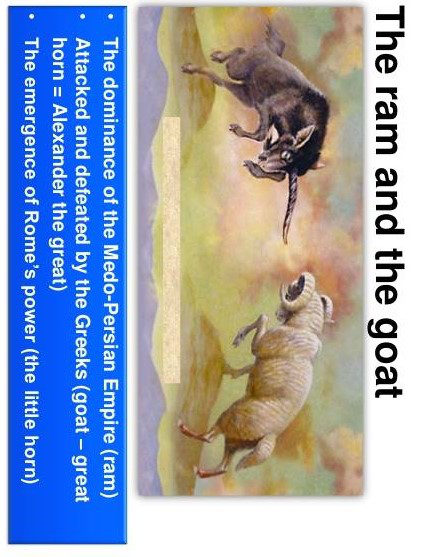
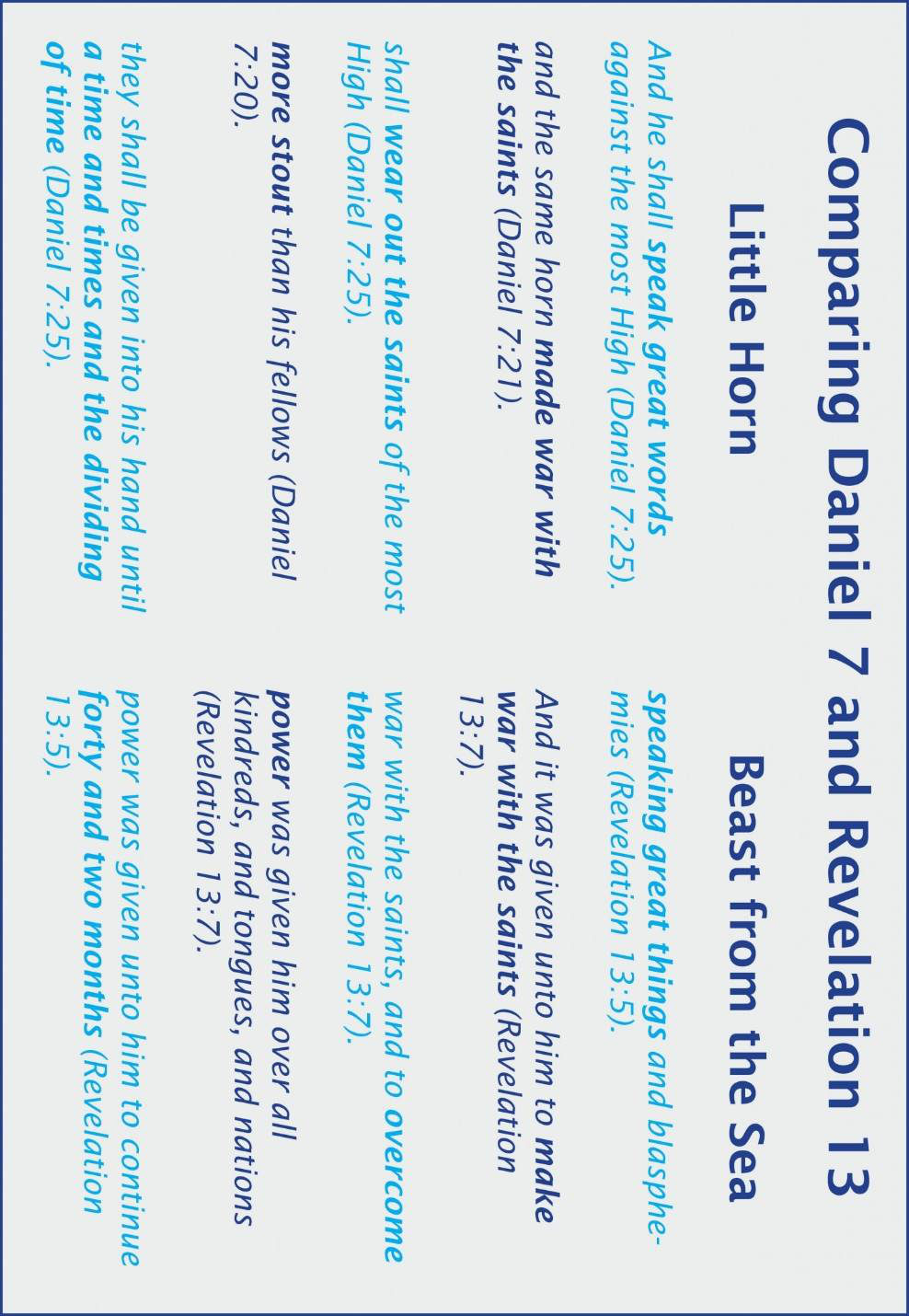
And out of one of them came forth a little horn, which waxed exceeding great, toward the south and toward the east, and toward the pleasant land (Palestine). Connect with these verses in Revelation 13:4 “And they worshipped the dragon [the serpent, Lucifer] which gave power unto the beast (the Antichrist) – saying, who is like unto the beast? Who is able to make war with him”?
Satan uses Others
Satan, through all the continuing ages, has used intermediaries to war against the people of God. In the Garden of Eden, sheltered in celestial bliss, in innocence, in supernal happiness, God placed our first parents. But outside the gate of the garden a sinister being darkly lurks. He is waiting for the opportune moment to find an inroad into the hearts of the Edenic pair. For this diabolical purpose, he used the serpent, to accost the woman. What did that serpent look like? We only know him now crawling on his belly, eating dust. But in his unfallen nature he must have been one of the most attractive creatures God had made, beautiful and appealing to the woman. The original, unfallen serpent could even talk to her. Satan used the serpent to destroy our first parents.
Satan using an intermediary is seen again in the story of Job. When the evil one was given permission to afflict Job, Satan took the Sabaeans and destroyed all of Job’s livestock. Then Satan took the Chaldeans and destroyed all of Job’s camels. Satan’s use of a human agent is demonstrated again in the story of the betrayal of Jesus. At the last supper, Simon Peter asked John to inquire of the Lord “who is it that will betray you”. The Lord replied, “It is he to whom I shall give this bread”. He took bread, dipped it in broth and handed it to Judas. And the scriptures say, “And Satan entered Judas”. Satan used Judas to betray the Lord. This has been a program of Satan through the ages. He uses other personalities to destroy the people of God. 2 Corinthians 11:14 “And it is no wonder, for Satan himself transforms himself into an angel of light”.
Satan’s Masterpiece
But there is no character or personality that appears in all of Biblical story or human history like the ultimate and final dictator, who is Satan’s masterpiece. He is the final Antichrist. The last awesome, terrible tyrant who will rule over this earth. In 1 John 2, the apostle speaks of many Antichrists and of the spirit of the Antichrist, but they are all preparatory to the final Antichrist. There is so much written about that final dictator in the Bible.
For example, in Daniel 7:8 he is called the “little horn”. According to Harry Ironside: “Many confound the little horn in chapter 7 and little horn of chapter 8. He who rises up in the western ten-horned kingdom is the same as the beast of Revelation 13-17. He is a Roman, not a Grecian offshoot. Here, we see one arising out of the old kingdom of Seleucus - a king of the north, not of the west. Antiochus in his blood thirsty career was the type of one who will be Jerusalem’s bitter enemy in the time of the Lord’s indignation. Now the Turks have for centuries been in possession of the lands once dominated by Seleucus. The future king of the north, therefore, will in all likelihood be the last sultan of the Ottoman Empire, or the fierce leader of whatever power controls Turkey in Asia at that time. The Grecian little horn is likely an utter infidel, the successor to Muhammad, actuated by inveterate hatred to the Jesus, and probably the bitter foe of the future emperor of the west.
7: 23-25
Now it is evident that much that is written here cannot possibly apply to Antiochus. He answers quite fully to the vision, but he does not meet the requirements of the interpretation. In the first place, the prophecy is to have its complete accomplishment “when transgressors are come to the full”, an expression which might refer to the ripening of iniquity in Syria of old were it not that the kingdom was not destroyed upon the death of Epiphanes, as it would have been if its sins had reached the limit set by the moral governor of the universe. It seems far more likely that the expression refers to the time of the end, when the whole world will be ripe for the judgment of God.
This agrees with the angel’s word, “I will make thee know what shall be in
the last end of the indignation”. (Verse 19), which is undoubtedly the end of the times of the Gentiles. In that time, then, this predicted little horn shall standup, a man of great intelligence and diplomacy, but of whom we read that “his power shall be mighty, but not by his own power”. Now these words could hardly be applied to the “little horn” of the past, for he reigned as an independent monarch, prosecuting his purposes as his own dictated until the measure thwarted by the inference of Rome. But there is a leader who occupies a large place in prophecy, denominated by Isaiah “the Assyrian”, who will be Israel’s enemy in the last days, and who is to be destroyed by the personal appearance of the Lord Jesus Christ. Israel’s blessing and restoration are connected by Isaiah with his downfall. He seems clearly to be the same as the little horn here depicted, for he too relies, apparently, upon some other ally. The power that will back him is prophesied in Ezekiel 38. Then, again, the little horn is to stand up against the prince of princes and be broken without hands. The prince of princes can be none other than the Messiah. Consequently, these words were not fulfilled in the life and death of Antiochus. But they point us on to the time of the end, when Messiah himself shall appear in person on behalf of oppressed Israel and shall overthrow the Assyrian.
What is said of the little horn as an individual is largely applicable to the Ottoman Empire as a whole. Fierce and relentless it has ever been the enemy of the people of God. It has existed for centuries, not because of any inherent power of its own, but because of the jealousies of the nations of Europe. Were the Turk driven out of Constantinople, all Europe would be thrown into war, each great power anxious to possess the dominions over which the crescent now floats. Hence the abominable horrors of Armenian and Jewish massacres are permitted by civilized and so called Christian nations because they do not dare to interfere, lest by so doing they jeopardize the place of the world. It is said of the little horn that he shall cause craft to prosper and by peace shall destroy many. This, too, has been characteristic of the “unspeakable Turk” especially in his dealings with the Jews. The little horn of the latter times will embody in himself the spirit of the Ottoman Empire.
In Chapter 8, verse 13-14, Daniel says, “Then I heard one saint speaking, and another saint said unto that certain saint which spoke. How long shall be the vision concerning the daily sacrifice, and the transgression of desolation, to give both the sanctuary and the host to be trodden under foot? And he said unto me, unto two thousand and three hundred days then shall the sanctuary be cleansed.” The word for days is really “evening-morning,” and refers, not to lengthened periods, but clearly and distinctly to twenty-four hours’ days. It is a time prophecy that has to do with the defilement of the temple by Antiochus. From the time that he polluted the sanctuary by sacrificing a sow upon the altar and setting up a statue of Jupiter in the holiest of all, twenty-three hundred literal days elapsed until it was again purified and dedicated to the service of Jehovah. As if to warn us of the danger of allegorizing this period, the angel says to Daniel in verse 26, the vision of the evening and the morning which was told is true: wherefore shut thou up the vision; for it shall be for many days”.
It was the failure to apprehend this that led the Millerites into their great blunder in the early part of the last century, and the same crude error has blinded their successors, the Seventh Day Adventists and resulted in the blasphemous sanctuary theory which they hold. According to them, the Lord Jesus never entered the holiest until A.D. 1844, being twenty-three hundred year days from the time when Cyrus issued the decree to build the temple.
But it is all a hallowed nightmare, utterly unsupported by scripture. The twenty-three hundred days have long since been fulfilled in the history of Daniel’s people, the Jews, and that literally, after the desecration of the holy places by the Syrian tyrant. There is no hint that there remains another 2300 days to be fulfilled in the future, though the characters of the little horn of the vision and the last great Assyrian of Isaiah 14: 24-27 are so very much alike. This latter will undoubtedly be a man of great ability, but cunning, crafty, and deceitful- a worthy successor to the Ottoman rulers of the past. But he is to be broken in Immanuel’s land, and all his army shall be destroyed upon the mountains of Israel, when he dares to stand up against the prince of princes, who shall come forth in glorious majesty for the deliverance of the faithful remnant whose hearts will cleave to Jehovah in that dreadful time of Jacob’s trouble. Already we can see events shaping themselves for the fulfilment of
these things. The end cannot be far off.” Look, I am coming like a thief. Blessed is
he who watches, and keeps his clothes, so that he does not walk naked, and they see
his shame." End of quote from Ironside. [Revelation-16:15]
The Anti-Christ Satan’s Masterpiece
There is no character or personality that appears in all Biblical story or human history like the ultimate and final dictator, who is Satan’s masterpiece. He is the final Anti-Christ, the last awesome, terrible tyrant who will rule over this earth. In 1 John 4:3 the apostle speaks of many Anti-Christ’s and of the spirit of the Anti-Christ, but they are all preparatory to the final Anti-Christ. There is so much said about that final dictator in the Bible.
For example, in Daniel- 7:8 he is called the “little horn.” In the story of human history after the breaking up of the Roman Empire into the multiple nations of the world, there comes finally a “little horn” who rules over all mankind. In Daniel 9:27 he is referred to as the awesome desolator. In Matthew 24 he is called the “abomination of desolation.” In 2 Thessalonian’s 2 he is a “man of sin,” who presents himself in the temple of God, in the house in Jerusalem, as God himself. And in revelation 13 he is presented as “the beast.”
What is he like? The Bible presents in meticulous detail the prophetic descriptions of the beast of the Anti-Christ of this final dictator. In the thirteenth chapter of the apocalypse John says, “I stood upon the sand of the sea, and saw a beast rise up out of the sea.” [Revelation- 13:1]. That is, he comes out of chaotic, turbulent world conditions, when the whole mass of mankind seems to be plunged into irretrievable, irrecoverable, despair. Men are weary of war; they have no answer to their insoluble problems. It is out of this turbulent sea of mankind that the ultimate dictator arises, swiftly, powerfully, and ominously. Revelation- 13:2 says that this beast which represents the Anti-Christ will be like a leopard. In the 7th chapter of the book of Daniel, Alexander the Great is referred to a leopard with quickness, swiftness, and alacrity. With swiftness, he conquered the world. This great, final dictator will be like a leopard, like Alexander the Great. He will rise suddenly and will conquer the whole earth.
The text in Revelation 13:2 says that he is also like a bear. In the 7th chapter of the book of Daniel the bear refers to Cyrus and the Medo-Persian Empire. The bear has great strength. Earth’s final dictator will be like that, as strong as Cyrus. Again, Revelation 13:2 says that he is invincible in his conquests like a lion. In the seventh chapter of the book of Daniel, the lion represents the golden kingdom of Nebuchadnezzar. Likewise, the final dictator will be regal in his demeanor, in the way he holds his scepter, in the way he walks, and in the way he carries his head. Through all of his gestures in life he will be the king. The Scriptures say that this lion-like man will be wounded unto death, but then miraculously recover. The whole world will wonder after him. The dragon, Satan, Lucifer, will give unto him his power, his throne and his authority. The glory of the whole world will be placed in his hands.
In Matthew 4 it is recorded that Satan offered the kingdoms of the world and their glory to Jesus if he would bow down and worship him. What Jesus refused to accept from Satan, this ultimate and final dictator will accept. The glory of the kingdoms of this world will be placed in his hands. The whole earth will rejoice to yield all this grandeur and sovereignty to the beast. The reason for such a willingness is very obvious. When the world is in turmoil, men will turn in any direction for an answer and solution.
The Germans were a cultured, educated civilized people, but they were also depressed. They lived in poverty and shame after World War-1. In their necessity and need, Hitler came and promised them victory, a place in the sun, as a superrace with superman. To the astonishment of the world, Hitler became the absolute Fuhrer of Germany. That is the kind of thing that will happen in the end times, as the world becomes more turbulent and chaotic and is finally plunged into terrible and indescribable war. Men will turn to anyone who will promise peace, unity, and prosperity.
The PaxRomana was not something nearly so much forced on the civilized world in the days of the Caesar’s, as it was something accepted by the nations of the world themselves. For example, the Attalid kings of Pergamos gave the
Attalid Empire to Rome, to the Caesar’s, because they saw no other way to security and defenses. The Bible says that another PaxRomana will be accepted when the great dictator comes. In the sixth chapter of the Revelation, he come’s riding on a white horse. The whole world bows before him. It is in such turmoil and agony that men seek someone, anyone, who can bring an answer of peace. This Anti-Christ will offer that peace. The Bible says that out of the sea of turmoil, trouble, trial, tribulation, and terror the Anti- Christ, the great and final dictator arises, and he comes as the answer to all of the problems of mankind. In the days of the French Revolution, their watchword was “liberty, fraternity, and equality.” This man, this final, ultimate Anti-Christ and dictator will come with a watchword of “peace, unity, and prosperity, and the whole world will receive him as a way out, as an answer to the problems of mankind.
The Holy Scriptures describe what will happen when the Anti-Christ rises to power. During the first part of Daniel’s seventieth week written in Daniel 9:25-27, the Anti-Christ is indeed all that he promises to be. He gives to the Jews their homeland. He makes a covenant of peace with the Jewish nation. He is their defender, benefactor, and protector. He brings unity, prosperity, and peace to the earth. Then suddenly, as the book of Daniel describes, he changes, he turns into something else. [Daniel-8: 26-27]. He is a fiend, a fury, a terror. Now the Bible is written from the standpoint of God’s chosen people, the Jews. Daniel describes in detail how, in the midst of that 70th week, this ultimate dictator, this final Antichrist breaks the covenant with the people of God, the Jews. He turns into friend and a prosecutor. He plunges the entire earth into war.
In the sixth chapter of the Revelation, he first comes riding on a white horse, the great and marvelous answer to humanity’s needs. But he is followed by a red horse of war, a black horse of famine, and then a pale horse of death. The whole earth is plunged into a field of blood, leading up to the final battle of Armageddon. In the trying, turbulent tribulation, which the Bible calls “the great tribulation”, there will be unexcelled and unparalleled persecution of the Jews. Over and over again the Scriptures say that as the end time approaches, as the great consummation of history draws nigh, the Jews will suffer unparalleled trouble and persecution.
For example, in the thirteenth chapter of the Book of Jeremiah, the prophet is describing those awesome days. His picture of those days is overwhelming. He says that it will be as if every man has his hands on his loins in travail, as a woman in labor and pain. Can you imagine every man in such agony as though he were giving birth to a child in pain, in agony, and in suffering? Jeremiah says, “Alas! For that day is great, so that none is like it. It is even the time of Jacob’s trouble” (Jer: 30:7). This is just one passage out of a multitude that depicted, toward the end of the time, Israel finding itself in unparalleled trouble, sorrow, and persecution.
The same Biblical prophecy applies to us of the Christian faith. There is no such thing as persecuting the Jews without soon finding that bitterness and venom being poured out toward the people of Christ. There is no exception to that. Do not ever think otherwise. Islam hates the Jews and Christians. That is why in the seventh chapter of the Book of the Revelation, we read that the Great Tribulation concerns not only the Jews but that the Christians are so innumerable who will have died under the iron hand of the final dictator, that John says he could not count their number. Our Lord says that were it not that those days were shortened, no flesh would survive. Jesus adds the comforting words, “But for the elect’s sake those days shall be shortened. (Matt 24:22). They are described in their brevity as being one-half of Daniel’s seventieth week, 42 months, 1260 days, time and times and the dividing of time. The trial will not last forever. We are promised that those awful, awesome days of horror and tribulation under earth’s final dictator will find an answer in the intervention of Christ from heaven at the battle of Armageddon, a war which is fully described in the 9th chapter, 14th chapter, and the 19th chapter of the Apocalypse.
The Description of the Antichrist
Summarizing a large section from Daniel, we notice that in chapter 8, verse 9 through 14, and verses 23 through 25, and then again in chapter eleven, verses 21 through 26, and verse 36 to the end, the description of the
Antichrist himself is presented. In Daniel 11:21-35 there is a description given in minute detail. The description in Daniel, chapters 8 and 11 concerns Antiochus Epiphanes. This description is about a tragic era of persecution in the life of Israel that was finished years ago. It is presented in the Bible in meticulous detail because Antiochus is a picture of the final Antichrist. What is the Antichrist like? What does he do? The answer is found in Antiochus Epiphanes who is portrayed in the Bible as a prototype of the final dictator who will rule over the world.
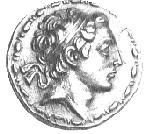
Antiochus Epiphanes is actually Antiochus the Fourth. He was the eighth in the long line of Seleucids who governed Syria and who built their capital at Antioch, a capital city named by Seleucid in honor of his father, Antiochus. Antiochus Epiphanes reigned from about 175 B.C to about 163. What was Antiochus like? His picture is what the ultimate dictator is going to be like. First, he was inordinately proud, lifted up, and ambitious. He was a copy of Satan through incarnation. He was Satan’s willing instrument. For example, when Antiochus came to reign, he imprinted on his coins, Theos Antiochus, Theos Epiphanes, “Antiochus, God manifest”. One need not doubt that such a thing could be, for according to the second chapter of 2 Thessalonians, this final dictator presents himself as “God manifest”, Theos Epiphanes. That same spirit is universal in human history. Ambitious, dictatorial men are like that. That was the spirit of Hitler. It is the spirit of any striving dictator who lifts himself above the mountain heap of prostrate humanity.
Second, he was given to bitter and unceasing persecution. In Egypt, when Antiochus was on his way to conquer the world, he was stopped by the armies of Rome. In fury and frustration, he turned his forces away from Egypt and marched up through the maritime border of the Mediterranean. Venting his anger, he took his army to Jerusalem and sacked the city. He killed 80,000 of the men, women and children. He sold 40,000 of the people into slavery. He also plundered the temple. He even took the golden altar of incense that stood before the inner veil. He decided to extirpate (root out and destroy completely) and destroy the Jewish religion forever, and to substitute it for Greek worship and Greek culture. He dedicated the temple of Jerusalem to Jupiter Olympus. He took a sow and offered it on the great, brazen altar spreading the juice of it all over the temple and the sacred vessels. In that way, he defied everything in the eyes of a mosaic Jew. He forbade the Jewish festivals and feasts. Instead of the feast of tabernacles, the Passover, or Pentecost, he celebrated in the temple the Bacchanalia, worshipping Bacchus, the god of pleasure and wine. He forced the Jews to observe the Saturnalia, worshipping Saturn, using harlots in the temple itself for those feast days. He forbade the observance of the Sabbath. He not only forbade the reading of the Scriptures but he burned the sacred books. He forbade the institution of circumcision. There were two mothers who circumcised their babies’ in defiance of his law. He took those two babies, slew them, hung each one around its mother’s neck, and marched the women through the streets of Jerusalem up to the highest wall and flung them head long into death.
In 2 Maccabees, and also in Josephus is presented the dramatic story of a mother with seven sons who defied Antiochus Law. First, they cut out the tongues of the seven boys, then before the mother’s eyes, they fried those boys to death one at a time, on a flat iron. Last of all they murdered the mother. This is just a part of the long story of the agony of Israel under Antiochus Epiphanes. It is a prototype of the great suffering and persecution yet to come under the earth’s final dictator.
In those days, there was a priest at Modin, a town just outside of Jerusalem. The priest was named Mattathias. He grieved over the sorrow of his people. Mattathias had five boys: John, Simon, Judas, Eleazar, and Jonathan. An emissary from Antiochus came to Modin to make the Jews there bow before the altar of Jupiter. When a Jew came to worship Jupiter, Mattathias looked upon him. The aged priest, like Moses in Egypt, slew the Jew and slew the officer, and the Maccabean revolt was on. Mattathias died soon after that, being an aged man. But he gave the torch of liberty and revelation to Judas, his third son. And Judas carried it to victory. Thereafter in the story, as each boy was slain, the other boy picked up the torch until all five of them carried it on. In 164 B.C Judas Maccabeus, “Judas the hammer”, won a victory over Antiochus and therein won independence for his people Israel. The first thing they did was to reconsecrate and rededicate the house of God. The ceremony lasted eight days. Tradition says that Judas Maccabeus sought
for a cruse (pot) enough to last for only one day, but when he took the oil, and lit the little lamp, it literally burned for eight days. That was the 25th of Kislev, our December. For eight days, the Jewish people celebrated that feast of reconsecration and dedication. It meant more to them than the dedication of the Solomonic temple itself. They call it today the feast of Hanukkah. On the first day of Hanukkah, the devout Jews light a candle, and the second day a second one and so on until finally on the eighth day, there are eight candles burning. It is a sign of victory, deliverance, and dedication.
In God’s Holy word it is significant that it is at that feast, the Feast of Lights, the Feast of Hanukkah, that our Lord is standing on Solomon’s porch in Jerusalem. At that feast time Jesus says three things in John 8 and 9 about that feast and its significance. First, it was a feast of deliverance, of victory, and assurance. It returned to God’s people God’s house and God’s land. The promises to Abraham, Isaac, and Jacob were confirmed to the people forever, and the Feast was a sign and a pledge. And at that Feast the Lord said to us, “I give unto them (my people) eternal life and they shall never perish”. It is a feast of deliverance, victory, and assurance. We shall not lose this war. We shall win it. God will crown us with ultimate and final victory. Second, it is a feast of light, and upon that occasion, Jesus stood and said, “I am the light of the world” (John 8:12). We who once sat in darkness have seen a great light, and we who sit in the valley of the shadow of death, upon us light has shined. For He has brought life and immortality to light. There is no victory for the grave or for death. Christ has won that victory for us. It is a feast of light, and in the gloom and the darkness of death, there we see the glorious light of the promise of Christ shining forever.
Last, it is a feast of dedication. In introduction to Jesus word, “I am the light of the world”, is the story of the healing of a blind man. The Jewish leaders cast him out because of his words of witness to Christ. When the Lord heard that they cast him out, He found him and said to him, “Do you believe in the son of God”? (John 9:35). It is a dedication and commitment. It is a belief with worship.
Daniel Chapter 7 and 8
Two little horns Some people say that the “Little Horns” of Daniel 7 & 8 describe the same person. But there is a relationship between the two; they are in the same family; similar, but not of the same evil entity. Let us examine some of the distinctive aspects of the two little Horns.
(CHAPTEREIGHT) The Little Horn and the Small Horn
Antiochus Epiphanes IV Coin
We have already seen that Daniel 2, 7, and 8 predicts the four world empires (Babylonia, Media-Persia, Greece, and Rome; also, we saw earlier that the “little horn” of chapter 7 is the Antichrist (see Daniel 7 “Who is the Little Horn?”). However, in chapter 8, we run into a similar figure called the “small horn.” Who is this person? Should we think the little horn is the same figure as the small horn?
Is Daniel’s “little horn” the same as the “small horn”?
There are many similarities between the little horn (Dan. 7) and the small
horn (Dan. 8), which we should consider:
SIMILARITIES between the Little Horn (Dan. 7) and the Small Horn (Dan. 8)?
Opposes God (Dan. 7:25) He will speak out (Dan. 8:11) He even magnified
against the Most High… himself to be equal with the
Commander of the host; and he removed the regular sacrifice from Him, and the place of His sanctuary was thrown down.
Persecutes (Dan. 7:25) He will… wear (Dan. 8:24) He will destroy Believers down the saints of the mighty men and the holy
Highest One (c.f. 7:21; Rev people.
13:7). Deceiver The Antichrist is pictured as a (Dan. 8:25) And through his
deceiver (2 Thess. 2:9; Rev. shrewdness He will cause
13:4, 14; 19:20). deceit to succeed by his
influence. Proud The Antichrist is pictured as (Dan. 8:25) He will magnify
insanely proud, narcissistic, himself in his heart, and he will and self-absorbed—even destroy many while they are at
claiming to be God! (Dan. 7:8, ease. He will even oppose the 11, 20, 25; 2 Thess. 2:4; Rev. Prince of princes, but he will be
13:5) broken without human agency. Associated with (Dan. 7:26) The court will sit (Dan. 8:19) He said, “Behold, I the End Times for judgment, and his am going to let you know what
dominion will be taken away, will occur at the final period of annihilated and destroyed the indignation, for it pertains
forever. to the appointed time of the
end.
| Cruel and Harsh | (Dan. 7:20 NIV) The horn that looked more imposing than the others. | (Dan. 8:23 NIV) When rebels have become completely wicked, a stern-faced king. |
|---|---|---|
| Master of Intrigue | (Dan. 7:8, 20) The little horns eyes speak of his brilliance. Also, his ability to fix global problems has this connotation. | (Dan. 8:23) Insolent and skilled in intrigue. |
| Powerful | The Antichrist is spoken of as incredibly powerful (2 Thess. 2:9; Rev. 13:7-8). | (Dan. 8:24) His power will be mighty, but not by his own power, and he will destroy to an extraordinary degree and prosper and perform his will; he will destroy mighty men and the holy people. |
| Called the “Little Horn” | (Dan. 7:8) While I was contemplating the horns, behold, another horn, a little one, came up among them, and three of the first horns were pulled out by the roots before it. | (Dan. 8:9) Out of one of them came forth a rather small horn which grew exceedingly great toward the south, toward the east, and toward the Beautiful Land. |
However, there are also many crucial differences between these two figures, leading us to the conclusion that these are two separate individuals: one is the Antichrist (Dan. 7) and the other is Antiochus Epiphanes IV:
DIFFERENCES between the Little Horn (Dan. 7) and the Small Horn (Dan. 8)?
Daniel 7 Daniel 8 Comes from the Roman Empire (the Comes from the Grecian Empire (“out
fourth beast). of one of them” 8:9). Tied to a Ten Nation Confederacy Tied to Four Divisions of the Greek
(Dan. 7:24). Empire (“out of one of them” 8:9). Given “time, times, and half a time” Given 2,300 evenings and mornings.
(3.5 years) Future Antichrist Antiochus Epiphanes IV: Eighth ruler in
the Seleucid dynasty. The 2,300 days was the time between his killing of Onias in 170 BC and his death in 164 BC. He took the throne “not by his
own power,” but through intrigue. He is associated with the end of history
(Dan. 8:17, 19) because he committed
the abomination of desolation. Because of these stark differences, we hold that these two figures were separate men. The little horn of Daniel 7 refers to the Antichrist, and the small horn of Daniel 8 refers to Antiochus Epiphanes.
The small horn: Antiochus Epiphanes IV The description of the “small horn” in Daniel 8 lines up closely with Antiochus Epiphanes IV:
(Dan. 8:10) It grew up to the host of heaven and caused some of the host and some of the stars to fall to the earth, and it trampled them down.
Antiochus Epiphanes IV began to persecute the Jews in 170 BC by killing the Jewish high priest Onias III. He then killed thousands of Jews, plundering the Temple, and killing 80,000 men, women, children, and even infants (1 Macc. 1:20–24; 2 Macc. 5:1ff). He also forbade the circumcision of baby boys on the 8th day and the celebration of any of the Jewish feasts. A few brave women and men defied him. Josephus tells us about two women who had their newborn sons circumcised on 8th day according to Jewish law. When Antiochus found out about it, he had each baby killed, tied each baby to a rope, and tied each rope around neck of each baby’s mother. Then he forced these poor women to parade their dead babies around the streets of Jerusalem while crowds of people scorned them and laughed at them. Then the women were pushed off the city walls, falling to their deaths with their babies hanging from their necks (2 Macc. 6:10-11).
Josephus tells another story of a woman who defied Antiochus by reading Scripture to her seven sons and observing Jewish feasts with them. Antiochus’ men heated a flat iron red hot and burned each of her sons alive in front of her. Then they killed her. Miller writes, “In December 167 B.C. Antiochus committed his crowning act of sacrilege against the Jewish religion by erecting an altar to Zeus in the temple precincts and offering swine on it (cf. 1 Macc 1:37, 39, 44–47, 54, 59; 2 Macc 6:2–5).
(Dan. 8:11) He even magnified itself to be equal with the Commander of the host; and it removed the regular sacrifice from Him, and the place of His sanctuary was thrown down. Antiochus decreed laws that banned Jewish religious practice, including dietary laws, circumcision, Sabbaths, and feasts. He also demanded that the Jews worship him, rather than God (1 Macc. 1:41– 50).
(Dan. 8:14) He said to me, “For 2,300 evenings and mornings; then the holy place will be properly restored.” What are the 2,300 evenings and mornings mentioned here?
There are two ways of interpreting the 2,300 evenings and mornings:
Option #1: This refers to 1,150 days. If we hold that the evenings and mornings are referring to the same day, then this would cut the total amount of days from 2,300 to 1,150 (or a little over three years). If we take this view, then we would begin this period from Antiochus’ altar to Zeus in the Temple (1 Macc. 1:54) and end it in December of 164 BC when Judas Maccabeus rededicated the temple (1 Macc. 4:52). However, as Miller notes, the 1,150 days would actually end in September/October of 164 BC—not December. He writes, “Either the date is to be taken as a close approximation or, as Archer suggests, the daily sacrifice may have been abolished even before the altar was erected, a suggestion that is plausible.”
Option #2: This refers to 2,300 actual days. Keil notes that the expression here is literally “until evening morning, 2,300.” This is used of a full day in Genesis 1—not two halves of a day. He also shows that when the Jews were trying to distinguish two parts of a day, they used the phrase “days and night,” rather than “evenings and mornings” (c.f. Gen 7:4, 12). Moreover, Daniel 7:25, 9:27, and 12:11-12 do not refer to Antiochus; they refer to the Antichrist. So, these passages cannot be used to correlate a three-and-a-half-year period from this number (2,300). If this option is used (which this author prefers), then we would begin the period in 170 B.C. at the murder of Onias III and end it with the rededication of the temple under Judas Maccabeus.
(Dan. 8:25) And through his shrewdness he will cause deceit to succeed by his influence; and he will magnify himself in his heart, and he will destroy many while they are at ease. He will even oppose the Prince of princes, but he will be broken without human agency.
Antiochus died in 163 B.C. (1 Macc. 6:1–16) after he was defeated at Elymais in fulfillment of this prophecy (“he will be broken without human agency”). Because of these close predictions, we hold that the small horn of Daniel 8 must be referring to Antiochus Epiphanes IV, rather than the Antichrist.
