Chapter 11 of 17
Chapter Nine
The ninth chapter of Daniel is one of the towering chapters of the Bible. Sir Edward Denny, a noted prophetic student in the 19th century, used to call this “the backbone of prophecy.” This title seems well given, for if the seventy weeks be misunderstood, then an effort will necessarily be made to bend all the other prophetic scripture passages into accord with that misinterpretation. But if we have a correct understanding of the teaching of this chapter, we can then see readily how all prophecy, without any forcing, falls right into place and is intimately linked up with this the greatest of all time prophecies.
Before coming to the prophetic revelation in the last half of the chapter, let us study Daniel’s marvelous, intercessory, confessional prayer. 9:1-5.In verse two of the ninth chapter the text reads, “In the first year of his reign I Daniel understood by the books the number of the years, whereof the word of the Lord came to Jeremiah the prophet that he would accomplish seventy years in the desolations of Jerusalem.” Daniel was reading the twenty -fifth and the twenty- ninth chapters of the prophecy of Jeremiah. In those prophecies, Jeremiah said that the Lord would let the temple and the city be in waste and desolation for seventy years, but at the end of the seventy years the Lord would remember His people once again in mercy , and they would have the opportunity to return home. As Daniel studied those prophecies, he was not able to ascertain the exact time, the certain year that the seventy year began. Had the Lord counted them from the time that Daniel himself went into Babylonian captivity, then the seventy years were up in the first year of Darius, when Daniel set himself to find the mind of the Lord.
Daniel was carried into captivity in 605 B.C. In 536,B.C. the first year of Darius the Mede, Daniel had been a captive for seventy years when he read in the Bible that at the end of the prophetic years, God would visit His people and allow them to return home. But Daniel did not know whether it was at the beginning of the year of his captivity, or whether it could have been at the beginning year when Jehoiachin the king was carried into captivity in 598 B.C,
or possibly the seventy years could have begun at the destruction of the temple, which was in 587 BC. But Daniel knew from the prophecy in Jeremiah that the first time was soon coming when the captivity would be over and God’s chosen people could return home.
The Prayers
Daniel 9:3 “So I turned to the Lord God and pleaded with him in prayer and petition, in fasting, and in sackcloth and ashes.” Daniel not only learned by reading and studying the Holy Scriptures, but he also learned by prayer, by supplication, by bowing and confession. By prayer, as well as by studying and reading, Daniel learned the meaning of God’s word. So, having studied, he came to God, setting his face to the Lord in prayer, in supplication, in fasting and sackcloth, and in ashes. When we approach God, it always ought to be in deepest reverence, and humility, and contrition. Daniel said, “I prayed to the Lord and made confession and said, O Lord, the great and dreadful God.”
The Fasting
Now notice that Daniel prayed and made his supplication with fasting, in sackcloth and ashes. There is no commandment in the Bible, either in the Old Testament or the New Testament, to fast or to sit in sackcloth and ashes. The nearest approach to it is in the Old Covenant in the 23rd chapter of Leviticus where Moses outlines for Israel the day of atonement, called in the Israel community and Hebrew language, Yom Kippur. But even there, all that Moses said is that on that day they were to “afflict their souls.” He mentions nothing about fasting at all. It is likewise in the New Testament. There is no commandment in the New Testament to fast. The only approach to it would be when the disciples of John came to the disciples of Jesus and criticized them because they did not fast. It was then that the Lord replied: “Can ye make the children of the bride chamber fast, while the bride groom is with them? But the days will come, when the bride groom shall be taken away from them, and then shall they fast in those days.” (Luke- 5: 34-35). But there is no commandment nor is there a commandment in the 6th chapter of Matthew, when the Lord explains what one should be like, and how one should act, when he fasts. Our Savior says that if one fasts he should not look disheveled and unkempt, but he ought to comb his hair, bathe, dress, and put on his finest clothes and smile. One should appear only to God to fast and not to men. In other words, the power and the blessing of the fasting intercession do not lie in the ritual, ceremony, or the external act, but in the agony of soul that can find no other proper expression except by saying to God, “I cannot eat.”
One of the problems and mistakes of the early church after the days of the apostles, and certainly of the medieval church, was the persuasion on the part of the Christian people and their leaders that in corporal mortification and laceration somehow there was a pious, and heavenly meritorious reward. Such practice is none other than the old Gnostic heresy which taught that in the body there was inherent evil, and the only way to liberate, emancipate, and elevate the finer qualities of the soul captured in the body was to torment and lacerate and flagellate the flesh. Somehow, they believed that in the persecution of the body there was elevation of the soul. Nothing could be further from the truth. This is a plain Gnostic heresy. And for the Christian Church to have accepted this and to have looked upon corporal tribulation as a means of a pious approach to sanctify, is no less heretical, for the Scriptures avow just the opposite.
Romans- 14:17 says, “For the kingdom of God is not meat and drink.” In 1 Corinthians- 8:8 Paul writes “but meat (that is the old English word for food) commended us not to God: for neither, if we eat, are we the better; neither, if we eat not, are we the worse.” We are not led into lives of holiness and piety by external, mechanical acts.
The Pharisee stood by himself and prayed saying “twice every week I fast.” But that did not lead him into holiness or into sanctity. True fasting as such must be disassociated from a planned, impersonal mechanical act; for it is not the going without food that leads to that holy, heavenly approach to God; it is the spirit that would lead one not to eat.
Have you ever felt or acted that way? Having such a burden of heart or such an agony of soul that you just did not eat, you just prayed before the
Lord? That has been true of the Old Testament Saints. That has been true of the New Testament disciples. If they fasted, always it was not some mechanical contrivance such as lent, or Shrove Tuesday or Ash Wednesday, but it always arose out of a deep burden before God. (Shrove Tuesday is Pancake Tuesday) shrive means confess and receive absolution. The concept they use it is from 1 Corinthians- 9:27. Ironically Shrove Tuesday has evolved into a day of frivolity and indulgence, during which people participate in as much pleasure and self-gratification as they can before lent begins. The same is true with the Sabarimala Temple pilgrimage for the Hindus in Kerala, South India.
The first chapter of the book of Samuel begins with the story of Hannah. She did not eat. (1 Samuel- 1: 8). Hannah had a burden of heart and she did not eat. She fasted and prayed before God. There was no mechanical refinement as such, but out of agony of spirit, she was importuning the help of heaven.
The true spirit of fasting is seen again in the story of Esther, when she pled with the king for the lives of the Jews. She sent word to Mordecai, her uncle, and called all of the Jews of Shushan together saying “and fast ye for me, and neither eat nor drink three days, night or day: I also and my maidens will fast likewise; and so, will I go in unto the king which is not according to the law: “and if I perish, I perish” (Esther- 4:16). It is out of the agony of soul that true fasting comes, and in no other way. It was thus with Daniel. (Daniel - 9:3).
There is no scriptural directive for Christians to “fast” by not eating food. Through the centuries fasting became such an important tradition in the Jewish religion that it was given the force of law. The Jews had many traditions that involved afflicting the flesh that were not commands of God, but which they kept as if they were. Many such traditions are mentioned in ancient Jewish literature,. Some are in the Bible, and even a cursory reading of the gospels shows Jesus in conflict with the Jews about traditions that made people’s lives difficult, including Sabbath traditions (Mathew- 12: 10- 12), traditions about helping parents (Mathew- 15: 3-6), and traditions involving cleanliness (mark- 7: 1-6). Jesus also did not require his disciples to fast, which was something that confused the people of his time. (Mark- 2: 18- 20). Fasting was not a part of the Law of Moses. The word (tsuwm) “fast”
never occurs in the Pentateuch (Genesis – Deuteronomy). The Mosaic Law, though directing minutely the foods to be eaten and to be shunned, never enjoins fasting. The false asceticism so common in the east was carefully avoided.
The Day of Atonement was traditionally a fasting day in the Jewish religion, so it is called “the fast” in Acts-27:9, but God never specifically commanded the Jews not to eat on that day. Faucet’s Bible dictionary says “on the yearly day of atonement, the 10th day of the 7th month, the Israelites were directed to afflict the soul.” (Leviticus- 16: 29-31; Numbers- 30: 13). This significant term implies that the essence of scriptural “fasting” lies in self-humiliation and penitence, and that the precise mode of subduing the flesh to the spirit and of expressing sorrow of sin, is left to the conscientious discretion of each person.
The Day of Atonement was a day for people to “afflict your souls” (Leviticus- 16: 29, 31 KJV), which other versions translate as “deny yourselves” (NIV), or humble your souls (NASB). The Hebrew word that the KJV translate “afflict” in Leviticus 16:29 and 31 means to “humble, overpower, subdue, oppress, or weaken, depending on the context. The same Hebrew phrase occurs in the context of a woman making a vow to afflict the soul, which could be any vow she made that involved self-denial. (Numbers- 30:13). Although overtime the Day of Atonement became a day of fasting, God never specifically said people were to go without eating. Instead, people were to deny themselves, which different people would do in different ways.
Another reason people think the Bible commands not eating is that “fasting” wrongly appears in three places in widely read versions of the Bible. That is because during the centuries that monks and scribes controlled and copied the New Testament, the word “fasting” was added to some manuscripts in several places. This could have happened by accident, but the scribes might have added it on purpose, thinking it would help people in their
walk with God, like the Jews, who for the same purpose enforced their traditions as if they were laws. This is the position Fausset’s biblical dictionary takes. “Evidently the growing tendency to asceticism in post-apostolic times accounts for these interpolations (added to the text).”
History shows us that what Fausset’s reference to as a “growing tendency to asceticism or pious observance of regulations, shows up in many ways besides fasting. Over time, many traditions that involved afflicting the flesh entered not only into Judaism, as we have already seen, but also into Christianity. For example, the Roman Catholic doctrine that priests do not marry, is a tradition that is not Biblical (1 Timothy- 3:2). The regulation not to eat meat on Fridays, and the tradition that many people followed when they got very dressed up to go to church on Sundays are further examples.
It is important to be aware of the three verses where “fasting” was added to some of the Greek manuscripts, eventually finding their way into both Protestant and Roman Catholic Bibles, especially the earlier versions such as the King James Version, Geneva Bible or Douay- Rheims.
Matt: 17:21 KJV. “Howbeit this kind goeth not out but by prayer and fasting”. Matt: 17:21: ESV Verse 21 does not even occur in the ESV, because the research done in the almost 400 years between the King James Version (1611 and the ESV 2001) to recover how the original Greek text reads show that the whole verse in the KJV had been added by scribes to make Matthew more closely harmonize with Mark. Verse 21 is missing in ESV translation.
Mark 9:29: KJV “And he said unto them, this kind can come forth by nothing, but by prayer and fasting. Mark 9:29 ESV: “And he said to them, this kind cannot be driven out by anything but prayer. The word “Fasting” is left out in most of the translations.
1 Cor: 7:5 KJV :Defraud ye not one the other, except it be with consent for a time, that ye may give yourselves to fasting and prayer, and come together again, that Satan tempt you not for your incontinency”.
1 Cor: 7:5 ESV: Do not deprive one another, except perhaps by agreement for a limited time, that you may devote yourselves to prayer; but then come together again, so that Satan may not tempt you because of your lack of self-control”. The addition of “fasting” in the above verses in widely read Bibles such as the King James Version has contributed to the idea that fasting was a command of God in certain situations.
We have seen that fasting was a man-made tradition that over time was given the force of law. Another reason Christians fast by going without food is that we have a tendency to want to save ourselves by our works, or gain the favor of God by what we do, and we think fasting get God’s attention and demonstrates our love for Him. God does show favor to those who humble themselves before Him as James 4:6 says “God opposed the proud, but gives grace to the humble”. However, we must keep in mind that no verse of scripture says that going without food is the kind of humility God wants from us. What God wants is what He has always wanted, that we deny ourselves in order to benefit others.
Isaiah 58 is a wonderful chapter about fasting which contrasts pompous and pious fasting which is just a show of the flesh, with the true fasting God expects from us. A careful study of the chapter shows that the people whom God was addressing were trying to look religious in the flesh, but were actually rebellious and sinful (Isa 58:1). God did not pay any attention to their fasting. God always looks on the heart, and does not respond, to hypocritical actions, no matter how pious they look. If going without food were necessary for our spiritual life, Jesus would have said so, but Jesus nor His apostles said anything about fasting.
Prayer of Daniel in the Light of the Bible and the Fast
This was one of the most meaningful prayers of all literature including the Bible. It was the prayer of Daniel on behalf of his people, offered at the end of seventy years, in the light of what the prophet Jeremiah said about how God would remember His people in mercy . We can learn so much from this moving intercession.
First, look at what the prayer was not. It was not a recounting of Daniel’s own merit. He was not parading his own goodness before God. Rather he says, “Lord, you are righteous but this day we are covered with shame the people of Judah and the inhabitants of Jerusalem and all Israel, both near and far, in all the countries where you have scattered us because of our unfaithfulness to you. (Daniel- 9:7). There was no virtue in Daniel. There was no goodness in him. As Isaiah said, “all our righteousness are as filthy rags. (Isaiah- 64:6). When the prophet came before God, there was no thought of personal merit or worth. It was not just because of this great crisis that Daniel prayed. He had prayed all during the years before. To Daniel, prayer was a habit of life.
What is True Prayer?
What is true prayer? It is an overwhelming, all-consuming confession of need. “Lord, we have sinned against thee. O God to thee belong mercies and forgiveness.” True prayer is intense and deeply earnest. Notice that Daniel’s prayer was for temporal blessings as well as spiritual blessings. We have a strange idea in our heads. We compartmentalize our lives. Here is a wall, and on one side, is religion, but on the other side are secular considerations, the materiality’s of life. Pray for the whole life.
This is true prayer Daniel 9:20-23
The answer to the prayer of the prophet came immediately. “While I was speaking, God sent the angel Gabriel.” The part the angel Gabriel plays in the kingdom of God is most fascinating. His name means, “the man of God.” God sent Gabriel to Daniel while he was still praying that God would hear his prayer and answer his supplication. Gabriel is mentioned four times in the Bible. In chapter eight in the book of Daniel, he explains to Daniel the vision of the ram and the he-goat. Here in chapter nine he is named again. He is named the third time in the first chapter of Luke when he is sent to announce to Zacharias and Elizabeth the birth of John the Baptist. He is named the fourth time also in the first chapter of Luke when he is sent to Mary, in Nazareth of Galilee, to announce to her the conception of the Son of God in her womb.
This man Gabriel is one of the messengers of heaven who stands in the presence of Jehovah God. He announces to Daniel that at the beginning of his supplications, the commandment was given by God to Gabriel to bear earthward the heavenly reply. It is as God promised, “Before they call, I will answer; and while they are yet speaking, I will hear”. [Isa: 65:24]
While Daniel was speaking, and making supplication at the beginning of his prayer, “the commandment came forth” from the celestial throne and Daniel’s prayer is answered immediately.
Heavenly Power
How is it that Daniel so touched God? How is it that all of the energies of heaven conspired to work for him? How does one reach such power? If only we knew how to ask God for it in a way that God bends down His ear to hear our prayers. At the beginning of his supplication while he was speaking, the commandment came forth and Daniel’s prayer was answered immediately.
How do we get answer from God? It is by praying in the will and purpose of God. He studied the Holy Scriptures. That is the way the chapter begins. [Dan: 9:2]. Studying the scriptures Daniel learned the mind of God, especially in its predictive, prophetic portion. Thus, Daniel bowed himself in prayer, and made the subject of his supplication as well as the object of his intercession the will of the Lord God. [Dan: 9:17]
The glory of God Himself is to be good to His people. The glory of God is His goodness. In the 33 chapter of Exodus Moses asked Jehovah “Show me your glory” [Exo: 33:18-19].
Praying with Intensity and Importunity
How did Daniel touch heaven and how was it that his prayer was answered even while he made supplications? He prayed in intensity and in importunity.
I have no objection to prayers that are beautifully worded and sentences that are so dramatically and literally balanced. However, the prayers which move God are those that are composed of broken sentences from broken hearts. In that flood of feeling there is no thought of eloquent words or grammatical structure. As Romans 8:26 describes the depths of our appeal sometimes our prayers can be prayers uttered only with groaning’s that defy the formation of sentence or words or language. Daniel prayed with intensity and importunity. [Dan: 9:3, 19]
Praying in Sincere Altruism for Others
Daniel prayed in sincere and true altruism for others. There is no sentence, no reference to himself, none at all. He is praying for his people, who in wormwood and in gall, bore the yoke of foreign slavery. Daniel is praying for the sanctuary of God, and he is praying for the restoration of the holy city and holy nation. Here Daniel pours out his heart with never any mention of himself, except in confession of his own sin.
Praying in Personal Acceptance
How does one touch God? What did Daniel do in that while he was speaking, the commandment came forth? He was accepted of the Lord in his own person. He prayed in personal acceptance. First, God accepted Daniel himself. Only afterward did He accept Daniel’s prayer. Isn’t that the story of Cain and Abel? God rejected Cain and having rejected Cain himself, He rejected his supplication, his offering and prayer.
The Seventy Weeks of Daniel
One of the most remarkable and important prophecies in the Bible is found in Daniel 9:24-27. It is the cornerstone of messianic prophecy because it establishes the timing of both the First and Second Advent of the Messiah.
A remarkable thing about the vision concerns the critics who crow that the book of Daniel is a forgery and that it was written during the Maccabean rebellion in about 165 B.C; rather than in 535 B.C, when it is supposed to have been composed. They say that the Book of Daniel is not prophecy at all, but history that has been placed in the mold of apocalyptic revelation as though it were prophecy. They say that, actually, everything in the Book was a part of history, and the forger just took that history and made it appear as though it were prophecy in order to encourage the Jews who were fighting for their lives during the Maccabean revolt. This is the interpretation of the liberal and modernistic theologians. Now the astonishing thing about the revelation of the seventy weeks is this: In the two predictions here, there is first the prediction that the temple and the city will be destroyed. What do you think of such encouragement as a revelation like that? When the people during the Maccabean rebellion were fighting for their lives against Antiochus Epiphanies, would such a word encourage them? The unbelieving critics say that the Book of Daniel was composed in order to encourage those Jewish people who were in a death struggle against the king of Syria. What kind of an encouragement would that be, to predict that their temple and city were going to be destroyed? The thought was terrifying to the Jews who reverenced that holy place, the temple, the sanctuary in Jerusalem beyond anything that our hearts could enter into.
A second thing about the revelation: This marvelous word from Gabriel to Daniel is the prediction that the Messiah will die. That also was unthinkable to the Jewish mind. The Messiah is coming to die. What kind of encouragement to the Jews was that? Even after the disciples had been with Jesus for the years of His ministry, when the Lord predicted and announced His coming crucifixion and death, Simon Peter said, “Lord, let that be far from thee”. Such a thing was unthinkable. That was when the Lord turned and said to Simon
Peter, “Satan, get behind me, for you don’t savor the things of God, but of men”. [Matt. 16:23]. Yet, in this writing, which is supposed to be one of tremendous encouragement during the Maccabean rebellion, according to the critics, the prediction is made that the Messiah will die.
There is yet another thing that is astonishing in this revelation: The exact day and the exact year of the death of the Messiah is predicted. Altogether the seventy apocalyptic weeks are four hundred ninety years in which God will finish His Judgment upon His people Israel. This passage constitutes one of the most amazing prophecies in all the Bible. If worked out logically, this text is both seminal (groundbreaking), and determinative in the outworking of one’s understanding of Bible prophecy.
Critics of the literal interpretation of Bible prophecy must strike down the plain meaning of Daniel’s prophecy in their failed attempts to stroke down the prophetic precision found in Biblical prophecy.
Should the overall approach of this prophecy be literal or allegorical? If literal, then this would mean that the numbers should be taken literally and do count. Yet some think that numbers don’t count. The angel himself gives a literal explanation, and it would be nonsensical to insist on giving a symbolical interpretation of a literal explanation. There are solid reasons why the numbers in Daniel’s prophecy should be taken literally. First, chapter 9 opens with Daniel realizing from Jeremiah’s writings that Israel’s captivity would last 70 years. These were literal years. Since the prophecy delivered by Gabriel to Daniel in 9:24-27 is related to the 70- year captivity, it follows that 70 weeks of years are equally literal. Second, since definite numbers are used in the prophecy (7, 62 and 1 weeks), it would be strange indeed for such odd numbers to not have literal meaning. Nothing in the context suggests a non-literal use of numbers in this prophecy.
Setting the Context
We know from the beginning of chapter-9:2 that Daniel had read about “the number of years which was revealed as the word of the Lord to Jeremiah the prophet for the completion of the desolations of Jerusalem, namely seventy years.” The two passages which Daniel surely studied were Jeremiah- 25:11-12 and 29:10-14. Both texts clearly speak of Israel’s Babylonian captivity as limited to a 70-year period. Both passages also blend into their texts, statements that look forward to a time of ultimate fulfillment and blessings for the nation of Israel. This is why Daniel appears to think that when the nation returns to their land, then ultimate blessing (the Millennial kingdom)
will coincide with their return. Daniel’s errant thinking about the timing of God’s plan for Israel occasioned the Lord’s sending of Gabriel “to give your insight with understanding” (Daniel-9:22). God was not yet ready to bring history to its destined final climax. Thus, he told Daniel that he was going stretch out history by seventy times seven years. (490 years).
The Meaning of “Weeks”
For those acquainted with Hebrew, they will notice that the same word appears twice at the beginning of verse 24. That twice used word is “Sabuim” meaning seventy sevens. That this Hebrew phrase should be rendered as “seventy sevens”, is unanimously agreed upon by representatives of all interpretive schools. There is also a great consensus that the “seventy sevens” refers to years, since that is what Daniel was contemplating in Jeremiah- 25:11-12; 29:10-14, as evident in Daniel 9:2. Thus our Lord has in mind seventy weeks of years, or 490 years.
The next word appearing in the Hebrew text in Daniel 9: 24 is a verb translated “have been decreed.” This word appears only here in the entire Old Testament. This verb has the basic meaning of “cut”, “cut off”, and came to mean “divide”, or determine. It appears that Gabriel choose this unique word to emphasize that God was carefully choosing or determining the length of Israel’s history. G. H. Lang writes, “decreed means divided or severed off from the whole period of world-empire in the hands of the Gentiles, as to which Daniel was already well informed. It points to a fixed and limited period, of definite duration, forming part of a longer period the duration of which is not fixed, or at least not declared”.
For whom did God reveal this period of prophetic destiny? The text says
that they have been decreed “for your people and your holy city”. This is such as obvious statement, yet too many interpreters attempt to shoehorn in a people not mentioned in the passage. In the sixth century B.C; when Daniel wrote, who were Daniel’s people and the holy city? Clearly it can only refer to Israel as Daniel’s people and Jerusalem as Daniel’s holy city. Yet many interpreters insist that it means something more, something different than what the text actually says. For instance, H.C. Leupold says, “here, as so often in prophecy, terms like God’s people and God’s holy city broaden out to the point where they assume a breadth of meaning like that found in the New Testament (Galatians-6:16)”. Another non-literalist, E.J. Young says, “it is true that the primary reference is to Israel after the flesh, and historical Jerusalem, but since this very vs describes the messianic work, it also refers to the true people of God, those who will benefit because of the things herein described”.
Notice that both allegorizes appeal to reasons that are outside the text. They just believe that it refers to individuals beyond Israel because that’s what they believe. Therefore, the text must have in mind something beyond what is stated. This is a clear example of reading meaning into the text from one’s own belief system, which is not what God wants us to do. Paul warns in 1 Corinthians 4:6, “that in us you might learn not to exceed what is written. Gabriel goes out of his way to inform Daniel that the seventy weeks of years are a decree for Israel and Jerusalem. Lang writes, “The endeavor to apply this prophecy, in general or in detail, to others than Daniel’s people, Israel, and Daniel’s city, Jerusalem, is an outrage upon exegesis, being forbidden in advance by the express term used”. Gabriel says that God has specifically cut away those 490 years to Israel and Jerusalem, which would not include the addition of anyone else.
The Six Prophetic Purpose Clauses
Daniel-9:24 is the general statement from Gabriel, while the final three verses provide a particular explanation of the general point. Thus verses 25-27 will help us understand the main statement of verse 24. There are six prophecies that tell us when the seventy weeks that have been decreed for Israel and Jerusalem will be fulfilled in history. The prophecy begins by stating that six things will be accomplished regarding the Jewish people during a period of 490 years.
- To finish the transgression
- To make an end of sin
- To make atonement for iniquity
- To bring in everlasting righteousness
- To seal up vision and prophecy and
- To anoint the most holy place.
The first three are concerned with the removal of sin, and the last three with the bringing in of righteousness. The first three are negative in force, speaking of undesirable matters to be removed; and the last three are positive, giving desirable factors to be effected.
- Finish the transgression The verb “to finish” looks to bring something to its culmination. It has the idea of “to close, shut, restrain”. Here it has the idea of ‘firmly restraining’ the transgression, thus the specific idea of the restraint of sin. “Transgression” connotes the idea of rebellion, and the rebellion of the Jewish people was their rejection of Jesus as their messiah. Jesus said he would not return until the Jewish people are willing to say, “Blessed is he who comes in the name of the Lord”. Matthew- 23:37-39. The Jews will open their hearts to their Messiah before Daniel’s 49-year period ends.
- To make an end of sin The period will also witness an “end of sin” for the Jews. The end of sin will occur at the time the Jews accept their Messiah, and his earthly reign of righteousness begins.
- Make atonement for iniquity While speaking of a sinful act, this word ‘iniquity’ looks to the fact that the reason why one commits iniquity is due to the perverted sinful nature inherited from Adam’s fall. An atonement for Israel’s sins will happen during Daniel’s 70 weeks of years. This atonement occurred when Jesus shed his blood on the cross for the sins of the world. But
that atonement will not actually be applied to the Jews until they appropriate it by accepting Jesus as their Messiah.
Summary
The first three of six goals in Daniel-9:24 have to do with the sin of Daniel’s people, Israel. The basis for dealing with Israel’s sin was provided during the first coming of Jesus when he died on the cross and rose again from the dead to pay for the sin of the Jews and for the sins of the entire human race.
However, the application of this provision for sin will not be realized for Daniel’s people until the end of the 70 weeks. This will be fulfilled by the second coming of the Messiah at the end of the tribulation period, which is yet in the future .
Leon Wood states “the first introduces the idea of riddance, saying that the coming 490-year period would see its firm restraint. In other words, God was about to do something to alleviate the basic serious problem. The second speaks of the degree of this restrain; sin would be put to an end. The third indicates how this would be done: by atonement. Though Christ is not mentioned in the verse, the meaning is certain, especially in view of verse 26, that He would be the one making this atonement, which would serve to restrain the sin by bringing it to an end. It is clear that reference in these first three items is mainly to Christ’s first coming when sin was brought to an end in principle. The actuality of sin coming to an end for people, however, comes only when a personal appropriation of the benefit has been made. Since Gabriel was speaking primarily in reference to Jews rather than Gentiles, this fact requires the interpretation to include also Christ’s second coming because only then does Israel as a nation turn to Christ. (Jeremiah-31:33, 34; Ezekiel- 37:23; Zechariah- 13:1; Romans-11:25-27). These clauses are prophetically important because if they are descriptive of items that have yet to be fulfilled, then the seventy weeks of Daniel have yet to be fulfilled. This means that the final (70th
week) has to be further to our day since all of the purposes must be brought to completion by the end of the prescribed time period. The first three clauses had to do with the sin issue in relation to Israel, while the second triad relate to God’s righteousness.
- To bring in everlasting Righteousness This prophecy is concerning the future time we know as the kingdom or Millennial reign of Christ (Rev-20:1-9), the time where the Lord will provide everlasting righteousness for the nation. There can be no “Everlasting Righteousness” until the “Millennial Kingdom” of Christ is set up, and it cannot be set up until the ‘Transgressions of Israel” have come to an end, and their “sins” sealed up.Then shall the Lord make a ‘New Covenat” with the “House of Israel” Jeremiah 31: 33-34.
- To seal up vision and Prophecy This triad of the Hebrew words commences with the same infinitive used above in the second clause which was “to make an end to sin. The notion of the Hebrew word “seal up” carries the idea of completion. In the context it is rendered “seal up,” since the last thing done by a writer as he completes a letter or document is to seal up the finished product. This fifth prophetic declaration, like the previous can only refer to a future time when all prophecies will be fulfilled relating to Israel.
- To Anoint the most holy The sixth and final prophetic clause begins with the Hebrew verb usually translated as “anoint” which means to pour oil on something or someone. Leon Wood explains it like this, “The phrase “holy of holies” occurs either with or without the article, 39 times in the Old Testament, always in reference to the tabernacle or temple or to the holy articles used in them. When referring to the most holy place, where the ark was kept, the article is regularly used (Exodus- 26:33), but it is not when referring to the holy articles (Exodus- 29:37) or to the whole temple complex (Ezekiel-43:12). In view of these matters, it is highly likely that the phrase refers to the temple also here, which in
view of the context, must be a future temple, and since the phrase is used without the article, reference must be to a complex of that temple, rather than its most holy place. Without exegeting any of the details of Daniel 9:24, Ken Gentry, like
many non-literal interpreters, simply declares that this clause refers to Jesus, “at his baptismal anointing that the spirit came upon him (Mark 1:9-11), but it is not a reference to the Messiah, nor to the Church, for the Church is nowhere mentioned or found in the whole prophecy of Daniel. Thus, this final prophetic purpose clause also awaits a future fulfillment.
Conclusion of the six prophecies
A perusal of the six prophecies indicates that none of them have yet to be fulfilled in their entirety. Therefore, we know from the goals that our Lord set for his people (Israel) and for his city (Jerusalem), that there remains a time of future fulfillment. This is an outline of the whole prophecy. We can conclude that the close of the seventy-seven must coincide with the end of the present order of things, and the beginning of the coming Millennial age. From the contents of these six prophecies, it appears that the termination of the seventy weeks coincides with the end of the present course of the world. The following section is taken from an article by Dr. Thomas Ice.
Israel’s Sabbatical Year
In reaching a correct understanding of Daniel 9:24-27, it is helpful to understand the circumstances that occasioned the giving of this revelation by God to Daniel. No one questions that the occasion relates to Israel’s Babylonian captivity for failure to observe the sabbatical year in their calendar that was given to the nation by the Lord. But how does that relate to the 70- weeks prophecy? As part of the stipulations in the Mosaic law code, Israel was to let her land lay fallow every seventh year (Leviticus -25: 2-6). (Fallow = Plowed and harrowed but left unsown for a period in order to restore its fertility) . Leviticus 26 provides the sanctions that God would impose upon this nation for the years that Israel did not obey the specifications of a sabbatical year (Lev: 26:34 -35).
Also (Lev 26:43).
The Lord provided a divine commentary to the nation on how they were keeping or not keeping His law in the historical books of Samuel, Kings, and Chronicles. Thus, the Lord explains why Israel was sent away to Babylon for 70 years in the following passage (2chro: 36:20-21) says: “And those who had escaped from the sword he carried away to Babylon, and they were servants to him and his sons until the role of the kingdom of Persia, to fulfill the word of the Lord by the mouth of Jeremiah, until the Lord had enjoyed its Sabbaths all the days of its desolation, it kept Sabbath until seventy years were complete.”
What passage in Jeremiah was the statement in Chronicles referring to? The following two references provide the answer. “And this whole land shall be a desolation and a horror, and these nations shall serve the king of Babylon seventy years”. [Jer: 25:11] For thus says the Lord “When seventy years have been completed for Babylon, I will visit you, to bring you back to this place”. [Jer: 29:10]
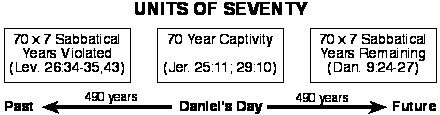
It is clear from the above passages that God had a specific reason behind the deportation of the Southern Kingdom (Judah) to Babylon for 70 years. This would mean that Israel violated the Sabbatical year 70 times. The Jews entered the promise land around 600 B.C. This means that they were in the land about 800 years before the Babylonian deportation. Had they disobeyed the Sabbatical year, it would mean that they should have been in captivity for about 114 years. Instead, they were held captive for 70 years, meaning that they were disobedient for only 490 of the 800 years in the land. This would mean that there were breaks or gaps in the accumulation of the 490 years, during the 800-year period, that resulted in Israel’s 70-year captivity. Why is this important? Because many of the critics of the literal interpretation of Daniel 9:24-27 insist that it is unreasonable to have gaps in that 490-year period. Of course, it is not since there were many gaps in the 490-year period related to the Babylonian captivity.
Critics of a Future 70th Week
Preterist Gary Demar is one of the most outspoken critics of a yet future 70th week of Daniel. Demar argues that there are never any gaps in any time periods that he examines in the Scriptures. He says “If we can find no gap in the sequence of years in these examples, then how can a single exception be made with the “seventy weeks’ in Daniel 9:24-27”? Interestingly, Demar does not examine the 490-year period that took place during the 800 years of Israel’s occupation of the land as mentioned above. There are all kinds of gaps within the sequence. There were roughly 310 years of gaps interspersed (scattered) throughout the 800-year period. This means it directly related to the 70-weeks prophecy given to Daniel. Demar acknowledges that Daniel’s 70 weeks are related to the violation of the Sabbatical year laws of Leviticus 25 and 26, and connected to 2 Chronicles 36 and Jeremiah 25, but he fails to observe the fact that the 490 years of Israel’s violation of the Sabbatical years was prescribed by God in His covenant with the nation.
Dr. Harold Hoehner answers critics like Demar when he notes that “The seventy-year captivity was due to the Jews having violated seventy sabbatical years over 490-year period and Daniel now saw seventy units of sevens decreed for another 490 years into Israel’s future. Daniel himself was familiar with the reason why God sent His people into the Babylonian captivity from the first part of Daniel 9:1-3.
Dr. Leon Wood explains this matter as follows: “Since Daniel was here thinking in terms of the seventy-year captivity, he, as a Hebrew could have easily moved from the idea of one week of years to seventy weeks of years. This follows because, according to 2 Chronicles 36:21, the people had been punished by this exile so that their land might enjoy the Sabbath rests which had not been observed in their prior history [Lev: 26:33-35, Jer: 34: 12-22]. Knowing this, Daniel would have recognized that the seventy years of the exile represented seventy sevens of years in which these violations had transpired; and he would have understood Gabriel to be saying, simply, that another period, similar in length to that which had made the exile necessary, was coming in the experience of the people”.
Gary Demar insists that it is impossible to have any kind of gap or chronological postponement of time between the 69th and 70th week because the advancing of God’s program relating to His people Israel was put on hold and will be postponed until a future time.
70 weeks
Daniel 9:25 provides the starting point for the chronological unfolding of the seventy weeks’ prophecy. But, at what point does the text tell us it was to begin? There are different views concerning the beginning point.
Gabriel tells Daniel to learn from the issuing of a decree to restore and rebuild Jerusalem, that the seventy weeks of years would begin their countdown. This history of the interpretation of these verses is a confirmation of the fact that this prophecy is difficult and requires spiritual discernment.
A Decree to Restore and Rebuild Jerusalem
The next element of Daniel 9:25 is clear. The countdown of time will begin with “a decree to restore and rebuild Jerusalem”. The text is specific that the countdown will start with a decree to restore and rebuild Jerusalem. The decree involves the rebuilding of the city of Jerusalem, not the Temple. This is important since earlier edicts were issued in relation to the Temple. [2 Chro: 36:22-23; Ezra 1:1-4; 5:3-17; 6:3-5]. There are at least three different decrees that are considered in an attempt to “to know and discern” the beginning of the seventy weeks of Daniel. First, there was the decree of Cyrus [Ezra 1:24; 6:3-5] issued in 537 B.C. Second, the decree of Artaxerxes [Ezra 7:11-26] given in 458 B.C. Third, a second decree from Artaxerxes [Neh: 2:5-8,
17, 18] given in 444 B.C, at the time of Nehemiah’s return to Jerusalem. The third is the only one that literally fits the exact words of Daniel 9:25. Leon Wood notes that the “first stressed rebuilding the Temple; the second, the establishment and practice of the proper services at the Temple; and the third, the rebuilding of the walls, when, long before, most of the city had been rebuilt”. Non-literal interpreters of the 490 years of the seventy weeks of Daniel are vague and non-precise in their overall handling of the numbers.
Artaxerxes Decree
The only decree that specifically fits the statements of Daniel 9:25 is the one by Artaxerxes given in 444 B.C as recorded in Nehemiah 2:1-8. Why? Because the first and second decree relate to rebuilding the Temple. Only the third decree speaks specifically of Jerusalem. It is clear that Nehemiah received a decree to rebuild and restore Jerusalem from King Artaxerxes. The letter of the King to Nehemiah granted him to rebuild the city. [Neh: 2:5]. The entire book of Nehemiah is proof that this godly governor built Jerusalem and its streets and walls.
Dr. Harold Hoehner, chairman of the New Testament department at Dallas Theological seminary, has produced one of the best works on the chronological aspects of the seventy weeks of Daniel in his book “Chronological Aspects of the life of Christ”. The third decree is clearly the beginning point for the countdown of the seventy weeks of Daniel. Dr. Hoehner provides the following arguments in support of the final decree, as recorded in Nehemiah 2:1-8.
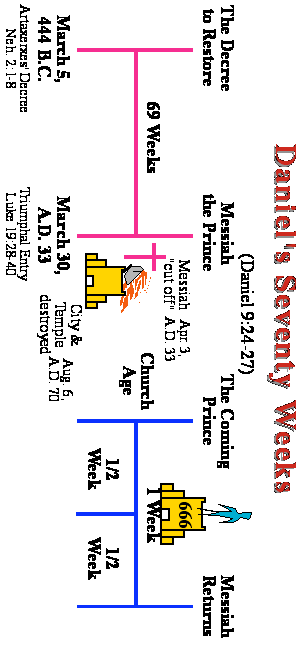
“First, there is a direct reference to the restoration of the city (2:3, 5) and of the city gates and walls. (2:3, 8). Second, Artaxerxes wrote a letter to Asaph to give materials to be used specifically for the walls (2:8). Third, the book of Nehemiah and Ezra 4:7-23 indicate that certainly the restoration of the walls was done in the most distressing circumstances, as predicted by Daniel [Dan: 9:25]. Fourth, no later decrees were given by the Persian kings pertaining to the rebuilding of Jerusalem. The exact date of this decree can be determined as March 5, 444 B.C. This provides a solid plank in developing a literal interpretation of Gabriel’s great prophecy to Daniel. So, you are to know and discern that from the issuing of a decree to restore and rebuild Jerusalem until Messiah the Prince there will be Seven weeks and Sixty-two weeks; it will be built again, with plaza and moat, even in times of distress. [Dan: 9:25]
Because there is no need to reinvent the wheel, we can resolve this issue by presenting two of the best explanations on this issue. 1. We will examine Sir Robert Anderson’s masterful presentation in “The Coming Prince”. Then we will examine Dr. Harold Hoehner’s insightful refinement of Anderson’s basic position from the “Chronological Aspects of the Life of Christ”.
Sir Robert Anderson
Of all the students of the scriptures that have looked into Daniel’s prophecy of the 70 weeks, none have opened up this key section of God’s holy word with more devotion, careful scholarship, and precise accuracy as Sir Robert Anderson. His classic work, “The Coming Prince” was first published in Great Britain in 1894. Sir Robert Anderson was the chief inspector for Scotland Yard. Anderson developed a chronology that used a 360-day year that he called a “prophetic year”. Anderson based this upon the Jewish calendar, with a clear implication that the prophetic time table of Daniel was derived from it as well. [42 months = 1260 days]. Anderson began the 483- year countdown with Artaxerxes decree that he said was March 14, 445 B.C. (Nissan 1, 445 B.C) and it culminates in Christ’s triumphal entry into Jerusalem on April 6, A.D 32 (Nissan 10, A.D.32). Here is Anderson’s explanation; “According to Jewish custom, our Lord went up to Jerusalem on the 8th Nisan, which as we know, fell that year upon a Friday. And having spent the Sabbath at Bethany, He entered the Holy city the following day, as recorded in the Gospels. The Julian date of that 10th Nisan was Sunday the 6th of April, A.D 32. What then was the length of the period intervening between the issuing of the decree to rebuild Jerusalem and this public advent of “messiah the prince”- between the 14th of March, B.C. 445 and the 6th of April A.D. 32(when He entered into Jerusalem)? The interval was exactly and to the very day 173,880 Days or seven times sixty-nine prophetic years of 360 days.
From B.C. 445 to A.D 32 is 476 years = 173,740 days (476x365) + 116 days of leap years. And from 14th March to 6th April, reckoned inclusively according to Jewish practice is 24 days. But 173,740 + 116+ 24 = 173,880. And 69x7x360 = 173,880.
It must be borne in mind here that in reckoning years from B.C to A.D. One year must always be omitted; for of course, the interval between B.C. 1 and A.D.1 is not two years but one year. In fact, B.C. 1 ought to be called B.C. 0; and it is so described by astronomers, with whom B.C. 445 is 444. And again, as the Julian year is 11M.10.46s; or about the 129th part of a day, longer than the mean Solar year, the Julian calendar has three leap years too many in every four centuries. This error is corrected by the Gregorian reform, which reckons three secular years out of four as common years. For instance, 1700, 1800, and 1900 were common years, and 2000 will be a leap year”.
Some minor corrections for Anderson’s findings have been provided by Dr. Harold Hoehner of Dallas Theological seminary.
Harold Hoehner
Dr. Hoehner has questioned the starting and ending times put forth by Anderson. Hoehner, advocates the time of Artaxerxes decree as 444 B.C and not 445 B.C. He explains: “The date of this decree is given in the biblical record. Nehemiah 1:1 states that Nehemiah heard of Jerusalem’s desolate conditions in the month of Chislev (November – December) in Artaxerxes twentieth year. Then later in Artaxerxes twentieth year in the month of Nisan (March/April) Nehemiah reports that he was granted permission to restore the city and rebuilds its walls (2:1). To have Nisan later than Chislev (in the same year) may seem strange until one realizes that Nehemiah was using a Tishri- to- Tishri (September/October) dating method rather than the Persian Nisan – to Nisan method. Nehemiah was following what was used by the kings of Judah earlier in their history. This method used by Nehemiah was confirmed by the Jews in elephantine who also used this method during the same time period as Nehemiah.
Next, one needs to establish the beginning of Artaxerxes rule. His father Xerxes died shortly after December 17, 465 B.C. and Artaxerxes immediately succeeded him. The report to Nehemiah 1:1 occurred in Chislev (November/December) of 445 B.C. Therefore, Nisan 444 B.C marks the beginning of the seventy weeks of Daniel 9:24-27. Dr. Hoehner further objects to Anderson’s use of the solar year instead of the Sabbatical year. Dr. Hoehner also corrects some of Anderson’s calculations. Dr. Hoehner spells out his difference in the following. “First, in the light of new evidence since Anderson’s day, the 445 B.C. date is not acceptable for Artaxerxes twentieth year; instead the decree was given in Nisan, 444 B.C. Second, the A.D.32 date for the crucifixion is untenable. It would mean that Christ was crucified on either a Sunday or Monday. In fact, Anderson realizes the dilemma and he has to do mathematical gymnastics to arrive at a Friday crucifixion date; Christ’s crucifixion occurred on Friday, Nisan 14 in A.D 33. Reckoning His death according to the Julian calendar, Christ died on Friday, April 3, A.D.33. As discussed above, the terminus a quo (beginning) occurred in Nisan 444 B.C.
Although Nehemiah 2:1 does not specify which day of Nisan the decree to rebuild Jerusalem occurred, it cannot have occurred before Nisan. It could have occurred on some other day in Nisan. Using the calculating method Anderson used, Hoehner comes up with the 476 solar years. This is the difference between 444 B.C and A.D 33. By multiplying 476 by 365. 24219879 days, comes to 173,855 days, and Hoehner states “This leaves only 25 days to be accounted for between 444 B.C. and A.D. 33. By adding the 25 days to Nissan 1 or March 5(of 444 B.C), one comes to March 30(of A.D.33) which was Nisan 10 in A.D.33. This is the triumphal entry of Jesus into Jerusalem. The terminus and quem of the sixty-ninth week was on the day of Christ’s triumphed entry on March 30, A.D. 33. As predicted in Zechariah 9:9, Christ presented Himself to Israel as Messiah the king for the last time, and a multitude of the disciples shouted loudly by quoting from a messianic Psalm “Blessed is the king who comes in the name of the Lord”. (Ps 118.26; Matt. 21:9; Mark. 11:10; Luke 19:38; John 12:13)
This occurred on Monday, Nisan 10 (March 30) and only four days later on Friday, Nisan 14, April 3, AD 33, Jesus was cut off or crucified.
The seventieth week of Daniel’s prophecy is yet to be fulfilled. When that
is accomplished, Daniel’s inquiry will be fully realized, for Israel will be back in her homeland with her Messiah.
Dr. Hoehner has put together an air tight case for his understanding of the beginning and ending of the first sixty-nine weeks of Daniel’s prophecy. Dr. John Walvoord notes, in support of Dr. Hoehner, that “the best explanation of the time when the sixty-nine-sevens ended is that it occurred shortly before the death of Christ, anticipated in Daniel-9:26 as following the sixty ninth seven”. Practically all expositors agree that the death of Christ occurred after the sixty ninth seven.
The Seven Weeks
It is important to note that God, through Gabriel, divides the seventy weeks into three sections: “seven weeks”, “sixty-two weeks”, and “one week”. (Daniel-9:27). What is the significance of these divisions? Since the first seven weeks of years (49 years) is segmented from the whole, to what does it refers to? The first of three segments refer to the time when it (Jerusalem) will be rebuilt again, with plaza and moat, even in times of distress (Daniel-9:25c). This modifying statement connects the first seven weeks with the distressing days of EZRA and Nehemiah. Thus, the first seven weeks refer to the time of the rebuilding of Jerusalem and the temple. Dr. John Walvoord states “the best explanation seems to be that beginning with Nehemiah’s decree and the building of the wall, it took a whole generation to clear out all the debris in Jerusalem and restore it as a thriving city. This might well be the fulfillment of the forty-nine years. The specific reference to streets again addresses our attention to Nehemiah’s situation where the streets were covered with debris and needed to be rebuilt. That this was accomplished in troublesome times is fully documented by the book of Nehemiah itself”. The fact that this prophecy divides the seventy weeks of years into three sections will come into play later when examining the single week in verse 27.
The sixty-two weeks
The next segment of times is the sixty-two weeks of years that are said to follow the first seven weeks of years. The total of the two parts equal sixty-nine weeks of years or 483 years. The sixty-two weeks follow consecutively the first seven weeks because there are no textual indicators or historical events that would lead to any other conclusion. The sixty-two weeks will end with the arrival of “Messiah the prince”. Daniel- 9:25, ‘until Messiah the prince there will be seven weeks and sixty-two weeks”. Messiah the prince can be none other than the Jewish Messiah, Jesus the Christ. Dr. Hoehner noted above that the seven and sixty-two weeks (that is sixty-nine weeks) ended on the day of Christ’s triumphal entry. The fulfillment of the seven and sixty-two weeks is recorded in Luke 19 as follows.
“And when he (Jesus) approached, he saw the city and wept over it, saying, “If you had known in this day, even you, the things which make for peace! But now they have been hidden from your eyes because you did not recognize the time of your visitation. (Luke-19:41-42, 44)
After the Sixty-Two Weeks
We now enter the area of the greatest controversy concerning the seventy weeks’ prophecy. The debate is focused upon whether the seventieth week follows consecutively the first sixty-nine. Actually, the seventieth week is postponed until a future time that we know as the tribulation. There are two different views. The two views are whether all seventy weeks of years have already been fulfilled in the past, or whether the final, seventieth week is future.
Textual reason for a postponement
“Critics of literal, futurist understanding of this text claim that there is no justification for a gap or postponement between the sixty-ninth and seventieth week. Preterist Gary Demar, says “the gap” that has been placed between the sixty- ninth and seventieth weeks of Daniel’s prophecy was created because it was needed to make the dispensational hermeneutical model to work. Nothing in the text of Daniel 9:24-27 implies a gap.”
He asks “since there is no gap between the seven and sixty-two weeks, what justification is there in inserting a gap between the sixty ninth week (seven weeks + sixty-two weeks= sixty-nine weeks) and the seventieth week”. First of all, the text says, “then after the sixty-two weeks” in other words, after the seven plus sixty-two weeks, which equals sixty-nine weeks of years (483 years). The Hebrew text uses a conjunction combined with a preposition, usually translated “and after”, or better “Then after”. It is the only indication given regarding the chronological relation between the sixty-two weeks and the cutting off of the anointed one. This event will occur after their close, but nothing is said as to how long after.
For interpreters like Gary Demar, who advocate a continuous fulfillment view of all seventy weeks without a break, they must put both the crucifixion of Christ and the destruction of Jerusalem some forty years later into the final weeks of years, which is only seven years in length. Yet, Demar accuses those who see a gap between the sixty- ninth and seventieth week as exercising “silly-putty” exegesis, of stretching out this biblical time frame in a manner
not supported by the text itself”. Demar argues that Christ’s death took place in the middle of the final week, which would then draw to a conclusion in A.D 33 with the conversion of Paul (an event which in no way is even remotely alluded to in Gabriel’s prophecy). What Demar and people like him fail to tell readers is that while he rails against a gap, he is silent about how to ram, cram, and jam two events separated by forty years into a seven-year period”.
Thomas Ice debunks Demar’s calculations:
“A closer look at Demar’s problem reveals a grave contradiction in his understanding of Daniel-9:24-27 and his view of Matthew-24:15, as having been fulfilled in AD 70. The abomination of desolation is mentioned in one Old Testament book. (Daniel-9:27, 11:31; 12:11) declares Demar. He then states that “there was no doubt in the minds of those who read and understood Jesus words in Matthew-24:15 that the abomination of desolation prophecy was fulfilled in events leading up to the temples destruction in A.D 70”. Clearly, Demar links the fulfillment of the abomination of desolation in Daniel-9:27, which will occur in the middle of the week, with the Roman destruction of the temple in A.D 70, some 40 years later. But even with the flexibility of new Math, the numbers don’t add up. There is no way to cram, events that occurred at least forty years apart into seven years”.
Messiah Will be Cut Off
Verse 26 begins with the phrase “after the sixty-two weeks”. The text goes on to describe three things that will take place at the end of the sixty ninth week ninth week of years (483 years). Therefore, in this installment, I will deal with three important phrases in verse 26. They are 1. The messiah will be cut off and have nothing.
- The people of the prince who is to come will destroy the city and the sanctuary”, and
- “It’s end will come with a flood; even to the end there will be war; desolations are determined”.
All interpreters agree that the cutting off of the Messiah certainly refers to the death of Jesus. Since the 483 years were fulfilled to the day on March 30, AD 33, the date of Christ’s triumphant entry (Luke-19:28-40) and Jesus was crucified four days later on April 3, A.D 33, then it was an event that took place after the 483 years, but not during the final week of years. This textual point is recognized by many, including Amillennialists. As this relates to the chronology of the prophecy, Dr. John Walvoord, says “It makes plain that the Messiah will be living at the end of the sixty-ninth seventh and will be cut off or die, soon after the end of it”.
G.H. Pember says “Now, his crucifixion took place four days after his appearance as the prince that is, four days after the close of the four hundred and eighty third year. Nevertheless, the prophecy does not represent this great event as occurring in the seven years which yet remained to be fulfilled. Here, then is the beginning of an interval, which separates the four hundred and eighty-three years from the final seven”.
The next phrase “and have nothing”, literally means “and shall have nothing”. To what does this refer? Certainly, Christ gained what was intended through his atoning death on the cross as far as paying for the sins of the world. What was it that He came for, but did not receive, especially in relationship to Israel and Jerusalem, which is the larger context of this over-all passage? It was his Messianic kingdom. Indeed, it will come, but not at the time in which he was cut off.
Dr. Charles Feinberg says “It can only mean that he did not receive the Messianic kingdom at that time. When his own people rejected Him (John- 1:11), he did not receive what rightly belonged to him”. It was because of Daniel’s people (the Jews) rejection of Jesus as their Messiah that the kingdom could not come in. The coming of the kingdom requires acceptance of Jesus as Messiah in order for it to be established in Jerusalem. The kingdom will arrive by the time the final week is brought to fruition. Since Israel’s kingdom has not yet arrived, this means it is in the future . Therefore, we have just seen another reason why the final week of years is also future to our day.
The Prince Who is to Come
The identity of the prince who is to come is a matter of considerable debate and discussion. The best way to determine the identity of this prince is to first look at what he is prophesied to do at his arrival upon the stage of history. The people of this coming prince will destroy the city, clearly a reference to Jerusalem because of the overall context, and also the sanctuary. What sanctuary was there in Jerusalem? It could be nothing else other than the Jewish temple. Has the city and the temple been destroyed? Yes. Jerusalem and the temple were destroyed in A.D 70 by the Romans. This cannot be a reference to a future time, since as Dr. Walvoord states “There is no complete destruction of Jerusalem at the end of the age as Zechariah 14:1- 3 indicates that the city is in existence although overtaken by war at the very moment that Christ comes back in Power and Glory. Accordingly, it is probably better to consider all of verse 26 fulfilled historically”.
The subject of this sentence is “the people”, not “the Prince who is to come”. Thus, it is the people of the prince who is to come that destroys the city and the Sanctuary. We have already identified the People as the Romans who destroyed Jerusalem and the temple in A.D. 70 under the leadership of Titus. The Prince who is to come is a reference to the yet to come Antichrist. Dr. J. Dwight Pentecost explains, “The ruler who will come is that final head of the Roman Empire, the little horn of 7:8. It is significant that the people of the ruler, not the ruler himself, will destroy Jerusalem. Since he will be the final Roman ruler, the people of that ruler must be the Romans themselves”. The coming Prince cannot be a reference to Christ, since He is said to be “Cut off” in the prior sentence. This prince has to be someone who come after Christ. The only two viable possibilities are that it could either refer to a Roman Prince who destroyed Jerusalem in A.D. 70 or the future Antichrist.
Why shouldn’t we see the Prince who is to come as a reference to Titus, who led the Roman conquest in A.D 70? Because the emphasis of this verse is upon “the People”, not the subordinate clause “the prince who is to come”. This passage is apparently stated this way so that this prophecy would link the Roman destruction with the A.D.70 event, but at the same time setting up the Antichrist to be linked to the final week of years to the first “he” in Verse 27.
He is not described as the Prince coming with the people but instead a detached and distant description, as one who is coming. This suggests that the People and the Prince will not arrive in history together. Dr. Steven Miller adds, “but”, V.27 makes clear that this “ruler” will be the future persecutor of Israel during the seventieth seven. The people of the ruler does not mean that the people “belong to” the ruler, but rather the ruler will come from these people.
Its End will Come with A Flood
This final sentence of Verse 26 also occurs during the interval between the sixty-ninth and seventieth weeks. However, the first part, “its end will come with a flood”, refers back to the destruction of Jerusalem in A.D 70, while the final phrase, “even to the end there will be war; desolations are determined”, is being fulfilled throughout the entire period (2000 years thus far) of the interval.
“The antecedent of ‘it’ is obviously Jerusalem, explains Leon Wood. ‘Flood’ or ‘overflowing’ can refer only to the degree of destruction meted out. History records that the destruction of Jerusalem was very extensive. The war and desolations that began with the destruction of Jerusalem in A.D.70 would continue throughout the interval leading up to the seventieth week. In fact, this language appears to parallel that of Luke 21:24, which says, “and they will fall by the edge of the sword, and will be led captive into all the nations and Jerusalem will be trampled underfoot by the Gentiles until the times of the Gentiles are fulfilled”.
Charles Fienberg says “The final words of verse 26 sum up the history of Israel since A.D.70: “desolations are determined”. Surely the determined wars and desolations have come upon them. (Luke 21:24). Such has been the lot of Israel and the city of Jerusalem, and such will be their portion until the “time of the Gentiles have been fulfilled”.
Dr. Pentecost says, “But that invasion, awesome as it was, did not end the nation’s sufferings for war, Gabriel said it would continue until the end. Even
though Israel was to be set aside, she would continue to suffer until the prophecies of the 70 “sevens” were completely fulfilled. Her sufferings span the entire period from the destruction of Jerusalem in A.D. 70 to Jerusalem’s deliverance from Gentile dominion at the second advent of Christ”.
Prophetic Postponement
Once again, we see that a plain straightforward reading of the text of the Bible provides a clear and convincing understanding that there is a Biblical basis for halting God’s clock between the sixty-ninth and seventieth weeks. Robert Culver summarizes as follows: “All attempts to place the events of verse 26 (the cutting off the Christ and the destruction of Jerusalem) is either the period of the sixty-two weeks or in the seventieth week stumble and fall on the simple language of the text itself. It seems that a more natural interpretation is the one that regards the events of Verse 26 as belonging to a period between the sixty-ninth and seventieth weeks, when God has sovereignly set aside His people Israel, awaiting a time of relationship in the future, after Israel has been restored to the land”.
Anti-Christ or Christ
Our study of Daniel’s seventy weeks’ prophecy now moves to the final verse in the passage, which also deals with the final week of years.
Daniel-9:27 “And he will make a firm covenant with the many for one week, but in the middle of the week he will put a stop to sacrifice and grain offering; and on the wing of abominations will come one who makes desolate, even until a complete destruction, one that is decreed, is poured on the one who makes desolate”.
The first question that arises in verse 27 is to whom the pronoun “he” refers to? Here “he” must refer to “the prince who is to come” in verse 26. However, opponents of literal interpretation disagree. Preterist, Dr. Kenneth Gentry says, “the indefinite pronoun “he” does not refer back to “the prince who is to come” of verse 26. Fellow Preterist, Gary Demar, insists “it is Jesus who will make a firm covenant with the many, not the Anti-Christ”. Yet, such an errant interpretation violates the grammar and syntax of the Hebrew text.
According to Thomas Ice, “in Hebrew grammar, as with most languages a pronoun would refer to the nearest antecedent, unless there was a contextual reason to think otherwise. In this instance, the nearest antecedent in agreement with “he” is “the prince who is to come” in verse 26. This is recognized by a majority of scholars, including a number of millennialists such as Kiel and Leupold.
Robert Culver explains the correct meaning of this text as follows:
“The ordinary rules of grammar established that the leading actor of this verse is the Anti-Christ, the great evil man of the end time. If the pronoun “he” were present in the Hebrew, a case might possibly be made for the introduction of an entirely new personality into the story at this point. However, there is no pronoun; only the third masculine singular form of the verb indicates that an antecedent is to be sought, and that of necessity in the preceding context. Usually, the last preceding noun that agrees in gender and number and agrees with the sense is the antecedent. This is unquestionably “the coming prince” of verse 26. He is a “coming prince”, that is, one whom the reader would already know as a prince to come, because he is the same as the “little horn” or the fourth beast of chapter 7”.
Leon Wood provides a list of further reasons for taking the “he” in verse 27 as a reference to “The prince who is to come of verse 26. Second, as noted above, the unusual manner of mention in verse 26 regarding that prince calls for just such a further reference as this. There is no reason for the earlier notice unless something further is to be said regarding him, for he does nothing nor plays any part in activities there described. Third, several matters show that what is now said regarding the one in reference does not suit if that reference is to Christ”.
A). This person makes a “firm covenant” with people, but Christ made no covenant. God made a covenant of Grace with people, and Christ fulfilled the requirement under it, but this is quite different from Christ’s making a covenant.
B). Even if Christ had made a covenant with people during His lifetime, the idea of mentioning it only here in the overall thought of the passage would be unusual, when the subject of His death and even the destruction of Jerusalem have already been set forth.
C). The idea of the seventieth week, here closely associated with this one does not fit the life or ministry of Christ, as will be shown presently
D). The idea that this one causes “sacrifice and offering to cease does not fit in reference to Christ in this context.
The Making of a Covenant
What is it that “he” will do? The Anti-Christ will “make a firm covenant with the many for one week” that is seven years. Non-literal interpreters of Daniel’s seventy-week prophecy usually attempt to make this covenant a reference to Christ’s covenant to save his people, usually known as the covenant of grace. “This, then, is a confirming of a covenant already extant i.e., the covenant of God’s redemptive grace that Christ confirms” (Roman- 15:8) claims Dr: Gentry. Dr: Gentry and those advocating a similar view, must resort to a non-textual, theological interpretation at this point, since there was no seven-year covenant made by Christ with the Jewish people at the time of his first coming. They must back off from the specifies of the text in verse 27 and import in a theological interpretation, thus providing us with a classic example of spiritualization or allegorical interpretation.
If this is supposed to be a reference to the covenant of grace, then “it may be observed first that this would be a strange way to express such a thought, notes Dr. Leon Wood. Christ’s salvation covenant is not limited to seven years rather it is an eternal covenant. Daniel-9:27 says the covenant is to be made with “many”. This term always refers in some way to Israel throughout the book of Daniel (Daniel- 11:33, 39; 12:3). Thus, it is a narrow term used in a specific context. It is not a broad term, synonymous with the language of global salvation. Further, “it is evident that the covenant is subsequent to the cutting off a Messiah and the destruction of the city and the sanctuary, in the twenty-sixth verse; therefore, it could not have been confirmed at the first advent, says G.H. Pember. Such an interpretation does not fit this text and it does not account for the seven years that Gabriel says this covenant will be in place. Dr.Leon Wood continues: “since the word for “covenant” does not carry the article (contrary to the KJV translation), this covenant likely is made at this time for the first time (not a reaffirmation of an old one, then) and probably will concern some type of non-aggression treaty recognizing mutual rights. Israel’s interest in such a treaty is easy to understand in the light of her desire today for allies to help withstand foes such as Russia and the Arab bloc nations”.
Since a covenant as described in verse 27 has not yet taken place in reference to the nation of Israel, it must therefore follow that this will be a yet future event. This then, demands a postponement of the seventieth week with a gap of time between the sixth-ninth and seventieth weeks of years.
For One Week
This passage clearly says that the length of the covenant that “he” will make will be for one week or seven years. Many of those who believe that the entire prophecy of the seventy weeks has already been fulfilled around the time of Christ’s first coming, teach that the first half of the seventieth week was fulfilled by Christ’s ministry. We know Christ’s three and one half year ministry says Dr: Gentry, “was decidedly focused on the Jews in the first half of the seventieth week (Matthew-10:5; 15:24). G.H. Pember objects to such a view with the following:
“If the Messiah could be the subject, and the time that of the First Advent, we should then be plunged into the greatest perplexity; for the Lord, did none of the things that are mentioned in the 27th verse. To fulfill that part of the prophecy, He must have made a covenant with the majority of the Jewish people for seven years, neither more nor less. But there is no hint of such a covenant in the Gospels. And, indeed, one of the prophets has intimated to us that the Lord just before His death, suspended all His relations with the Jews, and through them with the whole of the twelve tribes. This exactly corresponds to the suspension of His dealings with the Jews at the
close of the Four Hundred and eighty-third year, and to the facts of history. Still further, the very next verse of Zechariah carries us face to face with the Prince that shall come, the Antichrist, who will make the seven years’ covenant on pretense of being the shepherd of Israel. Lastly, Christ did not cause sacrifice and offering to cease, when He suffered without the gate: The Temple- services were carried on for nearly forty years longer”.
Once again, we have seen that the text of this passage supports a gap of time between the sixty-ninth and seventieth weeks. It is becoming increasingly obvious that the seventieth week is still future to the time in which we now live. Israel has now been reestablished as a nation (1948), suggesting that the seventieth seven may soon begin.
In the Middle of the Week
Gabriel divides his prophecy of seventy weeks of years to Daniel into three sections: Seven weeks, Sixty-two weeks and one week. The final week of years- seven years- is detailed in Daniel 9:27. The first part of 27, “And he will make a firm covenant with the many for one week. The rest of the verse says “but in the middle of the week he will put a stop to sacrifice and grain offering; and on the wing of abominations will come one who makes desolate, even until a complete destruction, one that is decreed, is poured out on the one who makes desolate”. This verse tells us what will happen during the final week of years, which is called the tribulation.
Since the week of years is a seven-year period, the middle of a week of years would be three and a half years into the seven-year period. Daniel 7:25 and 12:7 both refer to a three-and-a-half-year period (time, times, and half a time). The context of both passages speaks of the future time of the Antichrist or the beast. This would support a futurist understanding of the seventieth week of Daniel 9:27.
The allegorical interpreters do not provide a textual interpretation of this passage. They are rightly called allegorical alchemist, because they try to brew-up interpretations from out of thin air by just stating and then declaring them to be true. In Daniel 9:27 they attempt a topical approach, selecting a word of two from the passage and declaring that Daniel’s famous prophecy finds fulfillment in the first century of our era.
Dr. J. Dwight Pentecost explains: “This covenant could not have been made of confirmed by Christ at His first advent, because a) His ministry did not last seven years, b) His death did not stop sacrifices and offerings, c). He did not set up “the abomination that causes desolation”. (Matt: 24:15)
The Abomination of Desolation
Verse 27 says that in the middle of the week (3 ½ years), “On the wing of abominations will come one who makes desolate”. Here we have a reference to the Antichrist who will do something to desecrate the temple. This did not happen near the time of Christ’s first coming. If it did, then what event was it? If it happened in A.D.70, as some might say, then it could not have happened within the time-span of the seventy weeks of years by anyone’s calculation. In Matt: 24:15, we have the interpretation of Jesus concerning the event Gabriel describes in Daniel 9:27. The event has to be future to the time of Christ, and since nothing like it corresponds to within seven years of His prediction, then we have to see this as a future event.
A Complete Destruction
The latter part of verse 27 says “even until a complete destruction, one that is decreed, is poured out on who makes desolate”. Once again, when did this happen in conjunction with Christ’s first advent. It did not! Therefore, another reason to see this as a yet future event when the Antichrist will be destroyed, at the second coming of Christ, which will bring to an end the seventieth week of years. Gary Demar says that the abomination of desolation took place in A.D.70.
The Two phases of Christ’s Career
It is obvious from the Bible that if you view the ministry or career of Christ in its entirety, then it is composed of two parts or phases. The first phase encompasses the first coming of Jesus two thousand years ago, while
the second phase will consist of His second coming sometime in the future. Yet many Old Testament prophecies of the coming Messiah coming led their descriptions of both phases of Christ in to single passage, with distinguishing between the two comings or phases of His earthly career.
It is commonly understanding today that the Jews of the first century did not understand that these Old Testament prophecies spoke of a single Messiah who would come twice one in humiliation, then again in glorious exaltation. Many Jews of Christ’s day thought that there would be two different Messiahs – Messiah ben Joseph and Messiah ben David. Messiah ben Joseph would be one who suffers dies, but is immediately followed by Messiah ben David who reigns in glory”.
The reality of scripture is that there is but one Messiah- Jesus of Nazareth-who comes twice. This means that there is a gap of time between the two comings. Even though Preterist like Demar and Gentry belittle a gap of time between the sixty ninth and seventieth weeks of Daniel 9:24-27, they are driven to believe in a gap of time between the two comings. So how the Preterist hold to something like a gap of time that not explicitly stated in Scripture? There are many passages that speak in a single statement of items that encompasses both phases of Christ’s career – the first and second advents.
Two – Phased Messianic passages
This means that it is legitimate to argue for a gap of time from the other messianic passages that also include, in a single passage, the two elements of Christ’s career. Dr. Randall Price makes note of the way scripture uses time gaps and provides a list of passages that fit into this category in the following statement. The revelation of prophetic postponement in the fulfillment of the eschatological aspect of the messianic program is in harmony with numerous passages in the Old Testament that reveal the two advents of Christ. (Examples). Gen. 49:10-12; Deut:18:16; 2 Sam. 7:13-16; Isa:9:1-7; 11:1-2,11; 52:13-59:21; 61:1-11, Luke 4:16-19; 7:22; Joel 2:28, Acts 2:17; Zeph:2:13- 3:20; Zech 9:9-10; Mic 5:2-15; Ps: 2:7-8; Acts 13:33 ; Heb 1:5; 5:5; Ps 22:1-32; 34:14,16; Mal 3:1-3; 4:5-6. Perhaps the most well-known example of this kind of prophecy is found in Christ’s reading of Isaiah 61:1-2 as recorded in Luke 4:16-30. The passage reads as follows. “The Spirit of the Lord God is upon me, because the Lord has anointed me to bring good news to the afflicted; He has sent me to bind up the broken-hearted, to proclaim to prisoners; to proclaim the favorable year of the Lord, and the day of vengeance of our God; to comfort all who mourn”.
When Jesus read the prophecies about Himself in Isaiah 61, why did He stop at the beginning of verse 2? Because He was announcing the reasons for His first coming and because He was to “proclaim” the acceptable year of Jehovah’s favor”. That’s a reference to the Church Age, often called the age of Grace, a time when sinners can freely call on the name of the Lord to be saved (Rom: 10:13). Jesus stopped at the words, “and the day of vengeance of our God”, which speaks of the tribulation period, mentioned by the Hebrew prophets as “the day of wrath” and the time of Jacob’s trouble” and by Jeremiah as “a day of vengeance” (46:10). That’s because the purpose of His first coming was to announce the period of Grace and Salvation we are living in, not the time of judgment that is yet to come”.
Another example of what some have called “double reference” is found in Zechariah 9:9-10. Dr. Arnold Fruchtenbaum says concerning double reference: This rule should not be confused with another rule often called Double Fulfillment. This law states that one passage may have a near and far view; hence in a way, it may be fulfilled twice”. The law of double reference differs from the law of double fulfillment in that the former states that while two events are blended into one picture, one part of the passage refers to one event and the other part of the passage to the second event. This is the case in Zechariah 9:9-10.
In the same context, we see that verse nine refers to Christ’s first coming; “Rejoice greatly, O daughter of Zion! Shout in triumph, O daughter of Jerusalem! Behold, your king is coming to you; He is just and endowed with salvation, humble, and mounted on a donkey, even on a colt, the foal of a donkey. Verse ten is a reference only to Christ’s second coming as follows:
“And I will cut off the chariot from Ephraim, and horse from Jerusalem; and the bow of war will be cut off. And He will speak peace to the nations; and His dominion will be from sea to sea, and from the River to the ends of the earth. In the Zechariah passage, there has to be a gap of time between the fulfillment of verse nine that relates to Messiah’s first coming two thousand years ago, and His second advent which is still a yet future event. Even though no time factor is explicitly stated in the text, because of the specific nature of the events described in the two verses, a gap of time is required to coordinate the fulfillment of this prophecy with the events of history. So, a gap in Daniel’s prophecy is not unreasonable. The Preterist argue that the gap theory in Daniel is a recent development in Church history. Demar and others say that John Nelson Darby and others changed all this with their “Church – Parenthesis hypothesis”.
