Chapter 9 of 17
Chapter Seven
Daniel 7 is the final chapter in the Aramaic section of the book. The first six chapters have been mainly historical; the second division is mainly predictive. The seventh chapter begins, “In the first year of Belshazzar, king of Babylon, Daniel had a dream and visions.” The eighth chapter, begins, “In the third year of the reign of King Belshazzar, a vision appeared unto me, even unto me Daniel.” The tenth chapter continues, “In the third year of Cyrus, king of Persia, a thing was revealed unto Daniel. And the thing was true, but the time appointed was long; and he understood the thing, and had understanding of the vision.” The book of Daniel is plainly a book of prophecy. Why prophecy? What is the purpose of prophecy?
To Authenticate and to Confirm God and His Word
First, prophecy is an authentication and a confirmation of the true God and of the true word of the Lord. In brilliant, unmistakable light Jehovah God sets himself forth as the only God who is able to predict the future. In Israel, the Lord asks: “Tell me! Present the evidence! Let them consult with one another!
Who predicted this in the past? Who announced it beforehand? Was it not I, the LORD? I have no peer, there is no God but me, a God who vindicates and delivers;
there is none but me” (Isaiah. 45:21). And again, the mighty God declares “Remember the former things of old,
For I am God, and there is no other; I am God, and there is none like Me, 10 Declaring the end from the beginning, And from ancient times things that are not yet done, Saying, ‘My counsel shall stand, And I will do all My pleasure,’ 11 Calling a bird of prey from the east, The man who executes My counsel, from a far country. Indeed I have spoken it; I will also bring it to pass. I have purposed it;
I will also do it” (Isaiah- 46: 9-11).
Why can’t a man predict the future? Because only God can predict the future, for He says of Himself, “what I say shall surely come to pass.” Today men seek through fortune tellers, soothsayers, necromancers, and astrologers some answer for the future.
To Authenticate and Confirm the Messianic Ministry and Lordship of Jesus Christ
Second, the purpose of prophecy is to authenticate and to confirm the messianic ministry, deity, and Lordship of Jesus Christ. Such an approach was used by the Lord himself. In the 24th chapter of the gospel of Luke, it is written of our savior, “and beginning at Moses and all the prophets, he expounded unto them in all the scriptures the things concerning himself.” (Luke- 24:27).
When it says in the book of Acts that Paul and Apollos convinced their hearers that Jesus was the Christ, instructing and teaching them out of the Holy Scriptures, where did they learn that method? From the Lord, Himself. The Old Testament foretold His life,death,and resurrection.
To Authenticate and Confirm the Promises of God for the Future
The purpose of prophecy is to affirm, confirm, and authenticate to us the promises of God for the future. The Bible, two thirds of which is prophecy is sealed and revealed to us by symbol, by type, or by overt statement. Two thirds of the books are prophetic and one half of those prophecies have already come to pass, literally. If God has fulfilled one half of them actually and literally, the same Lord will also fulfill the half that remains. Just as it has been, so also it will be.
THE BEAST NATIONS (Daniel- 7: 1-3)
Daniel dates this vision as being in the first year of Belshazzar, which would be 541 B.C. Belshazzar died in 538 B.C, on the night that the Medo- Persians took over the Babylonian empire, the night that the hand of God wrote on the wall. He reigned about three years. In the first year of Belshazzar’s reign Daniel is now in his eighties. He has been forgotten and neglected. Belshazzar had no time for a Godly statesman, a God-fearing man like Daniel. This was sixty years after Daniel interpreted the dream of the golden, man- like image for Nebuchadnezzar. In that year of 541 B.C, the first year of Belshazzar, Daniel saw visions and dreams and wrote them down in this book, the most unique book in all of human literature.
The book of Daniel was the first apocalypse, the first recorded apocalyptic writing. The time period after Daniel saw a proliferation of apocalyptic literature. In the Bible, however, there are but three genuinely inspired apocalypses: the book of Zechariah, Revelation which closes the New Testament canon, and the first apocalyptic book to be written, the one by Daniel. An apocalyptic is a message whereby God expresses His truth through symbols and hieroglyphs. God introduced Daniel to this apocalyptic ministry in order that he might unveil for us the sweep of human history through the future. In the apocalyptic writing, Daniel has no peer, except the apostle John, who wrote the Revelation.
Daniel is pre-eminently the prophet of the times of the gentiles. He follows the sweep of human history until the coming of Christ into his terrestrial, earthly supremacy. The apostle John also presents the apocalyptic future, the sweep of history to the coming of Christ into his celestial supremacy, when the heavens and the hosts of all creation are made subject to the king and Lord of all. Those men, Daniel and John, by symbol and by picture present the whole story of human history until the consummation of the age receives the conquering, coming Christ.
THE VISION DESCRIBED
The coming of the anti-Christ (7: 1-28), with the two coming dictators who first loom before us are each described as a “little horn”, although the little horn of chapter 7 is not the same person as the little horn of chapter 8.

In chapter 7, the person so described was the anti-Christ, in chapter 8, the person described was Antiochus. The Anti-Christ was associated with the final stage of the fourth empire; Antiochus was associated with the final stage of the preceding Greek empire. Antiochus has already come and gone now, so we in the 21st century can study his story in the light of history; the anti-Christ has not yet come, so we are confined to prophecy for information about him.
The vision came to Daniel in “the first year of Belshazzar, king of Babylon.” Chronologically, it belongs between Daniel chapter 4 which deals with the humbling of Nebuchadnezzar and chapter 5, which deals with the overthrow of Belshazzar. Daniel had known for some time that the Medo- Persian Empire would replace the Babylonian empire on the world stage. Belshazzar was the eldest son of Nabonidus and heir to the throne of Babylon. Nabonidus was emperor and Belshazzar was prince regent. Nabonidus lived in virtual retirement while Belshazzar ran things from Babylon. Although Nabonidus actually reigned for seventeen years, he took little interest in his empire for the last ten years. During this period, Belshazzar was commander-in- chief and, for all practical purposes, in charge of the country.
Nabonidus had come to the throne on the time – honored expedient of murdering his predecessor, the boy king Labashi- Marduk, grandson of Nebuchadnezzar, rightful heir, and the last of his line. Belshazzar was about twenty at the time that title king was given to him. In this chapter, it is more than a courtesy title; it was real. He was king of Babylon; his father was king of the Babylonian empire, and for at least five years at the close of the reign of Nabonidus, Belshazzar reigned along with his father as full coregent.
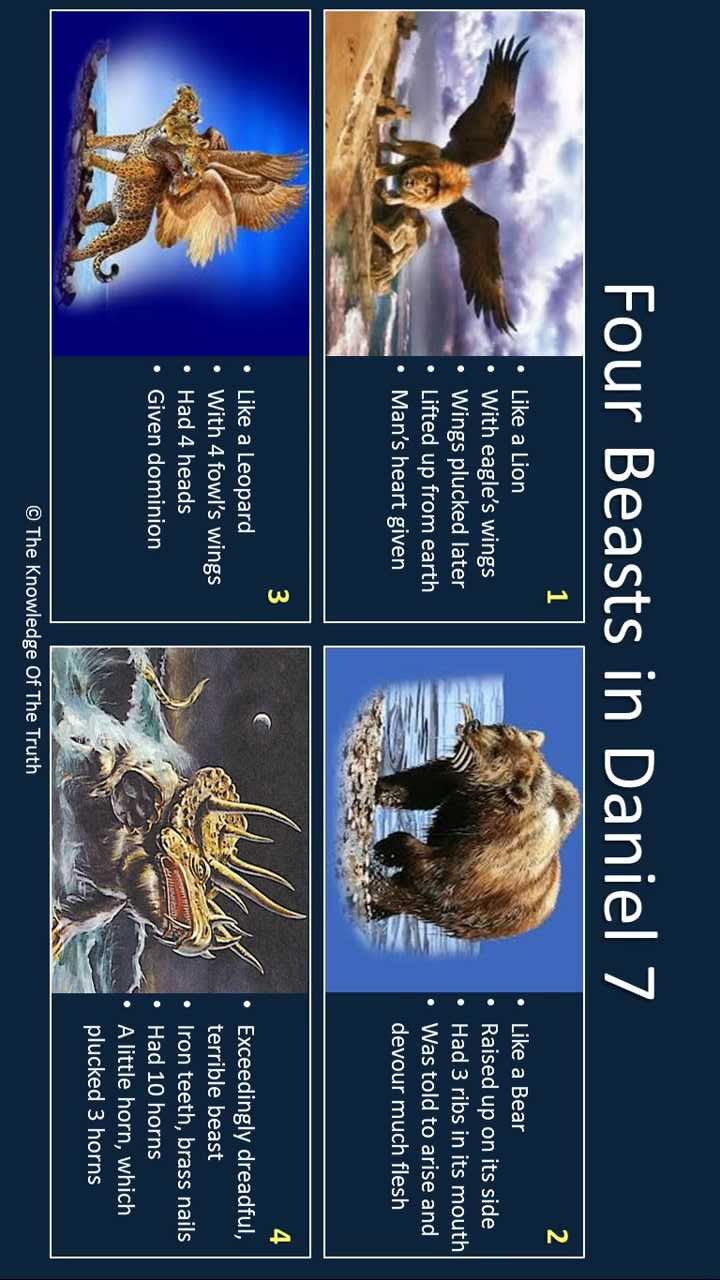
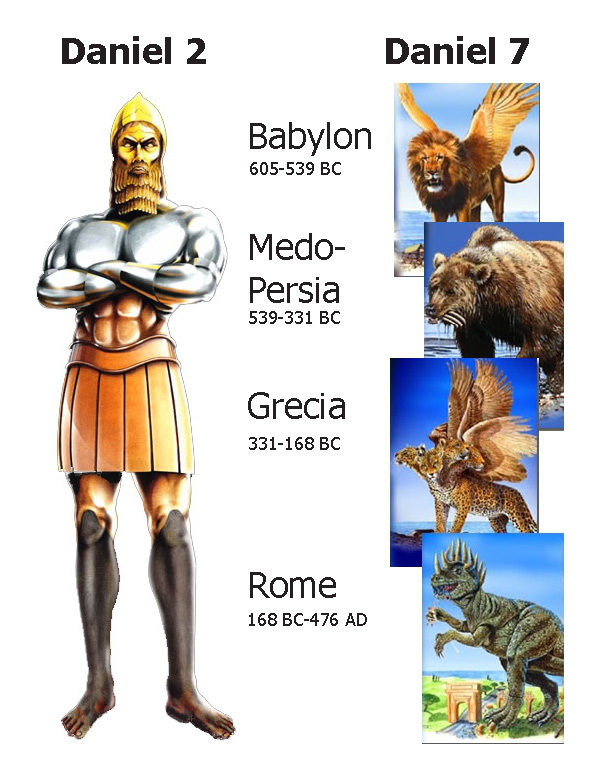
The vision in the seventh chapter of Daniel is identical with that of the vision that was given to Nebuchadnezzar and interpreted by Daniel in the second chapter of the book. In the seventh chapter of the Book of Daniel, there is that same inclusive sweep of history until the end of the age. There is first the lion which represents the Babylon. The bear represents Medo – Persia; the three ribs in its mouth represent victories over the Syrians, the Egyptians, and the Babylonians. The leopard, with its four wings and its four heads, represents the Greek empire of Alexander which, upon his death, was divided into four parts by his four generals. The non-descript beast with great iron teeth is the Ottoman Turkish Empire or revived Roman empire. The ten horns correspond to the ten toes, the multinational rule which exists to the coming of Christ. So, in both images, in chapters two and seven, you have the great sweep of history until the end of the age. The fact that God gave the vision twice shows how important it is.
From Arno c. Gaebelein D.D.
| Daniel | Revelation |
|---|---|
| Daniel saw the fourth beast, a great nondescript with ten horns | John beholds a beast out of the sea, with tens horns crowned (ten kings) and seven heads |
| The little horn had eyes and a mouth that spoke very great things. | To the beast "Was given a mouth speaking great things and blasphemies" |
| The little horn: He shall speak words against the Most High | The Beast: He opened his mouth in blasphemy against God. |
| The little horn: He shall wear out the saints of the most High | The beast: And it was given to him to make war with the saints and overcome them. |
| The little horn's time of domineering power is a time and time and divided of times? (3 1/2 years) | The beast has power for 42 months. |
God would show us something else by repeating that vision. When man looks at his work, and his empires and his kingdoms, he sees it as Nebuchadnezzar saw it in his vision: a great colossal man with a head of gold, and a breast and heart of silver. He looks upon his kingdoms through the symbol of a vast, impressive, triumphant, strong standing man. But in the 7th chapter of the Book of Daniel, looking at that same sweep of history, God sees it in an altogether different way. God looks at those kingdoms under the symbol and in the form of wild beasts. A man looks at human history and reads in it the proud stories of conquering, triumphant generals, statesman, and kings. But when God looks at those same strident leaders, He looks at them in divine evaluation as being wild beasts. The reason for that is very apparent. They act toward one another basically. They are wild beasts.
Nations rise by the power of the sword, in blood and in slaughter, in fire and in force. When we speak of these great empires ,such as Greece, we are not speaking of barbarous tribes that are ignorant and uncivilized. We are referring to the most cultivated and intellectual of all the nations who ever existed.
When Alexander the Great conquered the known world, he took with him Aristotle, the great philosopher who ever lived. Man, looks upon his empires as models of human achievement. But God looks on them as wild beasts which need to be controlled. When Alexander the Great marched up to Jerusalem, he had come to destroy it. One of the most brilliant stories that you could ever read, and a most moving one, is from Josephus about how Jerusalem was saved. Alexander was in Tyre, a city he was seeking to conquer. Nebuchadnezzar had besieged Tyre for 18 years and never succeeded in reducing it. The first time Tyre was ever conquered was by Alexander the Great. While he was there in that siege, he sent to the neighboring countries for provisions for his army as he fought against the people, the armies, and navies of Tyre. Both Jerusalem and Judea refused to help him. After the war was over in Tyre, Alexander marched to Gaza and burned it to the ground in indignant vengeance because of their refusal to help him while besieging Tyre, and he was on his way to Jerusalem to destroy and to burn it too.
In the meantime, God had appeared to the high priest and told him what to do. The next day when Alexander with his armies came sweeping up to Jerusalem to destroy it, the high priest came out with his miter, with his breastplate inlaid with 12 precious stones, and with his robe laden with all the beauty of bells and embroidered pomegranates. He was followed by all the priests dressed in pure white. They were followed by all the people of the city
dressed in robes, clean and white. They welcomed Alexander the Great, singing the songs of Zion. They opened to him the doors of their city and the doors of their temple. One of the priests took the Holy Scriptures and showed Alexander in the Book of Daniel where Daniel had prophesied concerning his very coming. So overwhelmed was the world conqueror by what he saw in the beautiful procession of the Jewish priesthood, and by the welcome of the Judean people, that he knelt down and prayed in the name of Jehovah God and offered a sacrifice on the brazen altar in the temple. When Alexander arose, he said that in a dream before he left Macedonia, he had seen that very man, the high priest, and heard him say in the dream that if Alexander crossed the Hellespont with his Greek army, God would give him victory throughout all of Asia.
That was a wonderful story, but don’t forget that Alexander the Great came to destroy Jerusalem with a sword and with fire. He came as a wild beast. All of those empires in both their activity and in their behavior toward one another was bestial. They lived by rule of might, by blood and fire.
It is no different today. ISIS has brutally killed hundreds of thousands of Christians in the Middle East starting from 2014 and is still continuing. Women and young girls are raped, small children even 2 years old were beheaded. Many are crucified and burned alive. Children were put in steel cages and drowned in the river. But the world is paralyzed, and there are no organized efforts to stop this bestial behavior. The 20th century was the bloodiest in the history of man. Mao Zedong killed 100 million of his own people. How do we account for the 20th Century bloodletting? Through previous centuries, the prevailing form of government was monarchies — inherited rule of one person. Even seemingly absolute monarchs were chained down by tradition, and violated it at their own personal peril. By the beginning of the 20th Century, monarchies had been replaced by dictatorships in many countries, and by the end of WWI, dictatorships, or democracies dominated the world. The much greater slaughter of the 20th Century occurred because of two historical socio-political experiments, one fascism (especially in Germany, Italy, Eastern Europe, Japan, and China), and the other, communism. These absolutist, unrestricted, uninhibited ideologies murdered people in war and democide without compunction, without the inhibition of tradition, culture, or religion. Their defeat and replacement by democracies whose leaders are restricted and inhibited by a democratic culture, liberal values, and an open and competitive electoral system has brought a virtual end to such incredible killing.
Joseph Stalin, Pol Pot, and other communist dictators butchered millions. Hitler was the symbol of brutality.
The nations act toward one another bestially; by the sword, by fire, by fury, and by force. God looks upon them as beasts, and as beasts do they act toward one another. Lenin asked what it would matter if two-thirds of the population of the world were destroyed, as long as the remaining third was communist.
Daniel 7:4-14
Daniel 7:4 “The first was like a lion and had the wings of an eagle. I kept looking until its wings were plucked, and it was lifted up from the ground and made to stand on two feet like a man; a human mind also was given to it.” The first beast, said to be like a lion, is symbolic of the empire in power in Daniel’s day, the Babylonian empire. Several matters give evidence for this symbolism. First, the lion, as king of beasts, and the eagle, as king of birds, correspond for importance to a head of gold, as indicated for the symbolism of Babylon and Nebuchadnezzar in the dream image. Second, the statues of winged lions, which are believed to have been representative of the empire and her king, have been recovered from the ruins of Babylon. Third, Daniel’s contemporary prophets employed the sign of both the lion and eagle for Nebuchadnezzar. (Jeremiah.4.7; 49:19;50;17,44; for the eagle, (Jeremiah. 49;22; Lamentations . 4;19; Ezekiel. 17:3; Habakkuk . 1:8). Fourth, the changes which this beast underwent, as indicated in the remainder of the verse, fit very well with the experiences of Nebuchadnezzar, as will appear. “Wings of an eagle”. This element is a fitting symbol for Nebuchadnezzar, not only in respect to the eagle being the king of birds, as noticed, but that wings are suggestive of speed and capacity for effective action (Jer.4:13; 48:40). Nebuchadnezzar, in establishing his empire, showed these characteristics in his defeat of the Egyptians at Carchemish (605 B.C.), and his ensuing occupation of the extensive territory which then fell to his titular domain, and
his continuing rule. “I kept looking”: This is the second use of the participial construction noted in verse two and pictures Daniel continuing to look intently at the vision. “Wings were plucked off”: the root of the verb used is “to pluck, pull out”, as one would the beard from his face(Isa.50:6), symbolizing the loss of the speed and capacity for action. The symbolism is best taken in reference to Nebuchadnezzar’s humiliation in his time of insanity, when these abilities were entirely removed. Lifted up…. “Made to stand”: With the wings plucked, further changes came as the beast was made to stand upright on two feet, and apparently took on the appearance of a human. The word for “lifted up” has been rendered by some expositors as “taken away” (from the earth), believing the thought to concern the destruction of the empire. This verb, however, means properly “to raise up, elevate,” and also the context calls for the idea of being made to stand in an upright position. The word for “feet “is in the dual form; thus, “two feet”. The “heart of a man”: This phrase reveals the significance of the prior change. The lion became a man outwardly and then inwardly; symbolizing that Nebuchadnezzar, following his time of insanity, became “humanized” in his manner of rule. A humanitarian interest came to play a major role in his life, rather than the former “beastly “lust for power.
Daniel 7:5 ““Then a second beast appeared, like a bear. It was raised up on one side, and there were three ribs in its mouth between its teeth. It was told, “Get up and devour much flesh!'”
Another beast, a second like a bear: “Another” means one distinct from the first, and “second” refers to the place of sequence in the order of beasts listed. The empire symbolized by this beast is the Medo-Persian, which succeeded the Babylonian in history; and which was symbolized by the silver chest and arms of Nebuchadnezzar’s image. This second beast, like the other two following, symbolized an empire only, not an outstanding ruler of the empire, as in the case of the first beast. “Was raised up on one side”: The words of this much-disputed phrase are best translated as given here, indicating that the bear was seen to have its two feet on the same side raised at one time, making that side to be higher than the other. Two points of symbolism should be noted. First, that the animal had one side rise higher than the other points to the greater importance assumed by the Persian division over the Median, in the Medo- Persian empire- a symbolism formed also by the two horns of the ram in Daniel’s second vision, (the second being made to grow higher than the first (8.3). Second, that the legs were lifted, as if the animal was about to move forward, points to the great Medo- Persian desire for conquest, carried out so dramatically by Cyrus. “Three ribs in its mouth”: Bones held in the mouths of beasts of prey may safely be taken as representative of conquests. That this beast held three ribs suggests the conquests of three major enemies, Lydia, Egypt, and Babylonia which were defeated by the Persians. “Arise, devour much flesh”: means that it should continue to make conquests. The overall stress for this beast is on conquest; and Medo- Persia did take over far more land than any prior kingdom, reaching finally all the way from the Indus river on the east of Egypt to the Aegean Sea on the West.
Daniel 7:6 “After this I kept looking, and behold, another one, like a leopard, which had on its back four wings of a bird; the beast also had four heads, and dominion was given to it.”
After this I kept looking: “After this” indicates that these views of the animals came in sequence, one followed by the next.” I kept looking” is the third instance of the participle indicating continuation of careful observation. “Like a leopard”: The word for “leopard” means either a leopard” or “panther” and is often considered related to an Arabic root meaning “to be spotted” (Jer.13:23). The outstanding characteristics of the leopard are agility, speed (Hab.1:8), and an insatiable thirst for blood, as a beast of prey. Its symbolism here can only be of Greece, the next empire in history after the Medo- Persian, and one which indeed was Characterized by swiftness of conquest and an insatiable lust for victory, even more than the Medo- Persians. It may be pointed out that all three animals used in the symbolism-the lion, bear, and leopard- find rather frequent references in Scripture, often in conjunction with each other (1 Samuel .17:34-36; Prov.28:15; Jer.5:6; Hos.13:7-8; Amos 5:19). This could be expected, for they were common animals of the day, though carefully selected here for their respective symbolic suitability to the three empires involved. “Four wings of a bird on its
back”: The word for “back” may also be translated “side”, which if properly used here, would indicate that the animal was more like the winged beasts found in Babylon. The existence of wings suggests the ideas of speed and action, as also with the wings of the lion. A contrast exists between the two cases, however. The wings on the lion are said to be those of an eagle, whereas these are not identified with any bird, and are said to have been four in number. The significance is that the eagle is important in the former instance, connoting kingliness, as noted; and the double number of wings in the latter imagery calls for stress, denoting unusual speed and action. The empire of Greece, more than any of the other empire, was characterized by speed and action. Under Alexander the Great, the borders of Greece were enlarged enormously and with remarkable speed. “Four heads”: Since “heads’ in Scripture normally represent persons or governments, it is logical to expect this development to concern some form of fourfold division of government; and that was exactly what did occur after Alexander’s death. His vast empire was divided among his four generals.
Daniel 7:7 “After this I kept looking in the night visions, and behold, a fourth beast, dreadful and terrifying and extremely strong; and it had large iron teeth. It devoured and crushed, and trampled down the remainder with its feet; and it was different from all the beasts that were before it, and it had ten horns.”
In the night visions: This phrase is preceded by the same words as used similarly in verse six. This added phrase might have been used also in verse six, for it depicted these various presentations of animals as separate visions, though together constituting the one overall vision. “A fourth beast”: The fourth beast differs from the others, was not named. Apparently, it did not look like any known animal, probably meaning that no animal was known which could adequately symbolize it. The beast described in Revelation 13 :1- 10, which is commonly taken to be parallel in significance to this one, is said to have had features resembling all three animals- leopard, bear, and lion. Since these are the same animals which appear in the earlier part of this vision, the implication is that the fourth beast had characteristics of all three. The outstanding feature of this beast, however, is strength, with all described aspects serving to amplify this quality. The empire symbolized can only be the Roman empire, which historically followed the Grecian, and which was truly characterized by strength. Rome also reduplicated within itself many of the characteristics which had been especially true of the earlier Babylonian, Medo- Persian, and Grecian empires . More description is given of this beast than of the first three, which means that its significance in the vision was greater. In this it corresponds to the emphasis on the fourth part of Nebuchadnezzar’s dream image. “Dreadful and terrible and exceedingly strong”: The first two verbs are close in meaning, speaking of fearfulness. The beast was one to inspire great fear in the spectator. The third verb gives the reason for this fact: the beast displayed enormous strength. Evidently it was of immense size, showing monstrous legs and body. “Great iron teeth”:
Another fear-inspiring aspect was its teeth, which apparently could be seen. They were made of iron, the same metal of which the legs of the dream-image were constituted. Iron also depicts strength. “Devouring…breaking…stamping”: The third fear-inspiring feature concerns the beast’s actions. The three verbs used to describe these are participles, indicating continuous action. Daniel saw the beast continuing to devour with the Iron teeth, to break in pieces all that could be found, and then to stamp with its feet on whatever was left, the residue. All this representd an extensive conquest, involving enormous destruction of people and property. “Different from all”: This beast was different from the others, a fact also stated in verse 23. This difference apparently pertained especially to the actions just mentioned, for the word “differed “is also a participle, in parallel with the verbs depicting the actions. It suggests that Rome would make her conquests with greater decisiveness, fearfulness, and terror- inspiring tactics than any of the others. This was true of Rome. Her Conquests were made at wide range, and with the greatest strength and ferocity. Her conquests were more permeant, too; for whereas the other empires had been satisfied with only a loose confederation of countries seized, Rome consolidated and organized for lasting control. “It had ten horns”: Horns commonly signify kings in Scripture, and it was definitely stated that these do here (Vs. 24). Since the beast had ten horns, which Daniel saw at the same time, the symbolism was that Rome, at the time depicted, would have ten
contemporaneous kings, presumably ruling over the same number of subdivisions of the empire. Various explanations have been suggested.
The correct view can only be that there would be a time still future when the Roman empire would be restored, so that these representations could be true in the manner depicted: a time when ten contemporary kings would rule, among whom another would arise, uprooting three in the process, and then move on to become the head of all. This thought was represented in the earlier dream- image by the ten contemporary toes, symbolizing kings in whose day’s God would set up a kingdom, which should never be destroyed (2:44). This kingdom, as observed in the discussion of the dream-image, will be Christ’s millennial kingdom, to be established still in the future. The thought finds a parallel also in the description of the “beast” of Revelation 17, where again ten horns symbolize ten kings ( V 12 ).These kings had not yet received power in John’s day, but would, along with the beast, who had not yet appeared ( V 11 ).The time when they and the beast will appear is said to be when they will make war with the lamb, which means when Christ (the Lamb)returns to deliver the Jews from the power of the beast and these kings, just prior to the institution of the millennial kingdom.
Daniel 7:8 "As I was contemplating the horns, another horn--a small one-- came up between them, and three of the former horns were torn out by the roots to make room for it. This horn had eyes resembling human eyes and a mouth speaking arrogant things.”
“As I was contemplating”: This is the fifth instance of this participial construction. Another little horn: “Another’ distinguishes this horn from the other grown horns, and does not imply the existence of other little horns. “Little” only that this horn started small, as it gradually emerged among the grown horns, not that it remained small; for the context, especially verse twenty, shows that it finally became the greatest of all. The word for “among them “means literally “between them”, indicating further that the other horn must symbolize another king, like the others, only emerging later, though while they still rule. Because the description of this ruler, given in this verse and later in verses 24-26, corresponds to the description of the “beas”’ of Revelation 13:5-8 and 17:11-14, the two are correctly identified. The one so described is commonly and properly called the Antichrist, who will be Satan’s counterfeit world ruler, trying to preempt the place of God’s true world ruler, Jesus Christ, who will later establish His reign during the millennium. “Three of the first horns were uprooted”: As the little horn emerged and grew larger, Daniel saw three of the original ten horns uprooted and displaced; thus, leaving a total of eight. This must signify that, when this king comes to power, he would takes control of the kingdoms of three of his predecessors. The word for uprooted connotes a gradual process, where new growth pushes out old. The new king would not take control of all three areas at once, then, but over a period of time. Finally, he would become the recognized leader of all (V 20). Likes the eyes of a man: Eyes are symbolic of insight, intelligence and prudence. The significance here is that the Antichrist would be characterized by unusual mental ability. He would be clever, shrewd, knowledgeable and able to solve problems and give advice, which others would find wise. That the eyes are said to be those of a man may indicate that this king would not be more than a man, not a supernatural being, which one otherwise might think. He will be a human king, though a remarkable one. Mouth speaking great things: This person would be a boaster, especially in speaking against God. He would have outstanding ability, but he would know it and boast of it, vaunting himself against God and even claiming to be greater than God.
(11:36).
The Vision Today
This is a picture of the world today in Daniel 7. What does it mean? What is its message for us? The raging sea of humanity and these superpowers that rise out of the sea who deal in blood and war and force, this terrible picture, what is its meaning? What is the future? What of future of our nation? What is the future of the nations of the world? What is the future of our people and the people of the earth? Out of this great, seething mass of humanity, and these nations which rise, what is the future? Is it good? Is it bad? Does it bring evil and disaster? Is that raging sea in birth pangs of the second coming of our Lord jesusChrist or as it in a death struggle?
Now when the historian of this world looks at human life without revelation and inspiration from heaven, all he can see is the sea in its tumultuous turmoil and the nations that rise out of the great social convulsion. Agitation is all that he can see. That is all he can see in the past. And as far as he can see in the future, there is nothing but that same torment and agony. There is rage, passion, war, bitterness and, strife. But Daniel said, “I beheld till the thrones were cast down, and the ancient of day did sit” [Dan: 7:9-14]. Over and beyond the raging torment of the sea of humanity, Daniel sees the throne of the living God. And coming before the throne, he sees the Son of man who receives a kingdom everlasting, that shall never pass away. These beast kingdoms abide only as long as God says they can abide.
Why does God allow such agony? That is the mystery of iniquity that Paul refers to in 2 Thessalonians 2:7. Why does God allow these nations, so cruel, so wanton, so bloodthirsty, so coercive, to sweep over the earth and bring agony, untold horror, and misery to the human race? Why does God allow to exist; ISIS, Islamic atrocities, Idi Amin, Pal Pot Mao, Stalin, Hitler etc? We are not told. These kingdoms and those empires exist only as long as God says.
The Vision for us
What does this mean for us personally, individually? We also are in that raging sea. We are on this planet. We are going to be buried here if the Lord delays His coming. We cannot disassociate ourselves from the human family and the human race. There is a raging sea that torments and tortures us. All of us face it. If not today, then tomorrow we shall face it. There is decay and disintegration, there is age and there is senility, there is corruption and there is death, and there is the grave. All of us experience that torment together.
What does it mean to the unbeliever, to the agnostic, to the infidel? All he can see is the fury of the terrible storm, the visage of that enemy called death. All that he faces is corruption, decay, and the grave. The darkness and the night are all alike for him. He sees just the raging torment of an uncertain and darkened future.
What does this mean for us when we lift up our eyes? What about those of us who look upward to Jesus in faith? We do not see the grave or the torment or the agony or the corruption or the decay or the blackness of the night. For us there has been set a throne of grace, and on that throne sits the incarnate son of God. The king of heaven and the king of earth. Around him are these ten thousand times ten thousand resurrected, immortalized saints who minister in His name, who live in His presence. Our life is filled with hope, and glory, and optimism, and triumph, and victory. That is the way the Book of Daniel closes. God said to Daniel, “But as for you, go your way to the end; then you will enter into rest and rise again for your allotted portion at the end of the age”. [Daniel 12:13]
Daniel 7: 9-14 The Ancient of Days
The phrase Ancient of Days occurs three times in the Bible, and all three references are found in chapter 7 of Daniel (verses 9, 13, 22). This chapter documents “a dream and visions” that Daniel received to show there would be four powerful human kingdoms followed by the Kingdom of God (verses 1, 17-18). The phrase Ancient of Days “denotes an elderly or old person. … It is employed, probably, with reference to the fact that God is eternal” (Barnes’ Notes on the Bible, commentary on Daniel 7:9). The passages in Daniel 7, which show how the Ancient of Days appears and what He does, make it clear who He is.
First Reference to the Ancient of Days
The first reference in Daniel 7 is of this being having great authority and executing judgment: “I watched till thrones were put in place, and the Ancient of Days was seated; His garment was white as snow, and the hair of His head was like pure wool. His throne was a fiery flame, its wheels a burning fire; a fiery stream issued and came forth from before Him. A thousand thousand, ministered to Him; ten thousand times ten thousand stood before Him. The court was seated, and the books were opened” (verses 9-10).
The being who has all authority is God the Father. As Moses explained,
“The LORD Himself is God in heaven above and on the earth, beneath; there is no other” (Deuteronomy 4:39).
When Christ appeared to His disciples after His resurrection, He told them, “All authority has been given to Me in heaven and on earth” (Matthew 28:18). John added, “The Father … has given Him [Jesus] authority to execute judgment also” (John 5:26-27). Although God the Father has “committed all judgment” (verse 22) to the Son, He is the One who has supreme jurisdiction over this process. As for the thousands of beings standing before the Father, this image is repeated in the vision John recorded in the book of Revelation: “Then I looked, and I heard the voice of many angels around the throne, the living creatures, and the elders; and the number of them was ten thousand times ten thousand, and thousands of thousands” (Revelation 5:11).
Second Reference to the Ancient of Days
“I was watching in the night visions, and behold, one like the Son of Man, coming with the clouds of heaven! He came to the Ancient of Days, and they brought Him near before Him. Then to Him was given dominion and glory and a kingdom, that all peoples, nations, and languages should serve Him. His dominion is an everlasting dominion, which shall not pass away, and His kingdom the one which shall not be destroyed” (Daniel 7:13-14).
Here, the being “like the Son of Man” is Jesus Christ and the “Ancient of Days” is once again God the Father. While “son of man” almost always refers to a human in the Old Testament (the book of Daniel is the only book that varies from this pattern), we must note that this was the primary name used by Christ during His earthly ministry (Matthew 16:13). The “Son of Man” in Daniel 7:13-14 must be Jesus because He appears before God the Father to present to Him an everlasting kingdom. Paul spoke of this future act by Jesus when he wrote: “Then comes the end, when He [Jesus] delivers the kingdom to God the Father, when He puts an end to all rule and all authority and power” (1 Corinthians 15:24).
Third Reference to the Ancient of Days
The last reference to the Ancient of Days is found in Daniel 7:21-22: “I was watching; and the same horn was making war against the saints, and prevailing against them, until the Ancient of Days came, and a judgment was made in favor of the saints of the Most High, and the time came for the saints to possess the kingdom.”
This judgment scene is not the “Great White Throne Judgment’ of Revelation 20:11-15, that takes place at the close of the millennium. It is not the Judgment seat of Christ that is described in 2 Corinthians 5:10; Cor. 3:11- 15. That judgment takes place before the Millennium, and soon after the Church has been raptured. This judgment scene is that of the “Gentile Nations’ as represented by the four wild beasts, for as the outcome of the judgment. Daniel saw the beast the fourth wild beast, the Roman empire (not the little Horn, it is not called a Beast in Daniel), slain and its body destroyed and given to the burning flame. This is figurative language describing the destruction of the Roman Empire. The little horn called by John “The beast (Rev. 13:1-8), is not slain, as is the Beast of Daniel, but cast Alive into the Lake of Fire. (Rev.19:20). While the fourth wild beast, the Roman Empire, will be destroyed as the result of this judgment, the other beasts the lion, the bear, and the leopard, representing respectively the Babylonian, the Medo- Persian, and the Grecian Empires simply have their dominion taken away, but their lives are prolonged for a season and a time. It is interesting to note that the Persian and Grecian kingdoms have been revived.
From the Bible, it is clear that there is a Dispensation of judgment between the present Dispensation, and the Millennium, during which there shall be three judgments:
- The judgment of believers for their works at the judgment Seat of Christ. 2 Cor. 5:10.
- The judgment of the Jews during ‘The Great Tribulation’. The Jews are an earthly people, and as all promises to them are earthly, it follows that their judgment must be of an earthly character, and it is called by Jeremiah and
Daniel as the time of Jacob’s trouble’.( Jer. 30:4-7). Daniel 12:1. Jesus calls it “The Great Tribulation”.( Matt. 24:21-31). The result of this judgment will be the conversion of the Jews.
- The judgement of Nations. (Matt. 25:31-46). This is a judgment of the Nations after Christ’s return to the earth. It will take place in the valley of Jehoshaphat (Joel 3:1-2), and its purpose will be to separate the “Sheep and Goat” Nations, so that the sheep Nations may enter into the “Kingdom prepared for them from the Foundation of the World’, which is the Millennium, or “Stone Kingdom” of Christ. The Goat Nations, as nations, will be destroyed. From this we see that the judgment scene that Daniel saw in his “Second Vision” is a general description covering the whole “Dispensation of Judgment”.
(Daniel 7:9). Who is it that sits upon this “Throne judgment”? He is called the Ancient of Days. Who is the Ancient of days ? He is the son of man, For the father judges no man (John 5:22). Then the description of him corresponds to that of the ‘Son of Man’ in Revelation 1:12-15, as Judge, not as High Priest. At that time, Christ will have completed His High Priestly Office, and assumed the Office of Judge, preparatory to His entering upon His kingly duties when the Millennial Kingdom is set up. This is seen in that He is not girdled around the waist like a priest, but wears a sash over His shoulder and breast like a judge, and His hair of “White Wool’ corresponds to the “Snow White Wig” worn by English judges.
Verses 13-14:“I was watching in the night visions, And behold, one like the Son of Man, Coming with the clouds of heaven! He came to the Ancient of Days, And they brought Him near before Him. 14 Then to Him was given dominion and glory and a kingdom, That all peoples, nations, and languages should serve Him. His dominion is an everlasting dominion, Which shall not pass away, And His kingdom the one Which shall not be destroyed”.
Here the reader may be confused and perplexed in an apparent contradiction of titles. We saw in the preceding vision that the “Son of Man” was the Ancient of Days, here the son of man is receiving dominion from the Father who is the Ancient of days here. How can we reconcile these contradictions? It is not surprising to know that each person in the Trinity can use this title interchangeably. Jesus said ‘I and My Father are One’ John 10:30. And Paul says “And without controversy great is the Mystery of Godliness: God was manifest in the Flesh.” (1 Timothy 3:16). Now we know from other scriptures that Christ is to receive the kingdom from the father.
The Coming of Christ is Judgmental
First, the coming of Christ is judgmental. The text states that the judgment is set as the books are opened (Daniel- 7:10). In the fifth chapter of John we are told that the father judges no one, but has committed all judgment to the son. When Christ comes, therefore the event will signal the gathering together of the nations and peoples of the earth for judgment. “The books are opened.” All of us some day shall stand in the presence of almighty God. Our proximity to that hour is as near as the day of our death. All of us are moving toward that vast assize. (a trial session, a civil or criminal, held periodically). The astronomers say that the entire universe is rapidly moving through space. Going where? Traveling to that final confrontation with God. We cannot escape being carried along by this satellite we call earth.
We are buried in this planet, its destiny, and its history. The planet itself is moving toward the final consummation, the judgment day of almighty God. However diverse our paths may be here, they shall converge at that one, common center when we stand in the presence of the great judge. Young, old, rich, poor all will be there one day.
In the 20th chapter of the book of Ezekiel there is the judgment of Israel. In the 25th chapter of the gospel of Mathew is portrayed the judgment of all the Gentiles of the earth. In the 5th chapter of the 2 Corinthian letter is described the judgment of the Christian who shall stand before the bema of
Christ. In the 20th chapter of Revelation there is described the great white throne judgment before which every lost man shall appear. All of us shall stand some day before the judgment seat of God. The judgment is set and the books will be opened.
There are three books mentioned in the Bible that are everlasting. One is the Bible itself. The flower fades, the grass withers but the word of God shall stand forever (Isaiah- 40:8) heaven and earth shall pass away but God’s word shall never pass away. The second book that is everlasting is the book of rewards. In glory, there is a recording angel who has a book (C.D. or DVD) on the pages of that book are written all the deeds of our lives. When we stand at the judgment seat of Christ, we shall be rewarded according to what we have done in the days of our flesh. The third book that is everlasting is the Lamb’s book of life. On those pages are recorded the names of all those who are the heirs of salvation.
The Coming of Christ is Pre-Millennial
Not only is the coming of Christ judgmental, but the coming of our Lord is also pre-millennial. He is to come at the beginning of the thousand years’ reign on earth. It is never presented in any other way in the Bible. There is the coming of Christ first, and then the establishment of the kingdom. Never does the Bible portray the establishment of the kingdom first, and then the coming of Christ. The Millennial rule of Christ is not the dawn that ushers in the glorious appearing of our great God and Savior, but rather Jesus is the Sun of righteousness rising above the horizon and flooding the world with his unshaded, undiminished glory. First, there is the coming of the Ancient of Days, then the thousands of thousands who gather to minister before him. First, there is the coming of the Son of Man with the clouds of heaven, and then there is given to him universal dominion. First, there is the great image, whose ten toes are smitten by the rock, cut out of the mountain without hands. Then afterward there is the growth of the stone to fill the earth, the kingdom of God.
There is nothing separating us from the return of Christ; no intervention between us and the coming of the Lord. We are not to look for a great tribulation, or for the battle of Armageddon, or for the development of the social fabric of national life, or for some system whereby men are ameliorated in their pain or suffering or desire in prayer for peace. Rather, we are to look for the great God and savior the Lord Jesus. (Philippians-3:20). Always in the Bible, the coming of the Lord is pre-Millennial. First, the Savior comes, then the kingdom is established.
The Coming of Jesus Christ is Interventional
Not only is the coming of the Christ judgmental and premillennial, but it is also interventional. It is the great interposition of God in human history. If there is any one thing that the prophets teach us, it is that the restoration of humanity is never found in itself, but in a power beyond itself, outside itself, above itself. That power is always in God. In the prophecy of the consummation of the age, it is always the intervention of Christ in human history, the coming of the Lord from heaven down to earth, that saves and restores humanity.
These great beasts, which represent the nations and kingdoms of the earth, reigned and followed their course in history for a while, but inevitably according to the word of the Lord, the saints of the Most High take the kingdom and possess it forever and ever. How do they take it? How is it transferred from terrestrial to celestial? How are the times of the violent Gentiles changed into the peaceful possession of the saints? How is it that these vicious governments suddenly are made docile, domestic, and joyful? The victory comes not from the nations themselves or from the human stream of life, but it always comes as an intervention from God. In the Scriptures, it is always the second coming of our Lord which begins the rule of God on earth. Without exception, the apostles and prophets through their apocalyptic visions, present the course of human history continuing as it is, full of murder, blood, war, trouble, sorrow, and death until the great, cataclysmic intervention of Christ coming from heaven.
The Coming of Christ is Triumphal
Not only is His coming judgmental, Pre-millennial, interventional – suddenly, cataclysmically coming down from heaven. But it is also triumphal. Think of the diverse complexity of the Millennial kingdom. In it are the angels and the redeemed, the saints of the Old Testament, the saints of the New Testament, all of them are there [Daniel 7: 18, 27].
Think of the creation and how diverse it is. There is the sky above us and the earth beneath. There are the stars, the moon, and the sun. There is the green foliage, the clothing of the trees. There is the water and land. There are the seasons. There are colors, sounds and dimensions. Not two leaves are alike out of the untold billions that fall to the earth. There are not two snowflakes that are alike. Think of the diversity of the handiwork of God in the great creation. It surrounds us. The diversity will be no less evident in the Millennial kingdom, in the new creation when Christ shall come again. Some of these things are spoken of in the text. For example, the heavenly kingdom is both angelic and human. Angels and men mingle together, and all have a part in praising God the Savior. In the fifth chapter of the Book of Revelation, the four cherubim, representing the creation are praising God. There, praising God in that Millennial kingdom, you will find the twenty-four elders- the twelve patriarchs, and the twelve apostles. There you will find the myriads upon myriads of angels. And there you will find the redeemed, the blood – bought ones of all ages, mingling together in the kingdom of Christ, singing “worthy is the lamb that was slain to receive power, and riches, and wisdom, and strength, and honor, and glory, and blessing”. [Rev: 5:12]
These angelic and celestial spirits do not disdain to look upon as their brethren, even though we are so poor, degraded, and made of the dust of the ground. What could be more beautiful of more precious than in the twenty – second chapter of the Apocalypse, when John has seen through the angel the vision of the consummation of the age, and seeing those visions, he falls down at the feet of the angel to worship him. The angel replies, “ But he said to me,
"Do not do this! I am a fellow servant with you and with your brothers the prophets,
and with those who obey the words of this book. Worship God!"(Rev: 22:9).
Although resurrected and glorified, we will still be ourselves. You will be you, and I will be me. If that is not true, then resurrection and glorification mean nothing at all. If it is not me who can resurrected if it is not I who am glorified. If I am not me in the kingdom, then resurrection has no meaning to me at all. If there is another mass, if there is another entity, if there is another person, it is not me then who is resurrected. Resurrection has lost its meaning and the word carries no promises at all. But if resurrection has any meaning, it must be that I am resurrected. We are going to be separate individuals . You will be you, and we shall be us in the kingdom, people who love the Lord.
And the nations shall be there. One flower differs from another flower, as one star differs from another star, so one country and nation will differ from another country and nation. [Rev: 21:24]. Not only people and nations, but also languages will be there. A part of the curse of sin was the breaking up of the one common language. But the reversal of that curse in eternity does not mean that we shall have just one tongue with which to speak. Rather it means that each nation possessing its own language and own tongue can understand every other nation. The miracle of Pentecost was not that they all, spoke in one tongue, but that each one understood in his own language the tongue in which the message was presented. So, it shall be in the kingdom of God, each one speaking his own language and his own tongue, yet all of us will understand.
One of the glories of that diversity is that it is also non-destructive. On earth, often some black people hate white people and vice versa. People hate, rape, rob, destroy, and overrun other nations. So often the diversities in the human family bring sorrow and conflict. But in the kingdom of God the diversity is non-destructive. The wolf will dwell with the lamb – they will both be there. The lion will eat straw like an ox. No animal was intended to be carnivorous, to eat another animal. But as it was in the beginning, the domestic tranquility, the whole diverse creation will move in the pattern, purpose, plan, and glory of God. [Isaiah: 11:9]
Civilization in history goes back about 7000 years. As far back as the archeologists can trace the story of the nations of the world, the story is blood
-red. It is marred with murder, blood, and war. The famous names that are in out human storybook- Cyrus, Alexander the Great, Caesar, Charlemagne, Genghis khan, Napoleon were all made immortal, not because they were philosophers, but because they were fighters, not because they were statesmen, but because they were warriors. Blessed is the nation whose history is short, for the story of mankind is one of blood, greed, invasion, and war. Nor is there any indication or any hope that as civilization progresses, our wars will become less fierce, less ferocious, or less destructive. It is just the opposite. As the story of mankind progresses, our wars become more ferocious and more fierce. We just trade a stone ax or a wooden club for an A.K.47 or for a pipe bomb, etc.
Does that violence continue forever? No: Even though nations differ from each other, they shall not lift up sword against each other, neither shall they learn war anymore. These swords shall be used for plowshares and these spears for pruning hooks. In that Millennial Kingdom, there will be no internal strife. Judah will not taunt Ephraim and Ephraim will not envy Judah. In the Millennial Kingdom, there will be no more those who sit helplessly in the valley of the shadow of death, but upon them the light will shine. They will need no candle, for the Lord God gives light in their helplessness, hopelessness, and darkness. “There will be no more sorrow and no more crying, for these things are all passed away”.
The Language in Heaven
Believers are fascinated with the language in Heaven. People from Kerala in South India jokingly say that Malayalam will be the language of Heaven. Some say that it may be the Hebrew language, Aramaic, Greek or English. Over the years many people have asked me this perplexing question. Immediately my memory takes me to a verse. “Beloved, now we are children of God; and it has not yet been revealed what we shall be, but we know that when He is revealed, we shall be like Him, for we shall see Him as He is. 3 And everyone who has this hope in Him purifies himself, just as He is pure”. (1 John 3:2-3). According to the above verse we are going to be like Jesus. Angels and Jesus had no problem with communicating in the native languages.
At one time, all the people of the world spoke the same language and used the same words. . .. Then they said, “Come, let’s build a great city for ourselves with a tower that reaches into the sky. This will make us famous and keep us from being scattered all over the world.” They wanted protection from a deluge in the future. Men, always try to do their own ways to protect themselves, instead of relying upon God. But the Lord came down to look at the city and the tower the people were building. “Look!” he said. “The people are united, and they all speak the same language. After this, nothing they set out to do will be impossible for them! Come, let’s go down and confuse the people with different languages. Then they won’t be able to understand each other.”The Babel account offers clues to the importance of shared language in an ideal society. God confused the language of the people and dispersed them, so their great city went unfinished. Notice that all people originally shared one language, which empowered them to cooperate together in great achievements. But because they were united in self-glorification rather than God-glorification, they embraced a false unity that would have empowered further rebellion and self-destruction. Unity based on evil motives and evil principles is catastrophic. Because the people were not united around their God-designed purpose to rule the earth for His glory, God removed a source of their destructive unity and power—their shared language. Once mankind is made righteous and entrusted with stewarding the New Earth, God will likely restore a common language. Adam and Eve did not have to study the language step by step in order to communicate. God enabled them to speak instantaneously. God may restore the same pure language that Adam and Eve spoke. The Book of Revelation describes the New Earth and New Heaven. Our Lord is going to make everything new. According to Revelation 2:17 we are all going to get a new name. So, it is possible that our Lord may give us a new universal language.
It is completely logical that God may establish one language. It is foolish to debate this subject.
In the Bible God reveals himself to people in their native language. He spoke to Moses on Sinai in Hebrew. God, Jesus, and the angels reveal themselves to John in the book of Revelation presumably in Greek or Aramaic. Obviously,
God can use whatever language he wants because He knows it all anyway. But what about our communication with each other in heaven?
- In Acts 2, the Holy Spirit comes upon the apostles and they begin to speak in tongues to the crowd of Jews from all over the world. Acts 2:6-8 says, "When they heard this sound, a crowd came together in bewilderment, because each one heard them speaking in his own language. Utterly amazed, they asked: "Are not all these men who are speaking Galileans? Then how is it that each of us hears them in his own native language? “God grants the apostles the ability to speak other languages. Presumably when Peter alone addressed the crowd, he spoke in Greek so that everyone present could understand him.
- I personally believe that when we get to heaven we will all speak our own language and hear each other in our own language. So, I speak to Paul in English or Malayalam and he hears Greek. He replies in Greek and I hear his Greek response in English. That would allow us the full range of expression of our native language. The Pentecostal experience described in Acts 2 is a reversal of the confusion of Babel described in Genesis chapter eleven. In my personal opinion, this may be the most possible outcome because God wants to maintain the beauty and diversity of each language without any confusion. God has used language in a miraculous way in the past. We may not know for sure, but certainly one day we will. Maybe we will sit around and talk about these comments and see who wasclosest.
Daniel 7:15-18
“As for me, Daniel, my spirit within me was anxious and the visions of my head alarmed me. 16 I approached one of those who stood there and asked him the truth concerning all this. So, he told me, and made known to me the interpretation of the things. 17 ‘These four great beasts are four kings who shall arise out of the earth. 18 But the saints of the Most High shall receive the kingdom, and possess the kingdom forever, forever and ever.’
After receiving the visions, his reaction was important. Daniel was distressed. He was grieved and perplexed. In verse 16, Daniel became an actor in the scene by addressing a question to a person standing by, considered to be an angel. The interpreter of Daniel’s vision first gave a general interpretation(vv.17-18). In the verses that follow, more details are given. The summary statement in verse 17 is that the great beasts represent four kings that shall arise out of the earth. The four kings obviously refer to four kingdoms, as the beasts represent both a king and a kingdom. In verse 18, the interpreter stated that “the saints of the most High shall possess the kingdom forever. There has been considerable discussion about the identity of these saints: This term would seem to include the saved of all ages, as well as the holy angels who may be described as ‘the holy ones” (Daniel 7:21-22,25,27; 8:24;12:7.)
Daniel 7:19-22
"Then I wanted to know the meaning of the fourth beast, which was different from all the others. It was very dreadful, with two rows of iron teeth and bronze claws, and it devoured, crushed, and trampled anything that was left with its feet”.
Daniel wanted to know the particulars about the fourth beast, especially those that distinguished it from the beasts that preceded. After the end was introduced in verse 18, beginning in verse 19 attention was again focused on the conflict leading up to this and the items requiring explanation- among them the traits of the fourth beast that made it so terrifying. Here Daniel added particulars not previously indicated in his recital of the vision, namely, the bronze claws, the fact that the little horn was stronger than the other horns, that this little horn made war with the saints and prevailed against them (Rev. 11:7; 13:7), and that judgment was given to the saints. Here Daniel is emphasizing the fourth beast because of its uniqueness, and because of its impact on God’s saints. The fourth beast resembled no animal known to man, so he became more curious and afraid. In particular, he wondered about the ten horns from which the little horn emerged (v.20) and which was allowed to
overcome God’s holy people (v.21). Whereas only three verses are given to the first three beasts, the remaining twenty-one verses of the chapter concern the fourth beast and his era; and Daniel used eleven verses to describe the details.
The Interpretation of the Vision of the Fourth Beast Daniel 7:23-25
The interpreter of the vision states plainly in verse 23 that the fourth beast represents the fourth kingdom, which will be different from the preceding kingdoms and will be worldwide in its sway. In the process, it will tread down and break in pieces the preceding kingdoms. This interpretation eliminates the idea that the fifth kingdom refers to the rule of God in the new heavens and the new earth (Rev. 21 and22), or that it is merely a spiritual kingdom that gradually gains sway by persuasion, such as the kingdom of God on earth at the present time. By its terminology, verses 23-27 demand that, for the fifth kingdom to overcome the fourth, the fifth must be a sovereign and political kingdom, whatever its spiritual characteristics. They also demand that this be a future fulfillment, since nothing in history corresponds to this. The ten horns of the vision are declared to be ten kings that shall arise. They clearly are simultaneous in their reign because three of them are disrupted by the little horn who is another ruler, but not given the title of king here. He also will be different from the ten horns, and shall subdue three of them.
If the ten kings are in power at the end of the age, which also seems to be supported by the ten kings of revelation 13:1; 17:12, it follows that they must still be future. The fact that they appear in the book of Revelation, written long after the fall of the Greek Empire, plainly relates them to the Roman Empire in its final stage.
Just as there is a special emphasis upon the fourth beast in the vision, so in the prophetic interpretation particular attention is given to the little horn, the outstanding person at the end of the age, who will be destroyed with the inauguration of the kingdom from heaven. He is described as a blasphemer and a persecutor of the saints. He will also attempt to change the times and the law, that is to change times of religious observance and traditions such as characterize those who worship God. Critics relate this to Antiochus Epiphanes. While Antiochus may foreshadow the activities of the little horn of Daniel 7, the complete fulfillment will be much more severe and extensive.
The duration of the little horn’s power continues for a time, times, and half a time. This expression which is also found in Daniel 12:7, is incorrectly identified with the times of the Gentiles in Luke 21:24 by Montgomery. The term is identical with the half-year week of Daniel 9:27 which equals three and one half years. Given other scriptures (Dan. 4:25) where periods of times equal years), the meaning seems clearly to refer to the last three and one-half years preceding Christ’s second advent, which will bring in the final form of God’s kingdom on earth. This computation is confirmed by the forty-two months, or three and one-half years, in Revelations 11:2 and 13:5, and the 1260 days in Revelation 11:3. Daniel also refers to 1290 days in 12:11 and 1335 days in 12:12, which apparently includes the establishment of the fifth kingdom as well as the destruction of the beast. All of these considerations lend support to the futuristic interpretation of this final period of world history.
The Destruction of the Fourth Empire and Establishment of the Everlasting Kingdom
Daniel 7:26-28. ‘But the court shall be seated, And they shall take away his dominion, To consume and destroy it forever. 27 Then the kingdom and dominion, And the greatness of the kingdoms under the whole heaven, Shall be given to the people, the saints of the Most High. His kingdom is an everlasting kingdom, And all dominions shall serve and obey Him.’
28 “This is the end of the account. As for me, Daniel, my thoughts greatly troubled me, and my countenance changed; but I kept the matter in my
heart.”
As Daniel, had indicated, the interpreter confirmed the vision as describing judgment upon the fourth beast and its ruler, the taking away of his power to rule, and how he is destroyed, either at the end or destroyed eternally. At the destruction of the fourth empire, the kingdom then becomes the possession of God’s saints. This does not mean that God will not rule, as verse 14 plainly states that dominion is given to the Son of Man. However it does indicate that the kingdom will be for the benefit and welfare of the saints in contrast to their previous experience of persecution. Contrary to the preceding kingdoms, which are terminated abruptly by God’s judgment, the final kingdom will be everlasting, and in it all powers and peoples will serve and obey God. Daniel then penned a postscript to the interpretation of the vision. He described again how his thoughts troubled him, but he kept the matter in his heart, that is, did not reveal it to others. Thus, ends one of the greatest chapters of the Bible that conservative scholars recognize as a panoramic view of future events as revealed to Daniel in the sixth century B.C.
