Chapter 22 of 26
Revelation Chapter 21
Now we come to the last and the climactic vision, recorded in chapters 21 and 22. These passages in the Bible are so rich in meaning. The wisdom and truth of God are unfathomable.

Three New Things Made by the Hand of God
This passage presents three new things made by the hand of God. “I saw a new heaven and I saw a new earth...And I John saw the holy city, New Jerusalem.” The first new thing is a new heaven. The Bible speaks of three heavens. The first heaven is the atmosphere world around us, the heaven through which the birds fly and the clouds float. The second heaven described in the Bible is the heaven of the starry sky, the Milky Way, the sidereal universes, all that you see when you stand at night under the blue firmament of the sky. The third heaven is the heaven of heavens. It is the throne and the dwelling place of God.
When the Bible says there is to be a new heaven, it refers to the heaven immediately above us, the heaven of the atmosphere, the heaven that brings storms and fury, the heaven of lightning and thunder, the heaven of the lowering, swarming clouds. There is to be a new atmosphere heaven above us. The new heaven also includes the heaven of the starry skies, for in that universe beyond us there are stars that have turned to cinders and solar systems that have become ashes. In the recreation of God, the whole universe above us will be remade in primeval, primordial and pristine glory.
The apostle continues the description: “And I saw a new earth.” The miseries of this present earth in its deep and dark apostasy from God are seen and felt everywhere. This earth is blighted and cursed. The desert places that are burned and seared, the floods that wash our villages and cities away, the earthquakes that tear down the handiwork of man, the diseases and death that waste the very life of millions, these are but evidences of the wages of sin. But this earth is to experience redemption. No longer will it be torn by hooks and irons in order that it yield its increase and its fruit. No longer will it be infested with thistles and thorns and briers. No longer will it be cut into graves and plotted into cemeteries. No longer will it be stained with the crimson of human blood. No longer will its highways bear the processions of those who are brokenhearted and bereaved. There is to be a new, redeemed world. It is to be a paradise regained, an Eden restored, the whole beautiful creation of God remade and rebuilt. “And I saw a new earth.” “And I John saw the holy city, New Jerusalem.” John saw a capital city made by the glorious workmanship of our infinite Lord. In the new creation, God will build a new heavenly city as a center for God's government and God's people and God's dwelling place. In Revelation18:1-24, there was described for us the city of Babylon, the ultimate work of the hands of
men, built in defiance and in blasphemy against God. But this city will reflect the glory of the Lamb, a new, heavenly capital city of God.
Renovation of the Earth
When John says, “I saw a new heaven and a new earth: for the old heaven and the old earth were passed away,” does John mean that the old, first heaven and the old first earth were annihilated, that they entered into extinction and nothingness, that they were swept into non-existence? Is that what he means? Does John mean that it is the same heaven renovated and redeemed and that it is the same earth purified and regenerated? William Kelly states, “Here in revelation not merely the present dispensation but the present heaven and earth have passed away, and give place to 'all things made new'. Doubtless the new heaven and earth will be made out of the old. Just as the resurrection – body will be formed out of the present body of humiliation, by the present earth and heavens destined to a kindred transformation. After the dissolution they will reappear in the form of the new heavens and earth. “No more sea” would be impossible without a miracle, as long as life in its present condition has to be maintained. The sea is absolutely necessary to animate nature as it is, man could not exist without it; and so with regard to every animal and even vegetable upon the face of the earth, not to speak of the vast world of waters.”
There's really very little said about the nature of the new heaven and the new earth. The earth will definitely be populated, and it will be restored as it was in the Garden of Eden. There will be no deserts or ice poles or snow. God, Himself, will supply all the natural resources that are needed to keep an earth running smoothly. He will be the source of light and heat and water.
The new earth as a whole will not be the principal residence of the believers, though they will have free access to it. The New Jerusalem is where Jesus has been preparing mansions for His own and is the capital from which He will rule. It will be the center of the new universe, with a beauty and a holiness that can hardly be fathomed. Revelation 21 and 22 describe the glories of this city.
The Location of the New Jerusalem
In Revelation 21:2 John said he saw the Holy City coming down out of heaven from God. Some Bible interpreters believe that this city has existed from the time
Jesus left the earth to go to prepare a place for His bride, the Church. If that's true, this city is in in existence during our present age, although it is invisible, and it will exist during both the tribulation and the millennium. It may be that the Holy City will be suspended above the earth during the thousand-year kingdom, and that the immortal believers will principally live there. This would help to explain the question of how mortal and immortal beings can live together in the millennium, since the mortals (those believers who live through the Tribulation) will continue to marry, have children, and live ordinary lives. This, of course, won't be true of the immortal believers, since these saints will already have received their resurrection bodies.
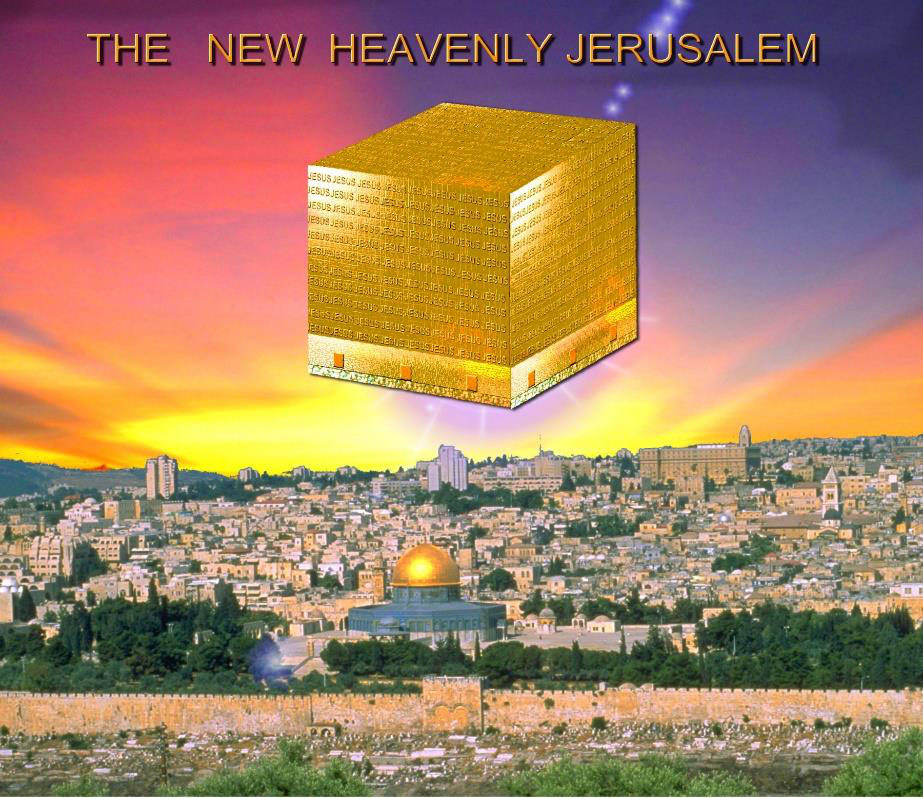
If this view is correct, then the city would have to be temporarily withdrawn when the earth is destroyed at the end of the millennium. After the re-creation or renovation of the earth, the city will apparently descend to the new earth and actually rest on it, since the New Jerusalem is said to have foundations, which implies a firm means of support. Also, the New Jerusalem has twelve gates through which the peoples of the nations will go in and out of the city. The New Jerusalem will be the center of the universe. All light will emanate from it, and all life in the universe will revolve around it.
The Inhabitants of the New Jerusalem
John pictures this magnificent city as a new bride adorned for her husband. Because of the term “bride”, some interpreters feel that only the bride of Christ, the Church, will live in this city. However, we know that Abraham was promised a city, for the writer of the Book of Hebrews tells us, “For he looked for a city which has foundations, whose builder and maker is God...But now they desire a better country, that is, a heavenly one; wherefore, God is not ashamed to be called their God: for He has prepared for them a city.” (Hebrews 11:10, 16).
There can be no question that this promised city is the New Jerusalem. While it may be the bride's city, it also has other permanent inhabitants – the saved of the house of Israel. You will notice that the foundation stones of the city have the twelve apostle's names on them, while the twelve gates are named for the twelve tribes of Israel. These 24 spiritual leaders represent the two main groups who will inhabit this city: they symbolize the foundation and access to the New Jerusalem.
A third group of people will also have access to the city, though their principal place of residence will be the new earth. This group is called the “nations”, which means “peoples”. They will be comprised of believers who didn't happen to be among Israel in the Old Testament or the church in the New Testament. Noah and Job also would be in this group, as well as many of the Old Testament people who knew God and believed in Him and found salvation, but were never part of Israel. All the Gentiles who are saved during the Tribulation will also be in this company of believers.
God Will Wipe Away Our Tears
Rev.21:6 – 7. Just to read the text is a benediction to our souls. It is a comfort to God's saints in our pilgrimage through this weary world. Out of all of the subjects in the Bible, the most difficult to speak on is the subject of heaven.
The vast difficulty in describing heaven is illustrated in the utterances of the men of God who have written the Bible.
For example, the Apostle Paul says, as he describes his celestial experience in 2 Corinthians 12:1-4 that he was taken up into Paradise, into the third heaven, the heaven of heavens where God dwells. Can Paul describe his experience? Does he say what he heard and what he saw? No. All the Apostle says is this: 2 Corinthians 12:1, “It is doubtless not profitable for me to boast. I will come to visions and revelations of the Lord: I know a man in Christ who fourteen years ago – whether in the body I do not know, God knows – such a one was caught up to the third heaven. And I know such a man – whether in the body or out of the body I do not know, God knows – how he was caught up into Paradise and heard inexpressible words, which it is not lawful for a man to utter.” Our spirits, our very minds and souls, cannot imagine it; this creation of God which we will call our heavenly and eternal home.
John here writes “And I heard a great voice out of heaven saying, Behold, the tabernacle [Greek, skene, 'dwelling place'] of God is with men, and he will dwell [Greek, skenoo, 'tabernacle'] with them. The dwelling place, the pavilion, the house of the Lord will be visibly with us. In the days past the Lord tabernacled with us. The Lord dwelt with our parents in the Garden of Eden. He walked with them and visited them. God tabernacled with the patriarchs. He spoke to Abraham as a man would talk to his friend, face to face. The Lord cast His tabernacle among the children of Israel and His presence was seen among them, a pillar of fire by night and a cloud by day. In the days of the temple, the Lord dwelt in the darkness of the Holy of Holies.
In the Gospel of John, 1:14 he says, “And the word was made flesh and dwelt among us” (skenoo), 'tabernacled', the same and identical word used in our text here in Revelation 21:3. The Lord tabernacles today in His Church, and lives in our hearts by the Holy Spirit. But how shall it be and with what words could we describe it, when God Himself shall live in our midst and our eyes shall see Him, our ears shall hear Him and we shall behold the glory and beauty of the Lord God Jehovah.
“And there was no more sea.” What does that mean in this new creation of God? And there was no more sea is to be a symbol of the fact that there will be no more separation.
John was on a lonely island in exile, sent there to die of starvation and exposure. Across the sea were those he loved, the church at Ephesus, all the friends and the saints of the household of faith. The dark sea rolled in- between. In glory, there will be no more exile and no more separation. There is certainly a dark sea that rolls between time and eternity. There is a dark river of death, a flood that rolls between us and our loved ones gone before. But in heaven “there will be no more sea.”
In John's day the sea was a frightful, a fearsome and an awesome monster. They had no compass, for example, and when the cloudy day came, their ships were absolutely lost on the vast bosom of the deep. Their frail barks were subject to destruction before the face of those fearful storms that suddenly arose. The loss of life in the sea was beyond measure, innumerable. To the ancient the sea was a horrible monster, a fearsome enemy. Now no more sea.
John now writes a beautiful thing. “And God shall wipe away all tears from their eyes; and there shall be no more death, neither sorrow, nor crying, neither shall there be any more pain; for the former things are passed away.” As long as we are in this life, tears will be in our eyes. Until we come to the gate of heaven itself, God's people will know how to cry. We may forget how to laugh, but we will never
forget how to cry. Not until we enter the New Jerusalem will God wipe away the tears from our eyes. Our pilgrimage in this world is like the pilgrimage of the children of Israel to the Promised Land. We are delivered in the grace of God from so much of the hurt and trial of the journey, but we are not delivered from the heartaches, diseases and afflictions of this life. Suffering is a common denominator and the experience of all of God's people. Even Jesus wept. He bowed His head in sorrow, in strong crying and tears. It is only there, beyond the pearly gates and the Jasper walls, that the Lord will wipe away our tears.
There is another encouraging thing to be said about this passage. We are not to forget, in our earthly pilgrimage with its burden and trials, its losses and its crosses, that our crying and bereavement yield for God's people a marvelous and heavenly reward on the other side of the river. For example, Paul says in 2 Corinthians 4:17: “For our light affliction, which is but for a moment, is working for us a far more exceeding and eternal weight of glory.” Paul says the things we suffer down here, the agony, the tears, the burden, the heartache and the disappointment of our lives, work for us a far more and exceeding weight of glory. If we are to be like our Lord, we must suffer. Our Lord suffered. He was called a man of sorrows and acquainted with grief. Paul said in 2 Corinthians 1:5 “For as the sufferings of Christ abound in us, so our consolation also abounds by Christ.” Having suffered here, wept here, cried in agony and died here, we shall find heaven as God's release from our bondage of tears and death. Let us follow the text word by word. “And God shall wipe away all tears from their eyes.” The story of this world is a story of bereavement. Jesus wept with Mary and Martha at the tomb of their brother. Here in this earth is misfortune and poverty, as Lazarus was laid at the door of dives (Rich Man). Here in this world of woe is lamentation like the cry of Jeremiah, “Oh that my head were waters, and mine eyes a fountain of tears, that I might weep day and night for the slain of the daughter of my people.” (Jeremiah 9:1). Here are despair, agony, and disappointment. But God purposes some better things for His people. All our tears will be wiped away.
“And there shall be no more death.” Can you conceive of a world without the scythe and the stroke, without the dreadful visit of the pale horseman? A world in which “there shall be no more death”? There is no home without its shadow in the circle of every family, a mother; or a wife or a husband or a daughter or a son or a friend is gone.
There is no flock however watched and tended, But one dead lamb is there! There is no fireside, howsoe'er defended, But has one vacant chair.
- Henry W. Longfellow
“Death is swallowed up in victory. Death, an enemy, the last and the final one, is cast with the false prophet and Satan into the lake of fire.”
When a baby dies, what will the baby be like in heaven? Does the baby grow? Is the baby still a child? There is so much that is not revealed to us, so much of which we are not told. But God has revealed this much, that there are no stonecutters chiseling epitaphs in glory. There are no wreaths on the mansion doors in the sky. There are no
graves on the hillsides of heaven. There are no obituary columns in the newspapers. There are no funeral processions over the streets of gold. The whole creation echoes with the glad and triumphant refrain of God's holy redeemed when they sing, “Death is swallowed up in victory”. “And there shall be no more death.” Death, an enemy, the last and final one, is cast with the false prophet and Satan into the lake of fire. “And there shall be no more sorrow, nor crying, neither there does any more pain.” Sorrow follows us like a shadow. Every heart knows its bitterness. How many pillows at night are wet with the teardrops that this world never sees and will never know, but is known and seen only by our Lord. Sorrow, Sorrow!
W.A. Criswell narrates a story about a preacher who conducted revival meetings in Dallas:
“We had a great preacher in this pulpit. He held a revival meeting here. From the days of my teen-age boyhood I loved that marvelous, wonderful man. While here in the revival, he began telling me about the days of his childhood. He was a mountain boy. His father was killed when he was a little boy. His stepfather was vile and vicious. One day at the breakfast table, the stepfather in anger picked up the plate of biscuits that displeased him and threw the plate into the face of the boy’s mother. He cursed her. He doubled up his fist and beat her. He then strode away from their mountain cabin. The little boy went over to the side of his mother and said, 'Mother, let's leave, let's leave. I don't know how, but I will make a living for you. Mother, let's leave.' The mother replied: 'Son, not so. There has never been a separation in our family, never. And son, I shall not live long. Soon I will be with the Lord Jesus. God will take care of you, my boy.' And according to this intuitive knowing that God revealed to her, she died soon after. The little boy went to live in the city, and according to the prayers of his mother, he was saved there and became the preacher that I loved and admired so much.”
The Heavenly City of God
Rev.21:9-22:5. There should be no chapter division between Revelation 21:27 and 22:1. Revelation 22:1-5 are the concluding verses in chapter 21. Beginning at verse 6 in chapter 22, John writes an epilogue to the book. The visions, however, close at Revelation 22:5. In this last vision, John sees the holy city, New Jerusalem. He describes it first from the outside as he saw it descend out of heaven; then he describes it from the inside as though he entered within the gate of the city.
The dazzling glory of the new city of Jerusalem that is to come down from God out of heaven is beyond man's ability to comprehend. It is pictured in Revelation as the ultimate preparation of God for man's habitation. The same difficulty of comprehension may be observed in the ministry of many missionaries. As they live amid a primitive tribe for a period of time and try to communicate to them scenes of the outside world, the natives look at them in bewilderment. How can one describe an electric stove, television, or telephone to a native who has never seen anything but an open wood fire? Only by comparing the unknown with the known is the missionary able to convey facts of the outside world, or more importantly, the eternal truths of God. Thus it is with us as we try to comprehend the glories God has prepared in the Holy City for them that love Him. He has used terms and descriptions with which we are familiar, to describe the things that are beyond our finite frame of reference.
The New Jerusalem – The Bride of Christ
Inviting John to a high mountain, the angel showed him the Bride, the Lamb's wife. But the Bride is described in the tenth verse as that great city, the holy Jerusalem. This does not suggest that the Bride of Christ is a city. Since Chapter 19 described the marriage of the Lamb to the Bride, we find that the Bride is not a physical city, but the Church. The Holy Spirit here is telling us about that city which the Lord promised His disciples in John 14 when He said, “I go to prepare a place for you”. Now that prepared city is coming to the earth, and the inhabitants of it are the members of the Bride. When this city comes to the earth, it will be a people-filled city – people in their resurrected bodies to dwell with Christ for eternity. That is why this city, which surpasses the splendor of anything comprehended by man, is called the Bride, the Lamb's wife. A city is more than buildings and streets, for these are merely the means of providing for the inhabitants which compose the real city. The Old Testament saints also will be the inhabitants of the city.
The city has 12 gates, and at the gate 12 angels, and names written on the gates, which are the names of the twelve tribes of the children of Israel. Obviously the number twelve takes on great significance in this city. Since the Bible is inspired by God, we can expect, in spite of the various authors and the length of time engaged in its writing, that there would be an unusual, even supernatural continuity in the use of numbers. F.W. Grant, one of the greatest Christians who ever lived after St. Paul, discovered the numerical structure of the scripture.
The Bible numerology points out this thrilling thread of consistency that attests to divine authorship. For example, it is suggested that the number one stands for unity, two for union, three for the trinity; four is the number of the earth (four directions: East, West, North, South, four seasons, etc.), five is the divisional number (five wise and five foolish virgins), six is the number of man. Everything in the Bible that has to do with man seems to be in the realm of six. For instance, “six days shalt thou labor”. The height of an average man is about six feet. The Antichrist uses for his number three sixes, called the number of man. Seven seems to be the perfect number, or God's number. Twelve seems to be the governmental or administrative number. Thus, we find multiples of twelve in the administration of God's universe.
Note the many references of twelve in this picture of the Holy City that will come down from heaven. Twelve gates: twelve entrances will always be open for God's people to have access to the City. Verse 13 indicates there will be three gates on each of the four sides of this gigantic city. Twelve Angels: Again we see the relationship of angels in the eternal order and their work with man. Twelve foundations: The foundation walls will be magnificent beyond comprehension. In verse 19 to 21 they are described as “garnished with all manner of precious stones”.
The various foundations are represented as layers built upon each other, each layer extending around all four sides of the city.
Jasper – gold in appearance but like clear glass in substance, namely glass with a gold cast to it.
Sapphire – a stone similar to a diamond in hardness and blue in color.
Chalcedony – an agate stone from Chalcedon (in Turkey), thought to be sky blue with other colors running through it.
Emerald – introduces a bright green color.
Sardonyx – a red and white stone. Sardius – refers to a common jewel of reddish color, also found in honey color which is considered less valuable. The sardius is used with Jasper in Revelation 4:3 in describing the glory of God on the throne.
Chrysolite – a transparent stone, golden in color, according to the ancient writer Pliny, and therefore somewhat different from the modern pale green Chrysolite stone.
Beryl – is sea green. Topaz – is yellow-green and transparent. Chrysopraus – introduces another shade of green. Jacinth – is a violet color. Amethyst – is commonly purple.
Though the precise colors of these stones in some cases are not certain, the general picture here described by John is one of unmistakable beauty, designed to reflect the glory of God in a spectrum of brilliant color. The light of the city within shining through these various colors in the foundation of the wall topped by the wall itself composed of the crystal-clear Jasper forms a scene of dazzling beauty in keeping with the glory of God and the beauty of His holiness. The city is undoubtedly far more beautiful to the eye than anything man has ever been able to create, and it reflects not only the infinite wisdom and power of God, but also His grace, as extended to the objects of His salvation.
The foundation stones contain the names of the apostles, indicating that the Holy City will contain the redeemed by the blood of Christ, who heard the word through the faithful witnessing of the servants of God in the first century, the apostles. The gates of the city contain the names of the twelve tribes, clearly indicating that they were the vehicles through which the oracles of God were revealed in the Old Testament days, and to whom the Messiah came.
The Size of the City
Rev.21:15-16. The New Jerusalem is shaped foursquare like a cube. The city is 1,380 miles (2220 km) on each face, including height, with a wall 72 yards (66m) thick. It has been calculated that even if only 25 percent of this space were used for dwellings, 20 billion people could be accommodated spaciously. Bible scholars do not agree as to whether this will be a square-shaped or a pyramid shaped city. “And the twelve gates were twelve pearls.” Every gate will be one pearl, large enough to cover the gateway of this huge city. In addition, the streets of the city will be pure gold, as it were, transparent glass, clearly indicating that we will walk on gold. In our mind's eye, gazing at this city with its fantastically beautiful and expensive foundational stones, for foundations, its gigantic pearl gates, and its gold streets, we are impressed with the superiority of this city over anything known to man. Today we use concrete and stone for foundations, scarcely the most beautiful material on earth, but selected because of its durability, supply and low cost. Our streets are made of concrete or blacktop for the same reasons. By comparison, the Holy City of God will be so magnificent that we will literally walk on precious metals that today are used for costly bracelets, necklaces, and rings. The city's foundation will consist of precious stones that today are used for ornaments only, and due to their expense, are very small. This presentation, when taken literally, emphasizes the phenomenal omnipotent power of our God.
Twelve gates were twelve pearls; every single gate was of one pearl. How appropriate! All other precious gems are metals or stones, but a pearl is a gem formed within the oyster – the only one formed by living flesh. The humble oyster receives an irritation or a wound, and around the offending article that has penetrated and hurt it, the oyster builds a pearl. The pearl, we might say, is the answer of the oyster to that which injured it. The glory- land is God's answer, in Christ, to wicked men who crucified heaven's beloved and put Him to open shame. How like God, it is to make the gates of the New Jerusalem of pearl. The saints as they come and go will be forever reminded, as they pass the gates of glory, that access to God's home is only because of Calvary. Think of the size of those gates! Think of the supernatural pearl from which they are made! What gigantic suffering is symbolized by those gates of pearl! Throughout the endless ages we shall be reminded by those pearly gates and the immensity of the sufferings of Christ. Those pearls, hung eternally at the access routes to glory, will remind us forever of one who hung upon a tree and whose answer to those who injured Him was to invite them to share His home.
John then tells us more about the street. He says, “And the street of the city was pure gold, as it were transparent glass.” All the walks and ways of that city will reflect the glory of God. Every step taken, every move made will be a step or a move along a path that brings glory to God.
The Missing Temple
Rev.21:22 There is no need for a temple in heaven. The city itself is a sanctuary. God's presence is there. No need of veils, curtains, ceremonies, rites or altars. No need for explanation, atonement, covenants, arks and intermediaries.
We shall live in the presence of God and shall worship Him immediately and directly. The place could be called Jehovah Shammah, “God is here”. God is present as He was in the Garden of Eden. This is paradise restored and regained. The Lord God is there and we do not need a temple. We shall see Him face to face.
John continues in Revelation 21:23, “The city had no need of the sun or of the moon to shine in it, for the glory of God illuminated it. The Lamb is its light.” The garments of God reflect the glory, the iridescence, the incomparable effusion of beauty, color, splendor and light that stream from His person. His resplendent, radiant and effulgent glory will illuminate the city. When Moses talked with the Lord and came down from the mountainside, his face shone. He had been with God. On the mount of Transfiguration, the face of our Lord became bright above the glory of the sun. When Paul on the road to Damascus met the Lord, above the splendor of that Syrian orb that shone in the sky, he saw the light of the glory of God in the face of Jesus Christ. There is an inherent light and glory in the city because Jesus is there, and the Lamb is its light. All light, hope, and blessings stream from His blessed face. From the first promised blessing in Genesis, to the last benediction in the Revelation, it is Jesus; as He was then, is now, and ever shall be, world without end. Amen.
John now presents a remarkable parallel between what he saw in the Paradise of God, in the beautiful city, and what was described in the first and the second chapters of the Book of Genesis.
