Chapter 21 of 26
Revelation Chapter 20
The Binding of Satan


This chapter is one of the greatest and yet one of the most controversial in the Bible. It continues the chronological history of Jesus Christ’s final judgment immediately after His return to earth.
In Revelation 19 the Antichrist and the False Prophet were cast alive into the Lake of Fire. Then all the armies that followed them were destroyed. And now at the beginning of chapter 20 Satan, the arch-fiend of the universe is finally judged.
There is a certain amount of theological dispute about this chapter, and it centers around a theme mentioned six times in the chapter, namely whether there will be a literal thousand-year period of history during which mortal and immortal men will live in an earthly kingdom ruled by Jesus the Messiah, after his return to earth. This is usually referred to as the Millennium, from the Latin words milli (one thousand) and annum (year).
The real issue at stake is whether God ever promised such an earthly kingdom, and if He did, will He keep His promise literally.
There are more prophecies in the Bible about this kingdom and its significance to the believing Jew than any other theme of prophecy. The heart of the OT prophetic message is the coming of the Messiah to set up an earthly kingdom over which He would rule from the throne of David. The only important detail which the Book of Revelation adds concerning this promised Messianic kingdom is its duration-one thousand years.
Different Views on the Millennium
Eschatology is the theological term for the study of the end times. Is comes from the Greek word eschatos, meaning “last or last things”. Thus, it is for biblical prophecy.
One of the unique features of biblical prophecy is that it has been interpreted by different hermeneutical methods. There are four general views of eschatology that have been proposed within Christian theology.
Futuristic View
The futuristic view holds that prophetic events will be fulfilled in the future at the time of the end. Christ is viewed as coming in the future to establish His kingdom.
Preterist View
The Preterist view holds that prophetic events were actually fulfilled at the time they were written and are now in the
past. Christ is viewed as already having come to destroy Jerusalem (AD 70) and establish His kingdom.
Historical View
The historicist view holds that prophetic events have been continually fulfilled throughout church history. Some may still come to pass in the future as Christ is viewed as continually coming.
Idealist View
The idealist view holds that prophetic events have no specific fulfillment in the past or the future, but are being fulfilled in the present experience of the individual. Christ is viewed as coming within the individual’s own experience.
Within evangelical circles, several schools have thought to have developed around the theme of the millennium or the millennial reign of Christ. The issue at stake among evangelicals has generally involved how one interprets prophecy. Three main schools of thought have been proposed: while most evangelicals are premillennialists in their view of eschatology, a millennial and postmillennial options also exist.
Postmillennial
This school of thought believes that the Millennium (the thousand years of Revelation 20:1-13) is to be interpreted symbolically as synonymous with the church age. Satan’s power is viewed as being bound by the power of the gospel. Postmillennialists believe that during this “Millennium” (Church age) the Church is called upon to conquer unbelief, convert the masses, and govern society by the mandate of biblical law. Only after Christianity succeeds on earth will Christ return and announce that His kingdom has been realized. Post-millennial advocates have included Catholics, puritans, charismatic’s, and Dominionists, who urge believers to take dominion over the earth.
Postmillennialists believe that the world will get better and better through the spread of the gospel, and this will be the millennial age. Then, after the millennium, Christ will take the believers to heaven and condemn those who reject Him. However, this teaching suffered a severe reversal in the past 100 years because of two world wars and numerous regional wars. The world is obviously not getting better and better, even though the gospel has had its widest hearing of any era.
A millennial
A-millennium teaches that there will be no thousand-year reign of Christ on earth and no earthly kingdom of God. According to this view, when Christ returns to earth He will take all the believers out, condemn all the unbelievers, and eternity will begin right then. This is what they believe is meant by the dividing of the sheep (believers) from the goats (unbelievers).
This view tends to allegorize all the prophecies about the promised kingdom. It also teaches that Israel forfeited all that God promised to her because of unbelief, and that the Church will inherit all the promises originally intended for Israel. A-millennialists teach that the Church is the fulfillment of the millennial kingdom, and that Christ presently reigns through the Church in peace and righteousness. This interpretation allegorizes the chaining of Satan in this chapter
and teaches that he was instead bound by Christ at His first coming, so that each time Christ gives a believer victory over temptation, it is a kind of reaffirmation of that binding of Satan. A-millennialism optimistically sees the church moving triumphantly to victory.
Pre-millennialism
The oldest interpretation is called pre-millennialism. This view holds that Christ will literally and bodily return to the earth before the thousand-year kingdom begins. He will set up this kingdom and reign from the throne of David out of a rebuilt city of Jerusalem. At the end of that thousand years He will turn the kingdom over to His Father, at which point it will merge with God’s eternal kingdom.
Premillennialists also believe that God made unconditional promises and covenants with Israel, and that regardless of Israel’s past history of spiritual failures, God will literally fulfill all His promises during this thousand-year kingdom period.
Church-age believers and tribulation believers will also be the recipients of these promises as the adopted sons of Abraham. The apostles and early Christians unanimously expected Jesus to set up the literal, earthly kingdom of God. In Acts 1:6, just before ascending into heaven, the disciples asked Him, “Lord, will you at this time restore the kingdom of Israel”. In His answer, Christ didn’t try to set them straight by telling them there wouldn’t be an earthly kingdom for Israel. He simply told His disciples that it wasn’t for them to know when it would come to pass, for this was something which only the God the Father knew.
In the Lord’s Prayer, Jesus emphasized this anticipated earthly kingdom when He told His followers to pray, “Thy kingdom come”. “Thy will be done on earth as it is in heaven”. His will can’t be done on earth in the same way it is in heaven until all of Christ’s enemies have been put down and Satan hindered from tempting men! One of the major tenets of pre-millennialism is that the earth is getting worse rather than better, and that the kingdom age can’t begin until Christ returns to destroy those who have led the world in its downward spiral.
The premillennial view of eschatology looks forward to the rapture (translation of believers to heaven) as the major prophetic event. The Rapture will end the church age and prepare the way for the tribulation period and the return of Christ. Biblical reference to rapture is given in (1 Thessalonians 4:16-17).
Rev.20:1-3. The angel came down with the key of the “abyss”. Abyss is the actual Greek word; we took the word bodily in to the English language. In Revelation 9, a fallen angel appears with a key to open the abyss and out of it came the terrible plague of locusts that waged war on the earth. This angel came down from heaven with a key to lock up Satan. The angel had in his hand a great chain. In verse 6 of the book of Jude, he writes, “And the angels who did not keep their proper domain, but left their own abode, He has reserved in everlasting chains under darkness for the judgment of the great day”. Whatever kind of a chain it is that God welds by which He holds these evil, black, foul demons in the abyss, it is that kind of a chain that the angel comes to lay upon Satan.
The meaning of Satan’s four names
Satan is described here by four names, the same identical names in the same order by which he is described in
chapter 12 of Revelation. The first two names reflect his personality, and the second two are his actual, personal names. As most of us have two names, so Satan has two personal names. The first two of the four employed here describe his character, his personality: “And he laid hold on that ‘dragon’. The designation ‘dragon’ refers to his bestial leadership of the beast governments of the world. The second designation “that old serpent” refers to his subtle nature. In the beginning, in the Garden of Eden, it was as a serpent that he insinuated himself into the confidence of our first parents and defeated them away from God. The next two designations comprise his personal names. That ancient serpent is “the devil”. There is only one devil. There are many demons. Demons are the agents of Satan. Diabolos, devil, refers to his character as a liar and a murderer. Jesus said he was a liar and a murderer from the beginning. He is Diabolos, an archfiend.
His first name is the same in Hebrew as it is in Greek and also in English. The Hebrew name is transliterated into Greek which in turn is transliterated into English, “Satan”. ‘Satan’ means accuser. He is the one who deceived our first parents. He is the one who brought death into our world. God sent a mighty angel from heaven with a key and a great chain in his hand. The angel shut him up in the bottomless pit.
The difference between “The Abyss and Hell”. Now, where is the abyss? In answering that question we come to a discussion of the whole nether world, the world beyond this present life. The devil is cast into the abyss where he is bound for a thousand years. But after the thousand years, he is loosed for a season, after which he is cast into the lake of fire and brimstone, where the beast and the false prophet are. There he is tormented day and night, world without end and forever. What is the difference between the ‘abyss’ and the ‘lake of fire’? The difference is plainly stated in the revealed word of God. The lake of fire is hell. The abyss is something else. The word “abyss” is used nine times in the NT. It is a Greek word meaning “bottomless pit”. Seven of the nine times it is used in Revelation. One time it is used in Luke 8:31 and one time it is used in Romans 10:7. We get a good idea of what it refers to in Luke 8:31. The passage recounts the story of the Gadarene demoniac who had in him a legion of demons (not devils). He was filled with every vile and unclean thing, as men today are filled with all manner of concupiscence, iniquity, vile, lust, and immoral filth. There was a legion of them that lived in that man and drove him into violence. When the Lord came, those demons recognizing Jesus said, “Lord, don’t send us into the abyss before the time”. There is that word “abyss”. It is a horrible place. It is an imprisonment; it is a place where demons, foul and wicked, are chained by the Lord God. Another time the word is used is in Romans 10:7. We are there warned not to say that the Lord Jesus is to come up from the abyss as if He were one of those demons. All seven times the word is used in the Book of Revelation it has the same meaning; it always refers to a place where fallen angels and where foul and evil spirits are imprisoned by God. That is where Satan is going to be cast, chained, locked and sealed for a thousand years.
But there are other places beyond this life and grave beside the abyss. We read in Revelation 19:20 “Both beast and false prophet were cast alive into the lake of fire. That is the ultimate place where the devil is cast Rev 20:10. That is also the place where the wicked dead are cast (Rev 20:13- 14). Then in the next chapter, Revelation 21:8 “But the
fearful, and unbelieving, and the abominable, and murderers, and whoremongers, and sorcerers, and idolaters, and all liars shall have their part in the lake which burns with fire and brimstone”. Our continuous confusion lies in the translation. It lies in the King James Version, the Authorized Version. They take the word “sheol” and translate it “hell”. They take the word “Hades” and translate it “hell”. In these mistranslations we come to the position where we have no idea of what God has revealed to us of that other world.
The word, “abyss”, the bottomless pit, is a place where God has imprisoned, against the day of judgment, evil, vile, fallen angels and demons, spirits of evil. That is the abyss. Now the word “sheol” is used in OT sixty-five times. Thirty-one times in the Authorized Version it is translated “hell”. Thirty-one times it is translated “the grave”/ Three times it is translated “the pit”. The Greek word “Hades” in the NT is the exact equivalent to “sheol” in the OT. They are identical words. One is the same as the other. The word “Hades” in the NT is used eleven times. Ten times it is translated “hell”. One time it is translated “the grave”. But there is nothing in the words “sheol” or “Hades” that refers to hell, nothing. All that sheol means and all that hades means is the departed, unseen worlds beyond this life. When we die, we enter into Sheol, we enter into hades.
But “hell” is something altogether different. In the OT the word “hell” is “Tophet”; in the NT it is “gehenna”. “Gehenna” is used twelve times in the NT and each time it is properly translated “hell” in the Authorized Version. Gehenna is the valley of Hinnom, outside Jerusalem. In that valley idolaters once burned their children to Moloch, a thing that God despised. God cursed the place. The Jewish people used the valley of Hinnom for the refuse of the city. For centuries, filth, garbage, even the carcasses of animals were thrown into the valley. The fire never died and the worm was never killed and the jackals fought and gnashed one another with their teeth as they ate the refuse cast into the horrible pave.
From this background the word Gehenna was used to describe the everlasting damnation of hell where there is weeping and wailing and gnashing of teeth, where the worm never dies, and the fire is never quenched”. That is hell.
Up to this present moment no soul has ever entered hell. The first ones to be cast into hell are the beast and the false prophet. They are first. The second to be cast into the hell is the devil. The third to be cast into hell are those whose names are not written in the Lamb’s book of life. That is why we have the urgency of preaching the Gospel of the cross. This is the imperative that brought our Lord down into this world. He never came just to preach us better ethics or a finer way to pronounce holy words. He came to die because we are in danger of hell fire.
Satan is loosened after the millennium
After Satan is bound for a thousand years, he must be loosed for a little season. When thousand years are expired, Satan shall be loosed out of his prison. Satan is loosed in order that those who grow up during the millennium, under the perfect and righteous reign of Christ, may have the chance to choose between good and evil, between God and Satan. They have never been tempted. They have never been tried. Everyone who is born during the millennium is going to have an opportunity to choose between God and Satan, between righteousness and unrighteousness. Satan is to be loosed to try them and to tempt them.
But this is the last confederation against God. This is the last deception. This is the last sin. Jesus comes down and takes that Diabolos, the Satan, and He cast him into hell, into
the lake of fire, where the beast and the false prophet are, and there God will judge him. Hell was not made for man, but for the fallen angels. The lost man goes there by choice.
Rev.20:4-5. The vision begins “And I saw thrones and them that sat upon them, and judgment was given unto them”. This is the occasion for the ultimate, final reward God has in store for His saints. “I saw all of them in glory” says John. When Satan is cast into the abyss and when God inaugurates the millennial age, the first vision that John sees is the glorious panorama of all of God’s people rewarded and enthroned. A Christian does not get his crown of reward until the end time. The reason for this is simple. A man does not die when he dies. His influence lives on and on. Therefore, it is only at the end of the age that a reward can be given to him. Thus at the consummation of the ages, John sees all of these gloriously resurrected saints enthroned and rewarded. This is the fulfillment of the promise the Lord gave to His disciples in Matthew 19:28, that they would sit upon thrones judging the twelve tribes of Israel. This is the word of Apostle Paul in 1 Corinthians 6:2, that God’s saints will judge the world. But the apostle goes even further in the next verse to say that God’s saints will judge the angels. This is the promise of our Lord in Revelation 3:21, that we who overcome shall share His throne in heaven. This is the millennial, triumphant age of the enthronement, the exaltation, the glorification, the rewarding of God’s resurrected people.
Here John sees a special and particular group. “And I saw the souls of them that were beheaded for the witness of Jesus and they lived and reigned with Christ a thousand years”. The souls are seen under the altar at the time of the breaking of the fifth seal-the first fruits of those martyred by the beast (Rev 6:9-10).
The third class to be crowned are the tribulation saint themselves. John mentions a great company; “which has not worshipped the beast, neither his image, neither has received his mark upon their foreheads, or in their hands”. These too are crowned. John says they lived and reigned with Christ a thousand years. “But the rest of the dead lived not again until the thousand years were finished. This is the first resurrection”.
It is a strange thing that there is no place in the word of God where the entire vision of the resurrection from the dead is presented. The truth is always revealed in parts, in pieces. First, God says there is such a thing as the resurrection. In Matt 22:23-31 our Lord discussed the doctrine with the Sadducees, who avowed that there is no such thing as a resurrection. Our Lord, in answering a question the Sadducees brought to Him, began with the words, “But as touching the resurrection of the dead ...” Speaking of the resurrection, He avowed that in that perfected state we do not marry nor are given in marriage. We are as the angels in heaven. But the point of discussion centered around the fact that there is a resurrection. Again, in John 11:23, Jesus tells Martha that her brother, Lazarus, shall live again. Martha replied, “I know Lord, that he shall live again in the resurrection, at the last day”. Jesus agreed with that statement. Again, in Act 26:8 the apostle Paul, in the defense of his life before King Agrippa, said to that Jewish monarch: “why should it be thought a thing incredible with you, that God should raise the dead”.
From the scripture, we learn yet another thing about the raising of the body. There is also to be a resurrection of
the lost, of the damned. Daniel 12:2 says, “And many of them that sleep in the dust of the earth shall awake, some to everlasting life, and some to shame and everlasting contempt”. Also read (John 5:28-29) and Acts 24:15.
We learn from the scripture that the resurrection of God’ people is not all at the same time, but comprises in itself a series. The raising of God’s elect is in a succession. In (1 Corinthians 15:20-24) Paul outlines the succession, the series, the companies, the troops, that appear before God in resurrection glory. There are four groups in that tagma order. Tagma is a Greek word for “a series”, or “a succession”, or “a troop”, or “a company”. Paul says that everyone is to be raised in his own succession, in his own order, in his own time. Paul names those companies. One, Christ; two, the first fruits; three, they that are Christ’s at His coming; four, those at the end. Paul is following here a pictorial typology found in the feast of the first fruits.
In Leviticus 23, God names the great convocations of Israel. All of them have a profound spiritual meaning. They are tremendous prophecies. They harbinger sublime events in the life of our Lord. For example, the first feast is the Passover, which represents the death of our Lord. The second one is the feast of unleavened bread, which represents the burial of our Lord, the taking of unleavened bread and hiding it away. The third is the feast of the first fruits. That is the resurrection of our Lord. The next, the fourth one, is the feast of Pentecost. That is the coming of the Holy Spirit. The fifth one is the feast of blowing of the trumpet. That is the harbinger of the return of Christ, the triumphant descent of our Lord. The next feast (the Jews later turned it into a fast) is that of Atonement and that pictures the tribulation and the mourning of the Jewish people when they come back to the Lord and accept their Messiah. The last is the feast of Tabernacles, which is a pictorial representation of the glory and happiness of God’s ultimate and final millennial age.
In those seven feasts, the apostle takes the feast of first fruits to depict the resurrection of our Lord. The feast of First fruits began on Sunday, on the first day after the Sabbath. It began on the first of the week after the Passover. Our Lord was crucified during the Passover. After His death and burial, on the first day of the week He was raised from the grave. Every time we met on Sunday, we celebrate the feast of the first fruits. Every time we gather in God’s house on the first day of the week, we are celebrating the resurrection of our Lord.
The feast of first fruits had three parts. First, on that day, the first day after the Sabbath, on the Sunday after the Passover, the faithful Israelite went out into the barley field and there plucked a handful of the first fruits of the coming harvest to the priest and dedicated it to the Lord. The priest took the offering into the tabernacle and waved it before the Lord. It was a sign; it was a harbinger, of the dedication of the whole harvest promised by the Lord. The first fruits offered unto God were just a handful of the ears of barley. The second part of the harvest came in summer time. It was then that the whole crop was gathered. Finally, at the end of the season, the harvesters gathered the gleanings. So in the dedication of the harvest unto God there was first, the handful of the first fruits, then there was the harvest itself, and finally the gleanings, the picking up of the heads that had been crushed and trampled down in the gathering. Paul uses that imagery and follows it precisely here in the resurrection of the just, in the resurrection of God’s people, in the resurrection of those who are saved. The harvest has a tagma, it has a succession, it has a series. We come before the Lord by troops and in different companies.
The first is Christ, He was the first one raised from the dead. In the scriptures we read of several resuscitations. For example, the dead man who in his burial touched the bones of Elisha and came to life again, was resuscitated. Remember the story of Elisha raising from the dead the son of Shunamite. Remember the story of Lazarus. Remember the story of the daughter of Jairus. But in all of those instances the body was merely revived. The body later and ultimately went back into the dust of the ground. They died. They were not immortalized. They were not resurrected. The first to be resurrected from the dead was our Lord Jesus Christ.
Paul says next in order is the first fruits, the little handful, the little company who are brought before the Lord as an earnest of the great harvest that is yet to be dedicated, to be raised. Let us see the order of resurrection by Paul. We are to look for a little harvest, a little first fruits, the earnest of a few heads of grain to be waved before the Lord. Matt 27:51-53. Read from the NKJV. Paul said Christ was first, then the first fruits, the little handful. When the Lord entered into heaven, raised from the dead, He did not go by Himself. He had a little company with Him. They were the first fruits. They are a harbinger, they are an earnest, they are a guarantee, they are a promise of the great harvest that is yet to come. Paul speaks of that. He says “Every man in his tagma. Christ is first, the first one raised from the dead.
Then Paul names the third group. “Afterward they that are Christ’s at his coming.” That is the rapture, the taking out of God’s people from the world when the Lord comes. (1 Thessalonians 4:16). That is the great harvest, when the Lord comes for His own. We shall comprise the great, main body of the harvest of the resurrection. Paul says “Then the end”. So we have some ‘end’ ones just as it was after the harvest, then the gleanings. The resurrection of those saved during the time of the tribulation will be the gleanings.
Why is there no salvation for the fallen angels? There is an essential difference between the sin of a human being and the sin of Lucifer and the fallen angels. Each angel chose to sin; we were born in sin. There is no salvation for them, however there is for us.
Rev 20:4-6. Rev 20:4 reads, “And I saw thrones, and they sat on them, and judgment was committed to them”. This refers to the glorified, resurrected host of God’s sainted people. Then John continues in the verse as he describes another group of those who had been beheaded for their witness to Jesus and for the word of God, who had not worshipped the beast or his image, and had not received his mark on their foreheads of on their hands. And they lived and reigned with Christ for a thousand years. But the rest of the dead did not live again until the thousand years were finished. This is the first resurrection. The verses that immediately follow describes the deception by Satan with the announcement that, “when the thousand years have expired, Satan will be released from his prison”. The result of this loosing is seen in the gathering together of Satan’s dupes against the Lord God. But they are immediately destroyed by fire from heaven, and the devil that deceived them is cast into the lake of fire, where the beast and the false prophet are, to be tormented day and night for ever and ever. Then follows the revelation of the Great White throne judgment. This is followed by the ultimate and eternal kingdom of our Lord and the new city in which His people will dwell in blessedness, in holiness, in righteousness, forever.
The dream of the golden age
As long as the human race has lived, there has been the dream of a “golden age”. It is found in the literature of all the cultures of the world. Ancient writers have fabricated a story about an age where a good king ruled their land and everyone was prosperous. They create a mythical story about a mythical ruler. The story narrates how paradise was lost, and celebrates the good old days. But none has a concept about the future paradise. We find it recurring again and again in the literature of the ancient Egyptians, Babylonians, Chaldeans, Persians, Medes, Greeks, Romans, and in ancient Hindu mythology and
the mythology of “Onam” celebration in Kerala. Prophet after prophet, apostle after apostle, book after book records of a golden age.
There is more said in the prophetic scriptures regarding this millennial age than of any other subject in the prophecies themselves. For example, in the book of Daniel, when Daniel saw the course of world history in the likeness of an image, he saw last of all a stone cut without hands that broke in pieces- that vast image and the stone grew to fill the whole earth. Then Daniel interprets it. (Dan 2:44-45). There is a kingdom coming that will be established by the intervention of the Lord God himself. Daniel 7:13-14 also describes the eternal kingdom of God. The preaching of the apostles is not different from the visions of the prophets. Simon Peter declared this age in Acts 3:14-21. Again in chapter 11 of the book of Revelation, the seventh angel sounded, and by anticipation he announces the coming of the kingdom (Rev 11:15). There has never been a time when God has not purposed this for us; namely, that we, with our Lord, shall reign in holiness, in glory and in triumph on this earth. In chapter 20 of the book of Revelation that glorious millennial has come to pass. This is its reality.
The millennium is a time period. Several of the time words in the English language come from the Latin. “Millennium” is just another one of those several time words. The Greek word for the “hour” is hora, and when it comes into English we pronounce it “hour”. The Latin word for year is “annus”. Our ‘annual’ is derived from that Latin word referring to a year. The Latin word for one hundred is centum; our word century comes from the word “hundred”. The English word “millennium” comes from two Latin words mille, which is a thousand and annum, which is a year. So, the millennium is a thousand-year period. The Millennium begins when Satan is bound after the great Battle of Armageddon, and it ends after a thousand years when Satan is loosed for a little season. It is a new age; it is a new order. There are many things concerning it that we cannot understand and there is no need to try. We cannot conceive of a world without sin, where Satan is bound, where righteousness reigns. These things to us are beyond experience, because we have never known a world that was not overgrown with sin, our lives have never known a time when we did not battle against iniquity. Weeping, crying, bereavement, separation, despair, these are common lot of every life. But in the Golden Age these shall be taken away.
Who enter the millennium?
No one will enter the millennium as a sinner. All who enter that holy and heavenly era will be saved, washed by the blood of the Lamb. The saints alone inherit the kingdom. For example, Daniel 7:18 says “But the saints of the most High shall take the kingdom, and possess the kingdom forever and
ever”. Daniel says again in verse 22 “The time came that the saints possessed the kingdom”. And he repeats in verse 27 the same fact.
The judgment preceding the millennium
In preparation for the Golden Age, there are two great judgments the people on this earth will go through. First, Israel will go through a judgment. God’s chosen people who now live in unbelief and who gather in their services in rejection of Christ will go through a judgment. No Israelite who refused the Lord Christ will ever enter the millennium. In chapter 20 of the Book of Ezekiel, there is described the judgment that Israel will go through. Ezekiel 20:33-38. As a shepherd places his rod, his staff, over the door of the sheepfold and as the sheep go through, one by one, he calls their names so the Lord says that He will bring all of Israel into the wilderness and plead with them there in the wilderness, causing them to pass under the rod, judging them one by one. There will be no rebel spared and there will be none left that transgress against the Lord. There will be no rejecter or unbeliever who will enter into the land. This is the great judgment of Israel before the days of the millennium.
There is also judgment of the Gentiles. No Gentile will enter the millennial kingdom of God who is not saved, born again, converted. The judgment of the Gentiles is described in Matthew 25:31-46. No one will enter that kingdom who is not saved, washed clean and white in the blood of the crucified one.
The millennial kingdom is not temporary. It is finally merged into the great, final kingdom of the Lord God Almighty in the eternities of the eternities. There is perpetuity of that kingdom that lasts forever and forever.
Daniel even multiplies the forever. It is an everlasting kingdom and our Lord has in it an everlasting dominion. That is confirmed by the Apostle Paul in (1 Corinthians 15:14-28).
The Blessings of the millennial kingdom
First of all, let us consider the elect of God, the people of Israel. They are to be restored to their home and to their land. Amos 9:14-15 (Isa 43: 1-7; Jeremiah 24:6-7; Ezekiel 28:25-26; Zephaniah 3:20). God says His people are going to be given Palestine for an inheritance forever and no one shall ever take it from them. Not only is Israel to be restored to the land, but they are to be converted, they are to accept the Lord Christ as their Savior and their Messiah. Read (Jeremiah 23:3-8). The number of passages that could be read are many. Here are some more verses: Isaiah 4:3-6; Jeremiah 31:31-34; 32: 36-41; Ezekiel 11:18-20; 12:10-14; 13:1, 8, 9; 16: 60-63; 21:10-14; 13:1, 8, 9; 16:60-63; 21:40-44; 36:24-28; 37:26). Beside all these there is another tremendous passage from Paul in Romans 11:21-29.
After stating that, “Blindness in part has happened to Israel, until the fullness of the Gentiles becomes in”, the apostle continues: But there is a time when “all Israel shall be saved. God made some great promises to Abraham, to Isaac, to Jacob, to David, through his holy prophets. He made an Abrahamic covenant with them; He made a Davidic covenant with them; He made a Palestinian covenant with them; He made a covenant of a “new heart” with them, and God does not change. Man may change. Man can forget what God has promised. Every promise that God has made to Israel God will faithfully keep. When Israel is converted, the Jews will mourn over their rejection of their Savior, and God will provide a
healing fountain for their sins, in which they will be forgiven and will be saved. As there are blessings for Israel, so there are blessings for the Gentiles also. (Isaiah 2:2-4). Read Isaiah 19:23-25. Can you imagine things like that? Think of the hatred of Arabs and Muslims toward the Jews.
All creation will be blessed in the millennium
In that millennium kingdom there is to be a new creation. There are blessings for the whole universe. One of the most sublime and meaningful of all of the passages in the word of God is in Romans 8. Listen to Paul as he describes what God is going to do. (Rom 8:19-23). The prophecies of all OT confirm this passage from Paul. Isaiah 11:6-9 speaks of the change in the animal kingdom.
God never intended the balance of nature to be now as we have it in this world. God never intended for animals to eat one another, to lie in wait, to destroy, to drink blood. This is a mark of sin in the world. God never intended one man to kill another man, much less for one nation to go to war and slay millions of his fellow men. The Lord made His creation to be filled with light, goodness, glory, holiness, love and happiness. But all that we lost in Eden, God will give us back again in the new creation. Think of a day when the wolf and the lamb, the leopard and the kid, the lion and the fatling will lie down together? When that vicious, ferocious, carnivorous lion is a vegetarian! He will eat straw like an ox. Isaiah 35:5-6 says “Then the eyes of the blind shall be opened and the ears of the deaf shall be unstopped”. The curse of Genesis 3:17-19 is removed. Compare Isaiah 35:1-2; 55:13). Sickness, sorrow, sighing and crying is no more.
As there are blessings in the millennium for God’s chosen people, Israel, there are also blessings in the millennial kingdom for Gentiles, as well as for all God’s creation. Zechariah 14:4-9: This is what God has promised for His Son. “He shall be King over all the earth”. This is what God has promised for His Son. “He shall be King over all the earth”. In Luke 1:32 the angel Gabriel said to Mary “And behold, you will conceive in your womb and bring forth a son, and shall call His name Jesus. He will be great, and will be called the Son of the Highest; and the Lord God will give Him the throne of His father David. And He will reign over the house of Jacob forever, and of His kingdom there will be no end.” This is the ultimate and final glory that Paul describes for our Lord in Philippians 2:6-11. And that glorious consummation is seen in the Revelation, the unveiling of Jesus the Christ, the rightful Ruler of the universe. (Also Revelation 11:15.) In 2 Corinthians 4:4 Paul says that “Satan is the god of this world”. Surely the Devil is a usurper God never intended it to be like that. But Satan shall be cast out and the rightful King- our living, Lord shall ascend the throne.
Throughout the millennium, righteousness has reigned. The golden age began with a population on earth of soundly saved people, filled with the Spirit, living according to the precepts of the Sermon on the Mount. But as the ages come and go, countless children are born, disease will be banished, and death will be exceedingly rare. Children born during this age will be born with sinful natures, needing to be saved, just as today. Children of believing parents today sometimes become gospel-hardened; so, during the millennium many will become glory- hardened. They will submit to Christ’s rule and to the stern laws of the Kingdom because to rebel will mean instant punishment. During the millennium many will render only feigned obedience. Sin will
reign in secret in their hearts, and they will long for a time when the strict rules will be relaxed. The Devil will find fertile soil in their souls.
Throughout millennium the nations will come up to Jerusalem to worship. During the golden age, the memory of Russia’s disaster will linger on, and Gog and Magog will lend their names symbolically to the dissidents of earth. Satan will seek them out and will find them only too willing to listen to his lies.
During the millennial reign of Christ, Israel as a nation will fulfill the function for which they were originally set apart by God. They will become a kingdom of Priests (Exodus 19:6) who are intermediaries between those who need to be saved, and the king who provides salvation. They will become as they were originally appointed to be, God’s lights to the world. Those born in the millennium who need salvation will approach the Savior through Israel. (Zechariah 8:20-23.) Salvation during that period will be provided through the benefits of the death of the Passover Lamb. That is why the Passover will be observed throughout the Millennial Age, as a memorial of the death of Christ (Ezekiel 45:21); and why blood sacrifices will be offered in the millennial temple as memorials of the death of Christ (Ezekiel 43:19-27). Jews living in the millennium will live in perfect obedience to the law of the king. This will be possible because the redeemed will enter into the fulfillment of the promise of Joel 2:3-8 and Ezekiel 36: 26-27, and the indwelling spirit will empower them to obedience. In addition, there will be a universal knowledge of the demands the king made to those who would walk in obedience to His law. (Jeremiah 31:34). What the king demands will not be written on external tablets as was the Law of Moses. Instead it will be inscribed on their hearts. (Jeremiah 31:33). The outbreak of sin will be punished by immediate death. (Isa 11:4). Rebellion against the authority of the king will be immediately judged.
(Zechariah 14:16-19).
All those born during the millennial kingdom will have the opportunity to receive the salvation that the king has provided, and because of fear of judgment and respect for the power of the king they will outwardly live in conformity to His law.
Since Satan will be removed during Messiah’s millennial reign, there will be no one to entice them to an organized rebellion. Thus at the conclusion of the Lord’s earthly reign, it will be necessary to test those who have lived during this period. For that reason, Satan must be set free for a short time (Rev 20:3).
The subjects of the millennial rule of Christ at the beginning of the millennium will consist of those who survive the searching judgments of both Israel and Gentiles as the millennial reign of Christ begins. From many Scriptures it may be gathered that all the wicked will be put to death after the second coming of Christ, and only saints who have lived through the preceding time of trouble will be eligible for entrance into the millennial kingdom. This is demonstrated in the judgment of the Gentiles in Matt 25:31-46, where only the righteous are permitted to enter the millennium. According to Ezekiel 20:33-38, God will also deal with Israel and purge out all rebels, that is, unbelievers, permitting only the saints among Israel. The parables of the wheat and the tares (Matt 13:30-31) and of the good and bad fish (Matt 13:49-50) teach likewise that only the wheat and the good fish, representing the righteous will survive the judgment.
The millennial kingdom will display the fullness of the Holy Spirit. At the institution of the theocratic kingdom the prophecy of Joel will be fulfilled. Joel 2:28-29.
The prophecies picturing the millennium unite in their testimony that the work of the Holy Spirit in believers will be more abundant, and have greater manifestation in the millennium than in any previous dispensation. It is evident from the Scriptures that all believers will be indwelt by the Holy Spirit in the millennium even as they are in the present age (Ezekiel 36:27; 37:14, Jeremiah 31:33).
The fact of the indwelling presence of the Holy Spirit is revealed as part of the glorious restoration of Israel depicted in Ezekiel 36:24. In Ezekiel 37:14, it is stated, “And I will put my Spirit in you, and you shall live, and I will place you in your own land. The filling of the Holy Spirit will be common in the millennium, in contrast to the infrequency of it in other ages, and it will be manifested in worship and praise of the Lord and in willing obedience to Him as well as in spiritual power and inner transformation Isa 32:15; 44:3, Ezekiel 39:29, Joel 2:28-29.
In contrast to present day spiritual apathy, coldness, worldliness, there will be spiritual fervor, a love of God, holy joy, universal understanding of spiritual truth, and a wonderful fellowship of the saints. The emphasis will be on righteousness in life and on joy of the spirit.
The remarkable, astounding, outpouring of the Holy Spirit as presented in the millennial descriptions are so powerful in its transforming, glorifying and imparting miraculous gifts to the saints; so pervading in and over the Jewish nation that all shall be righteous from the least to the greatest; so wide-reaching over the Gentiles that they shall rejoice in the light bestowed; and so extended in its operation that the whole earth shall ultimately be covered with glory- this, with the magnificent portrayal of the millennial and succeeding ages, is so sublime with the indwelling, abiding, communicated divine, that no one can contemplate it, without being profoundly moved at the display of spirituality.
It must, thus, be observed that the outstanding characterization of the millennium is its spiritual nature. An earthly kingdom, to be sure, but spiritual as to its character.
Conditions Existing within the Millennium
Peace: The cessation of war through the unification of the kingdoms of the world under the reign of Christ, together with the resultant economic prosperity, since nations need not devote vast proportions of their expenditure on weapons, is a major theme of the prophets. Isaiah 2:4; 9:4-7; 11:6-9; 32:17-18; 33:5-6; 54:13; 55:12; 60:18; 65:25; 66:12. Ezekiel 28:26; 34:25, 28; Hosea 2:18; Micha 4:2-3, Zech 9:10.
The fullness of joy will be a distinctive mark of the age. Isa 9”3-4; 12:3-6; 14:7-8.
Holiness: The theocratic kingdom will be a holy kingdom, in which holiness is manifested through the king and the king’s subjects. The land will be holy; the city holy, the temple holy, and the subjects holy unto the Lord. Isa 1:26-27; 4:3-4; 29:18- 23, Joel 3:21, Zephaniah 3:11.
Full Knowledge: Because of the fact that Christ is in the world and ruling over all nations, the millennium is characterized as a time in which the truth of God is widespread. Isaiah writes,
for instance “The earth shall be full of the knowledge of Jehovah as the waters cover the sea (Isa 11:9).
The removal of the curse placed upon creation (Gen 3:17-19) will be removed, so that there will be abundant productivity to the earth. Animal creation will be changed so as to lose its venom and ferocity. (Isa 11:6-9, 35:9; 65:25).
Sickness removed: The ministry of the king as a healer will be seen throughout the age, so that sickness and even death, except as a penal measure in dealing with overt sin, will be removed. (Isa 33:24; Jeremiah 30:17; Ezekiel 34:16).
Healing of the deformed: Accompanying this ministry will be healing of all deformity at the inception of the millennium. (Isa 29:17-19; 35:3-6; 61:1-2; Jeremiah 31:8; Micah 4:6-7; Zephaniah 3:19)
No immaturity: The suggestion seems to be that there will not be the tragedies of feeble- mindedness nor of dwarfed bodies in that day. (Isa 14:3-6; 42:6-7; 49:8-9; Zech 9:11-12).
Reproduction: The living saints who go into the millennium in their natural bodies will beget children throughout the age (Not the saints of the Church age. Church age saints will have a body like Jesus). The earth’s population will soar. Those born in the age will not be born without a sin nature, so salvation will be required. Jeremiah 30:20; 31:29; Ezekiel 47:22; Zech 10:8.
Labor: The period will not be characterized by idleness, but there will be a perfect economic system, in which the needs of men are abundantly provided for by labor in that system, under the guidance of the king. There will be a fully developed industrialized society providing for the needs of the king’s subjects. Isa 62:8-9; 65:21-23; Jeremiah 31:5; Ezekiel 48:18-19. Agriculture, as well as manufacturing, will provide employment. The perfect labor situation will produce economic abundance, so that there will be no want. Isa 4:1; 35:1-2; 30:23-25; 62:8-9; 65:21-23; Jeremiah 31:5, 12; Ezek 34:26; Micah 4:1, 4; Zech 8:11-12; 9: 16-17; Ezek 36:29-30; Joel 2:21-27; Amos 9:13-14.
Increase of Light: There will be an increase of solar and lunar light in this age. This increased light probably is a major cause in the increased productivity of the earth. Isa 4:5; 30:26; 60:19-20; Zech 2:5.
Unified Language: The language barriers will be removed so that there can be free social interaction (Zephaniah 3:9).
Unified Worship: All the world will unite in the worship of God and God’s messiah. Isa 45:23; 52:1, 7-10; 66:17-23; Zech 13:2; 14:16; 8:23; 9:7; Zephaniah 3:9; Mal 1:11; Rev 5:9-11.
The fullness of the spirit’s divine presence and enablement will be the experience of all who are in subjection to the authority of the king. Isa 32:13-15; 41:1; 44:3; 59:19, 21; 61:1; Ezekiel 36:26-27; 37:14; 39:29; Joel 2:28-29; Ezekiel 11:19-20.
The duration of the Millennium:
The duration of the millennium is 1000 years (Rev 20:1-6). It is generally held, even by those denying the literalness of the thousand-year period, that the angel, heaven, the pit, Satan, the nations and the resurrections mentioned in this chapter are all literal. It would be folly to accept the literalness of those and deny the literalness of the time element. Most of Christendom spiritualizes this chapter according to their whims. Six times in this passage it is stated that Christ’s millennial kingdom will continue for a thousand years. An important section is 1 Corinthians 15:24-28. In
these words, the apostle is stating the ultimate purpose of the theocratic kingdom, that God may be all in all”. This envisions the absolute accomplishment of the original purpose in the establishment of the theocratic kingdom, “prepared before the foundation of the world”. (Matt 25:34). The father has put all things under Christ’s feet. And when all things are ultimately subjected unto Christ, then shall the Son also himself be subject unto the Father, who put all things under Christ that God may be all in all”. God’s original purpose was to manifest His absolute authority, and this purpose is realized when Christ unites the earthly theocracy with the eternal kingdom of God.
Concerning the question of the surrender of authority by the son to the Father, Chafer says, “The delivery to God of a now unmarred kingdom does not imply the release of the son. The truth asserted in 1 Corinthians 15:27- 28 is that at last the kingdom is fully restored – the kingdom of God to God. The distinction to be noted lies between the presentation to the Father of a restored authority and the supposed abrogation of a throne on the part of the son.” In the eternal state, Jesus Christ will go on ruling under that same authority of the Father's as subject as ever to the First Person. At the end of the millennium, Christ will hand over the mediatorial kingdom to God, to be merged into the eternal kingdom, so that the mediatorial kingdom is perpetuated forever, but no longer having a separate identity. (1 Corinthians 15:24-28). He shares the throne with the Father in the final Kingdom. (Revelation 22:3-5).
The Government in the Millennium
The government will be a theocracy. The Messiah is the King in the millennium. The New Testament records firmly establishes Christ's right to assume the Davidic throne.
David's role in the millennium. David is regent in the millennium. (Isaiah 55:3-4; Jeremiah 30:9; 33:15,17, 20-21; Ezekiel 34:23-24; 37:24-25; Hosea 3:5; Amos 9:11)
The Subjects in the Millennium. The earthly theocratic kingdom, instituted by the Lord Jesus Christ at His second advent, will include all the saved of Israel and the saved of the Gentiles, who are living at the time of His return.
Jerusalem and Palestine in the Millennium. Because the covenants made with Israel guaranteed them the possession of the land, which is fully realized in the millennial age, Palestine and Jerusalem figure largely in the prophetic scriptures.
Jerusalem in the Millennium. Jerusalem will become the center of the Millennial earth. (Isaiah 2:2-4; Jer. 31:6; Micah 4:1; Zechariah 2:10-11). Because the world is under the dominion of Israel's king, the center of Palestine becomes the center of the entire earth.
Palestine in the Millennium
Palestine will become the particular inheritance of Israel. (Ezek. 36:8, 12; 47:22-23;
Zech. 8:12). The land will be greatly enlarged in comparison to its former area. (Isa. 26:15; 33:17; Obadiah 17-21; Mich. 7:14). For the first time, Israel will possess all the land promised to Abraham: (Gen. 15:18-21). The topography of the land will be altered (Isa. 33:10-11; Ezek. 47:1-12; Joel 3:18; Zech. 4:7; 14:4, 8, 10). Instead of the mountainous terrain which characterizes Palestine today, a great fertile plain will come into existence at the second advent of the Messiah (Zech. 14:4), so that Palestine will truly be beautiful for the situation. (Ps. 48:2). This changed topography will permit the river to flow out from the city of Jerusalem and
divide to the seas to water the land. (Ezek. 47:1-12). There will be renewed fertility and productivity in the land. (Isa. 29:17; 32:15; 35:1-7; 51:3; 55:13; 62:8-9; Jer. 31:27-28; Ezek. 34:27, 36:29-35; Joel 3:18; Amos 9:13). Then the plowman will overtake the reaper because of the productivity of the land. There will be an abundance of rainfall. (Isa. 30:23-24). Throughout the Old Testament the rain was a sign of God's blessing and approval and the absence of rain a sign of God's disapproval and judgment. The land will be reconstructed after being ravaged during the tribulation period. (Isa. 32:16- 18; 49:19; 61:4-5; Ezek. 36:33-38; 39:9; Amos 9:14-15). The remnants of destruction will be removed that the earth may be clean again. Palestine will be redistributed among the twelve tribes of Israel. In Ezekiel 48:1-29 this redistribution is outlined. In that chapter the land is seen to be divided into three portions. In the northern portion land is apportioned to the tribe of Dan, Asher, Naphtali, Manasseh, Ephraim, Reuben and Judah.
(Ezek. 48:1-7). The land seems to be divided by a line running from east to west all across the enlarged dimensions of Palestine. In like manner in the southern portion land is allotted to Benjamin, Simeon, Issachar, Zebulon, and Gad. Ezek. 48:23-27. Between the northern and southern divisions is an area known as the “holy oblation” (Ezek. 48:8- 20), that is, that portion of the land which is set apart for the Lord. This is to be an area twenty-five thousand reeds long and wide (Ezek. 48:8-20), to be divided into one area 25,000 by 10,000 reeds for the Levites (Ezek. 45:5; 48:13-14), the same area for the temple and the priests (Ezek. 45:6; 48:15- 19). The reed would be 72 feet. The holy oblation would be a spacious square, 34 miles each way, containing about 1100 square miles.
The Temple in the Millennium
A large portion of the prophecy of Ezekiel 40 (v. 1-46; 24) is devoted to the temple, its structure, its priesthood, its ritual, and its ministry. Arno C. Gaebelein states, “The temple which the remnant built does in no way whatever corresponds with the magnificent structure which Ezekiel beheld in his vision. The fact is if this temple is a literal building (as it assuredly is); it has never yet been erected. Furthermore, it is distinctly stated that the glory of the Lord returned to the temple and made His dwelling place there, the same glory which Ezekiel beheld departing from the temple and from Jerusalem. But the glory did not return to the second temple. No glory cloud filled that house. And furthermore no high priest is mentioned in the worship of the temple Ezekiel describes, but the Jews after their return from Babylon had high priests again. Nor can the stream of healing waters flowing from the temple as seen by Ezekiel be in anyway applied to the restoration from the Babylonian captivity.”
Some think this temple in Ezekiel symbolizes the spiritual blessings of the Church in the present age. But the true interpretation is the literal one which looks upon these chapters as a prophecy, yet unfulfilled, when Israel has been restored by the shepherd and when His glory is once more manifested in the midst of His people. The great building seen in his prophetic vision will then come into existence and all will be accomplished. Merrill F. Unger stated “Ezekiel's temple is a literal future sanctuary to be constructed in Palestine as outlined during the millennium.” And he continues, “The temple itself would be located in the middle of this square (the holy oblation and not in the city of Jerusalem), upon a very high mountain, which will be miraculously made ready for that purpose when the temple
is to be erected. This shall be 'the mountain of Jehovah's house,' established upon the 'top of the mountain and exalted above the hills,' into which all nations shall flow. (Isa. 2:4; Mich. 4:1-4; Ezek. 37:26). Ezekiel gives the picture in chapter 37, verse 27: 'my tabernacle also shall be with (“over or above”) them.' The prophet sees the magnificent structure on a grand elevation commanding a superb view of all the surrounding country.” In Ezekiel chapter 40 to 43 we can see the details of the temple. The extensive description of the throne is given in the prophecy (43:7-12), which is seen to be the very seat of authority.
Will there be Literal Sacrifices in the Millennium?
One of the problems accompanying the literal interpretation of the Old Testament presentation of the millennium is the problem surrounding the interpretation of such passages as Ezek. 43:18 – 46:24; Zech. 14:16; Isa. 56:6-8; 66:21; Jer. 33:15-18 and Ezek. 20:40-41, all of which teach the restoration of a priesthood and the reinstitution of a bloody sacrificial system during that age. An alleged inconsistency between this interpretation and the teaching of the New Testament concerning the finished work of Christ, which brought about the abolition of the Old Testament sacrificial system, has been used by the Amillennialists to reduce the premillennial system to an absurdity and to affirm the fallacy of the literal method of interpretation. The problem that confronts the premillennialists is the necessity of reconciling the teaching of the Old Testament that bloody sacrifices will be offered in the millennium with the New Testament doctrine of the abolition of the sacrifices of the Old Testament order because of the sacrifice of Christ. If a consistent literalism leads to the adoptions of literal sacrifices during the millennium, it becomes necessary to give reason why such a system should be re- instituted.
Is the Mosaic order re-established? A question which faces the advocate of animal sacrifice during the millennial age is that of the relationship existing between the former mosaic system and the system operative in the millennium. An opponent of premillennialism Oswald T. Allis says, “The crux of the whole question is undoubtedly the restoration of the Levitical ritual of sacrifice. This is referred to or implied a number of times. In Ezekiel, burnt offerings are mentioned. The bullocks, the he-goat, the ram are to be offered. The blood is to be sprinkled on the altar. The priests, who are Levites of the seed of Zadok, are to officiate. Literally interpreted, this means the restoration of the Aaronic priesthood and of the Mosaic ritual of sacrifices essentially unchanged.” He states further: “Since the pictures of the millennium are found by Dispensationalists in the Old Testament Kingdom prophecies and are, consequently, marked by Jewish in character, it follows that the question of the re-establishment of the Mosaic economy, its institutions and ordinances, must be faced by them.” J. Dwight Pentecost aptly replies: “There is one grave error in his observation and conclusion. The kingdom expectation is based on the Abrahamic covenant, but is in no way based on the Mosaic covenant. It is insisted that the covenants will be fulfilled in the kingdom age. This does not, however, link the Mosaic covenant with the kingdom necessarily. It is therefore fallacious to reason that because one believes in the fulfillment of the determinative covenants, he must also believe in the restoration of the Mosaic order, which was a conditional covenant, non-determinative and non-eschatological in intent, but given rather to govern the life of the people in their relation to God in the old economy. One
great stumbling block that hinders the acceptance of literal sacrifices in the millennium is removed by observing that, while there are many similarities between the Aaronic and millennial systems, there are also many differences between them that make it impossible that they should be equated.
- There are certain similarities between the Aaronic
and millennial systems. In the millennial system we find the worship centers in an altar on which blood is sprinkled
(Ezekiel 43:13-18) and on which are offered burnt offerings, sin offerings, and trespass offerings (40:39). There is the reinstitution of a Levitical order in that the sons of Zadok are set aside for a priestly ministry (43:19). There are prescribed rituals of cleansing for the altar (43:20-27), for the Levites who minister (44:25-27), and for the sanctuary (45:18). There will be the observance of new moon and Sabbath days (46:1), morning sacrifices will be offered daily (46:13), perpetual inheritances will be recognized (46:10-18), the Passover feast will be observed again (45:21-25), and the feast of Tabernacles becomes an annual event (45:25). The year of Jubilee is observed (46:17). There is a similarity in the regulations given to govern the manner of life, the dress, and the sustenance of the priestly order (44:15-31). It can thus be seen that the form of worship in the millennium will bear a strong similarity to the old Aaronic order.
The very fact that God has instituted an order strangely like the old Aaronic order is one of the best arguments that the millennium is not being fulfilled in the Church, composed of Gentile and Jew, in the present age. That this worship was particularly planned for a redeemed Israel is well observed by William Kelly, who writes:
“Israel shall yet return to the land, and be converted indeed, and blessed, under Jehovah their God, but as Israel, not as Christians, which all believers do become meanwhile, whether Jews or Gentiles. They belong to Christ in heaven, where such differences are unknown, and therefore one of the great characteristics of Christianity is that such distinctions disappear while Christ is head on high, and His body is being formed on earth by the Holy Ghost sent down from heaven. When Ezekiel's visions shall be accomplished, it will be the reign of Jehovah Jesus of earth, and the distinction of Israel from the Gentiles will again be resumed, though for blessing under the new covenant, not as of old for curse under the law... The heavenly people rest upon one sacrifice, and draw near into the holiest of all, where Christ is at the right hand of God. But the earthly people will have a sanctuary as well as land suited to them, and such are all the ordinances of their worship.”
it is the argument of the book of Hebrews that Israel sought access to God in the old economy through the order or arrangement of the Aaronic priesthood, but that we are brought to God through Christ as He ministered in a new order or arrangement, the Melchizedek priesthood. It is particularly emphasized in Hebrews 7:15 that Christ came to minister in a new order of the priesthood. The requirements or rituals of the two orders need not vary appreciably for them to be two different orders. Since both these orders point to Christ, it would be expected that similarities should exist.
- There are many basic differences between the
Aaronic and millennial systems. The significance is not in the similarities, but rather in the marked differences between the two systems. The millennial system is marked by omissions
from the Aaronic order that make the two systems so different.
a) First of all, there are changes in the millennial order. Nathaniel West states the differences: “There are changes in the dimensions of the Temple so that it is neither the temple of Solomon, nor that of Zerubbabel, nor that of Herod; changes in the measures of the outer court, the gates, the walls, the grounds, and the locality of the temple itself, raised on a high mountain, and even separate from the city. The Holy places have hardly anything like the furniture that stood in the Tabernacle of Moses or the Temple of Solomon.”
This change in the physical temple and its environs is so marked that it is necessary for Ezekiel to give detailed descriptions of it. One of the major changes to be observed is in the relation of the Levites to this order. In a number of passages, the existence of a Levitical order is affirmed. (Ezekiel 40:46; 43:19; 44:15-31). Yet it is to be noted that the priests who serve are not taken from the whole Levitical line, for the line as a whole was set aside because of their apostasy, but are taken from the sons of Zadok. The Levites are restricted in their ministry to that of guarding and maintaining the temple and are excluded from the priestly ministry, with the exception of the sons of Zadok. Concerning the line of Zadok, F.W. Grant writes: “Zadok fills a prominent place in the history of Israel, being high priest in David's and Solomon's reigns. He remained faithful to David during Absalom's rebellion, and with Nathan the prophet espoused the cause of Solomon when Adonijah sought to secure the throne. David being of one mind with them instructed Zadok to anoint Bathsheba's son. (1 Kings 1:26, 32- 45). Zadok thus stands as representative of the priesthood in association with the king of God's choice, and with the kingdom as established by him in David's seed-type of Christ.”
It is thus to be observed that God has set aside the whole Levitical line because of their apostasy, has singled out the line of Zadok from within the Levitical line, and appointed to his seed the important priestly ministry of the millennial age. If it should be argued that tribal lines have vanished and no genealogy exists by which the line of Zadok should be established, let it be observed that the God who, in infinite wisdom, can call twelve thousand from each of the tribes of Israel (Rev. 7), can preserve and identify the line of Zadok.
b) The millennial system is marked by the deletion of much that had the highest place in the Aaronic system.
There is no Ark of the Covenant, no pot of manna, no Aaron's rod to bud, no tables of the Law, no Cherubim, no mercy-seat, no golden candlestick, no show-bread, no veil, no unapproachable Holy of Holies where the High Priest alone might enter, nor is there any High Priest to offer atonement to take away sin, or to make intercession for the people. None of this. The Levites have passed away as a sacred order. The Priesthood is confined to the sons of Zadok, and only for a special purpose. There is no evening sacrifice. The measurements of the Altar of Burnt Offering differ from those of the Mosaic altar, and the offerings themselves are barely named. The preparation for the singers is different from what it was. The social, moral, and civil prescriptions enforced by Moses with such emphasis, are all wanting.
While there is mention made of the five great offerings in force under the Aaronic order, in the millennial age, these offerings are given a different emphasis. The complete system is not restored. In like manner, while there is emphasis on the Passover in Ezekiel (Ezekiel 45:25), there is an omission of any reference to the feast of Pentecost. While portions of the Aaronic system are seen in the millennial
system, yet it is marked by incompleteness and deletion of much that was observed formerly. The very center of the whole Levitical system revolved around the Day of Atonement, with its ritual of sprinkling of the blood of atonement by the High Priest on the mercy seat. It is significant that all necessary parts of this important ritual – the High Priest, the ark and mercy seat, and even the day itself – are all omitted from the record. The absence of that which was most vital to the Levitical system shows that the millennial age will not see the re-establishment of Judaism.
c) There are additions to the Levitical system to be observed in the millennial age.
Nathaniel West writes: “The entrance of the 'Glory' into Ezekiel's temple to dwell there, forever; the living waters that flow, enlarging from beneath the Altar; the suburbs, the wonderful trees of healing, the new distribution of the land according to the 12 tribes, their equal portion therein, the readjustment of the tribes themselves, the Prince's portion and the city's new name, “Jehovah-Shammah”, all go to prove the New Israel restored is a converted people, worshiping God 'in spirit and truth.' As established by God, the Levitical order of the old economy was unaltered and fixed so that Israel might be confronted with a picture of the unchangeable holiness of God. The change in the order for the millennial age bespeaks an entirely new order.”
One of the greatest changes to be observed in the coming millennial order is the person and ministry of “the prince”, who not only has royal prerogatives but priestly ones as well. Ezekiel describes one who is a king-priest in the office of high priest. Concerning this one F.W. Grant writes: “We have 'the Prince' who has a unique and highly favored position. It is his privilege to occupy the eastern gate at which the glory of Jehovah entered. To him the offerings of the people are given, and by him administered in providing for the ritual sacrifice. It does not appear that the people bring sacrifices of themselves, but that it is the prince who gives all for the prescribed ritual including the daily burn offering (Ezekiel 45:17). The people are spoken of as simply worshiping at the times of offering by the prince, but the act of offering is his, the priests and Levites acting in their respective capacities. He thus fills a representative position on behalf of the people in the matter of specific offerings, while in all of these the people may be considered as having their part, since, in the first instance, they present their offerings to the prince (Ezekiel 45:13-17), and join in worship when he offers. It would seem also that he occupies a representative position for God toward the people, since he is privileged to commune with Jehovah at the East Gate.”
Concerning the person and the work of this prince, F.W. Grant writes in another place, “This important personage, the prince, is apparently one of the nations, not Christ Himself; his sons are spoken of (Ez. 46:16) and he offers a sin-offering for himself (Ez. 45:22). It seems clear that he occupies a representative position, yet neither the same as that of the high priest, of whom Ezekiel does not speak, nor that of the king as formerly known in Israel. He is not accorded the privileges nor the power of either. He seems to occupy an intermediary place between the people and the priesthood, since he is found among the former in their seasons of worship (46:10), not among the priests, nor privileged to enter the inner court, yet drawing nearer than the people themselves, since he may worship in the inner east gate which opens upon the inner court, while the people worship in the outer court as gathered at the door of this gate (46:2). But he is responsible to supply the various offerings at the
feasts, the new moons, the Sabbaths, in the solemnities of the house of Israel, and he is therefore the recipient and holder of what the people offer for those occasions; and thus too the priesthood would look to him for the provision needed to carry on the national worship (45:13-22). Then he is given his own special portion in the land, and he is enjoined not to take any of the people's inheritance.”
It must be obvious that such a person, with such an important ministry, is unique to the millennial age and has no counterpart in the Levitical order and thus represents a major change in that coming age. In all probability this personage will be an earthly representative of the king-priest ministry of Christ after the order of Melchizedek, perhaps resurrected David.
The system to be inaugurated in the millennial age will be a new order that will replace the Levitical order, for there are too many changes, deletions, and additions to the old order to sustain the contention that, literally interpreted, Ezekiel teaches the institution of the Levitical order again. The whole concept of the new covenant of Jeremiah 31 envisions an entirely new order after the passing of the old.
B) The Purpose of the Sacrifices
Several factors are observed concerning the millennial sacrifices which make them entirely legitimate.
1)It is to be observed, in the first place, that the millennial sacrifices will have no relation to the question of expiation. They will not be expiatory, for it is nowhere stated that they are offered with a view to salvation from sin.
- In the second place, the sacrifices will be memorial in character. There is general agreement among premillennialists as to the purpose of the sacrificial system as
inaugurated in the millennial age. Interpreted in the light of the New Testament, with its teaching on the value of the death of Christ, they must be memorials of that death. F.W. Grant states: “This is the permanent memorial of sacrifice, maintained in the presence of the revealed glory. It is not sacrifice rendered with a view of obtaining salvation but sacrifices in view of accomplished salvation.” Gaebelein takes the same view of the memorial character of the sacrifices. He writes: “While the sacrifices Israel brought once had a prospective meaning, the sacrifices brought in the millennial temple have a retrospective meaning. When during this age God's people worship in the appointed way at His table, with the bread and wine as the memorial of His love, it is in retrospect. We look back to the cross. We show forth His death. It is 'till He comes'. Then this memorial feast ends forever. Never again will the Lord's supper be kept after the saints of God have left the earth to be with the Lord in glory. The resumed sacrifices will be the memorial of the cross and the whole wonderful story of the redemption for Israel and the nations of the earth, during the kingdom reign of Christ. And what a memorial it will be! What a meaning those sacrifices will have! They will bring to a living remembrance everything of the past. The retrospect will produce the greatest scene of worship, of praise and adoration this earth has even seen. All the cross meant and has been accomplished will be recalled, and a mighty “Hallelujah Chorus” will fill the earth and the heavens. The sacrifices will constantly remind the people of the earth of Him who died for Israel, who paid the redemption price for all creation and whose glory now covers the earth as the waters cover the deep.”
Adolph Sapphire describes the parallelism existing between the Lord's Supper in its relation to the death of
Christ and the memorial sacrifices in relation to that death: “May we not suppose that what was typical before the first coming of Christ, pointing to the great salvation which was to come, may in the kingdom be commemorative of the redemption accomplished?
In the Lord's Supper we commemorate Christ's death. We altogether repudiate the popish doctrine of a repetition of the offering of Christ; we do not believe in any such renewal of the sacrifice, but we gratefully obey the command of Christ to commemorate His death in such a way that both an external memorial is presented to the world, and an outward and visible sign and seal given to the believing partaker. May not a similar plan succeed the Lord's Supper, which we know shall cease at Christ's coming. It is also possible that both the glorified saints in heaven and the nations on the earth will contemplate during the millennium the full and minute harmony between type and reality. Even the church has as yet only a superficial knowledge of the treasures of wisdom in the Levitical institutions and its symbols.”
Burlington B. Wale has stated the proposition clearly: “The bread and wine of the Lord's supper are, to the believer, physical and material symbols and memorials of a redemption already accomplished on his behalf. And this will be the case with the re-instituted sacrifices at Jerusalem; they will be commemorative, as the sacrifices of old were anticipative. And why should they not be? Was there any virtue in the legal sacrifices which prefigured the sacrifice of Christ? None whatever. Their only value and meaning was derived from the fact that they pointed to Him. And such will be the value and meaning of those future sacrifices which God has declared shall yet be offered in that future temple. Whatever the difficulty the reader may imagine in the way of the accomplishment of the prediction, it is sufficient for us that GOD HAS SAID IT.”
It is concluded, then, that these sacrifices are not expiatory, for no sacrifice ever accomplished the complete removal of sin, but are memorials of the perfect sacrifice of the one typified by all sacrifice, the Lamb of God that takes away the sin of the world.
The Relation between Living and Resurrected Saints in the Millennium
There has been general confusion, even among premillennialists, concerning the relationship that would exist during the millennial age between the resurrected and translated saints of the Church age, the resurrected saints of the Old Testament, and the living saints from among both Jews and Gentiles, all of whom would bear some relationship to that period. There has been no specific delineation as to the positions these various groups would occupy, their spheres of activity, their relation to the role of the king, their relation to the earth, nor their relationship to each other. It has been recognized that the Church would reign as a bride with Christ. The Old Testament saints are to be resurrected and rewarded in that age. The saved Jews, who are found to be righteous at the judgment on Israel, together with the saved Gentiles, who are declared righteous at the judgment on the Gentiles at the time of the second advent, are to be the subjects of the King in the millennium. But there has been little said concerning their specific relationship to that period.
The Nature of the Old Testament Hope
The Old Testament scriptures abound with descriptions of the glory and blessing that wait the “heirs of promise”. A glorious
expectation was clearly presented as the hope of the saints. In order to present the relationship between the Old Testament and New Testament saints, between the resurrected and un resurrected individuals in the millennial age, it is necessary to distinguish certain aspects of the promises given in the Old Testament as to the hope of the saints.
A) National Promises
In the Old Testament, God made certain promises to the nation of Israel. The vast majority of the promises of future blessing and glory were given, not to individuals to buy their hope, but were given to the nation as the basis of their confidence and expectation. These promises rest on the eternal and unconditional covenants which God made with the nation and which find their fulfillment by the nation itself. The Abrahamic covenant, as originally stated in Genesis 12:1- 3, and reiterated in Genesis 13:14-17; 15:1-21 and 17:1-18, while it included certain individual promises to Abraham, concerned itself with a posterity in the line of Abraham and their possession of the land given to Abraham by promise. All subsequent covenant promises were reiterations, enlargements, and clarifications of parts of this original covenant made through Abraham with the nation, and established certain national promises and hopes.
Thus we see that the Old Testament was occupied with national promises and programs and not primarily individual expectation.
B) Individual Promises
It is true; however, that certain individual hopes were indicated in the old economy. Israelites were given the hope of a resurrection. (Isaiah 26:19-20; Daniel 12:2-3, 13; Hosea 13:14 and Job 19:25-27 indicate this.) The Israelites were given the expectation of individual judgment and reward, as witnessed by such passages as Isaiah 40:10; Ezekiel 11:21; 20:33-34; 22:17-22; Daniel 12:3; Zechariah 3:7; 13:9, and Malachi 3:16-18; 4:1. The Israelites were promised blessings in the new heaven and new earth in Isaiah 65:17-18; and 66:22.
It is not until the New Testament that a more specific delineation of the individual Israelite's hope is given to us. See Hebrews 11:10.
THE BEGINNING OF ETERNITY
The Great White Throne Judgment
Rev.20: 11– 15 Satan has persuaded mankind for centuries that there is no future punishment; no final accounting before God. That lie is now fully exposed. Here in the beginning, John describes the background; we see a great white throne. Guilty men summoned to that throne, have no place to hide, nothing behind which to cower. All the foolish little delusions behind which men hide today will be gone, and men will be confronted by a fact too terrible to contemplate – the great white throne judgement. John sees Him at once and knows Him as the Lord. The nail prints are in His hands; the scars are upon His back and brow, the spear wound is in His side. The marks of what wicked men did to Him. There He is! Men have ignored Him, denied Him, cursed Him, disbelieved in Him, sold Him. Now He is their judge. There is a terrible fear gripping each heart. To look upon the face of Jesus is bliss beyond words for the child of God, but for the ungodly, it will be the first agonizing stab of hell. From the face of Christ, the earth and heavens fled away. Heaven and earth have been defiled by sin, and need to be made anew. What a face it is! The ungodly spat in it once and wrenched the beard from its cheeks, leaving it more marred that any man's. Now they gaze on it in fear and torment.
The dead, small and great, stand before God. Dead souls are united to dead bodies in a fellowship of horror and despair. Little men and paltry women whose lives were filled with pettiness, selfishness, and nasty little sins will be there. The great will be there, men who sinned with a high hand. Men like Alexander and Napoleon, Hitler and Stalin will be present, men who went in for wickedness on a grand scale with the world for their stage, and who died unrepentant at the last.
The Books
Psychologists assure us that nothing we have experienced is really forgotten. The subconscious mind stores it all up in neat compartments, awaiting the appropriate trigger to recall it to the conscious mind. God keeps records of everything. It is all written down. God keeps books. There are two in particular that are mentioned by John.
There is the book of life of the Lamb. John says, “And the books were opened: and another book was opened, which is the book of life.” This book is the Lamb's book of life, in which are written the names of all those who, from the beginning of time to the end, have been saved through faith in Christ. The book is vast, for the names are many. Every kindred and nation, people and tongue, every strata of society and every culture, are represented in that book. It contains the names of hopeless sinners who trusted in God's Son and were saved from wrath through Him. It contains the names of those long deluded by false religion who finally turned to Christ to be saved by Him alone. It contains the names of those saved in childhood's tender years, as well as those saved with life's final breath. It contains the names of those who have gone from strength to strength and of those who have stumbled again and again. No matter! Is your name written in there? That is the important thing.
Then there is the book of the lives of the lost. John says, “And the dead were judged out of those things which were
written in the books, according to their works.” Nothing can save the man who is determined to stand on his record: who insists, “I am doing the best I can.” Salvation as proclaimed in the Bible is always according to faith. (Ephesians 2:8-9). Judgment is always according to works. The sinner can either ask God for a free pardon or demand a fair trial. If he chooses the fair trial, it will land him in the lake of fire, for he will be judged according to his works. To receive the free pardon, he must plead guilty, cast himself upon the mercy of God, and accept the salvation He offers through Christ. This he must do before it is too late.
When the books are opened, God is going to judge “the secrets of men” (Romans 2:16), as well as the open, flagrant sins. He is going to judge the things we have left undone as well as the things we have done. Read the indictment of the nations in Matthew 25:41-46. Every count is a sin of omission. We will be judged not only for what we do, but for what we are, for we are sinners. We are not sinners because we sin; we sin because we are sinners; we do what we do because we are what we are. The lost will be weighed and measured by the holy character of Jesus and will be shown that they “have sinned and come short of the glory of God.” (Romans 3:23).
All of the deeds that men do in this world are written down in God's Books. To those who trust in Jesus, whose sins are washed away in the blood of the lamb, who have looked in repentance to Him, to those who are saved, the things that are written in the Book are things that are blessed.
It is most evident why these judgments are at the end of time. A man does not die when he dies. His life continues. His influence continues. The deeds of this life continue. God only is able to unravel out of all of the skeins of human history the influence of a life. For those whose sins are covered and who are saved, God unravels the good of their lives and the record becomes our crowning reward at the final Bema of Christ when we stand before our Lord.
However, at the end of millennium, at the white throne judgment, the Lord unravels the skein of the lives of the lost and these iniquitous records become the basis of their eternal of damnation. It cannot be done until the end of time. When the lost, the damned, the doomed, the unbelieving, the Christ-rejecting get to the end to that white throne judgment, oh, what an appalling thing when God sums up the wickedness of a man's life! What a somber, what a fearful summation.
The Summons
Rev.20:13. The Holy Spirit now goes back to describe how men will be brought before the great white throne. John says, “And the sea gave up the dead which were in it; and death and hell delivered up the dead which were in them: and they were judged every man according to their works.” There will be no hiding place. The first question put to man by God was, “where are you?” As that word rang out across Eden, Adam and Eve came out of hiding to stand naked and ashamed before their judge.
That cry will go forth again, and out of their tombs they will come, up from the depths of the sea, from the arctic wastes, up from the burning sands, and out of the tropical bush. From this age and from that they will come, those newly dead and those whose bones are but dust. He knows where every speck of human dust is hidden, and at His word it will come scurrying back to make again the forms of the departed. The bodies will rise from the dust, and the souls
will come up from Hades. Back they will come, with faces wrecked and ruined by sin and with souls knotted and gnarled, shriveled and shorn by lust, and hate, envy and scorn, passion and pride, iniquity and crime. Back they will come to be judged according to their works.
The Fire of Hell
Rev. 20:14-15. The dragon, the Beast, the False Prophet, and now all the unbelieving, from the days of Cain, find themselves in one horror of horrors, in one place where memory will give point and sting to the agony of eternal separation from God, from light and happiness. The fearful sentence is proclaimed. The terrible words are spoken:
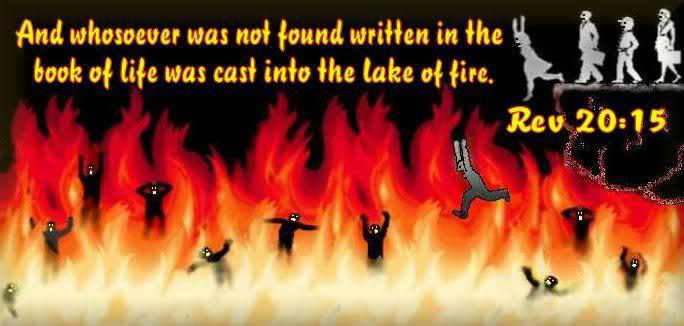
“Depart from me, ye cursed, into everlasting fire, prepared for the devil and his angels.” (Matthew 25:41) It was to save men from this judgment, that Christ came and suffered, bled, and died. It was to warn men of this, that God wrote the Bible and for centuries has striven by His Spirit with men.
The verse in the Book of Hebrews becomes real at this time, “It is a fearful thing to fall into the hands of the living God. For our God is a consuming fire.” Jesus and all the prophets and writers of the Bible gave this solemn warning.
The Awesome Judgment of God upon Sin
It was the curse upon the sin of lost humanity that brought down our Lord from heaven. Paul says that Christ was made a curse for us, that we might be redeemed from the damnation pronounced by the law. Our Lord became a man, was given a body, that He might be sacrificed for our sins, that He might pour out His holy blood for our salvation. Never let anyone persuade you that our Lord came down from heaven in order to teach us as a better example. We had all the fine examples we needed. What drew our Lord down from heaven was the tragic plight of our souls, facing eternal damnation in the presence of a holy God. He came to deliver us from evil, to offer us remission of sins in His blood. Against this background of damnation, a true minister preaches. With the hope of a soul's salvation he delivers his message from God. Always and always over every gathering there is that shadow of what it means to be damned. Always before the faithful worker is the tragedy involved in the rejection of a man who says “No” to God and “No” to Christ and “No” to the wooing appeal of the Holy Spirit of grace and intercession. It is a fearful thing to fall into the hands of the living God. “And whosoever was not found written in the book of life was cast into the lake of fire.”
The Separation between the Saved and the Lost
Time and time again, over and over again, page after page, God says in the Bible that there will someday be a separation between the lost and the saved, between those whose sins are forgiven and those who die in unforgiven sin. There is an example of this in the parable of the tares.
(Matthew 13:24-30) In Matthew 13 is the parable of the fish caught in the net, the good fish are kept and the bad fish are thrown away. “So shall it be,” said our Lord at the time of the great separation between the good and the bad, between those whose sins are forgiven and those who die in unforgiven sin.” “As it was in the days of Noah when Noah was taken out and the judgment of God fell upon this earth, so shall it be at the time of the coming of Christ.” Two shall be sleeping in a bed, one shall be taken and the other left. Two shall be grinding at a mill, one shall be taken and the other left. Two shall be working in a field, one shall be taken and the other left. (Matthew 24:37-41). This is the great separation. As we turn the pages of the Bible, this great separation is evident everywhere.
Finally, we come to the Great White Throne Judgment where the records are searched, “and whosoever was not found written in the Book of Life was cast into the lake of fire.” This tragic sentence is made all the more awesome with the words of Revelation 21:7-8...over and over God reveals that tragic, final separation between the saved and the lost.
Another great thing God reveals in His Book: As there is an eternal abode for the saved, so there is an everlasting habitat for the lost. The scripture says that angels came and carried Lazarus to Abraham's boson, to Paradise, to the presence of God, where the people of the Lord dwell with their savior. The same scripture also says that when the rich man died he lifted up his eyes in torment, in the flame and the fire of his sins, unforgiven. He died without God. And those two states in which Lazarus and the rich man found themselves are eternal and fixed.
Matthew 25:40
According to William Kelly, “The meaning clearly is that one is taken away judicially, and the other left to enjoy the blessings of His reign, who shall judge God's people with righteousness and His poor with judgment. It is the converse of our change, (rapture) when” the dead in Christ shall rise first, and we, the living who remain, shall be caught up together to meet the Lord in the air; for those who are left in our case are left to be punished with everlasting destruction from His presence.”
There is a great gulf fixed in- between. The residents cannot pass from one side to the other. There is an eternal abode for those who are saved and there is an eternal abode for those who are lost. The abode of the saved is in heaven, when God has washed away the sins of His children; they stand in His presence, perfect without spot and without blemish, their names written in the Lamb's book of life. These are the children of God. But there is also an eternal abode for those who reject the – mercies, the overtures and the intercession of the Spirit of grace.
In the Greek language Jesus called the place of torment “Gehenna” or hell. Gehenna means “the valley of Hinnom.” It was located outside of Jerusalem and was the place where the heathen had burned their children to the fiery god Moloch. God cursed the place and it became the dumping ground for the filth of Jerusalem through the centuries. In that refuse of Gehenna the worm never died as it ate into the putrid mass; the fire was never quenched as it
burned the endless waste: and the gnashing of teeth never ceased as the jackals fought with one another over the dead carcasses that were cast into that horrible place. This is the Gehenna of hell. It is our Lord who speaks of it, even Jesus.
No lost man is ever saved beyond death. No lost man is ever saved in that eternity when the great separation is made and he falls into hell. That is the end forever and forever. There is no other chance.
The Choice that Confronts Every Human Soul
Now let us speak of the choice God gives us concerning our eternal destiny. No man can ever say that God sent him to perdition. No man can ever say that God damned his soul. No man can ever say that he is tormented in the flame because of the injustice and cruelty of Almighty God.
Matthew 24:41 says “Then he will say to those on his left, 'Depart from me, you who are cursed into the eternal fire prepared for the devil and his angels.” The fire is not made for us; it is not made for any man; it is not made for you. It is prepared, that flame of fire that torment in hell, for the devil and his angels. The only people who are there are those who choose to cast their lot, life and destiny with the devil and his angels. For a man to fall into hell with the devil and his angels is for a man to choose to go there.
How certain and obvious is this judgment! God says this world shall pass away; the very fashion of it shall perish. And if your life is in this world, when the world is lost, you are lost, too. The judgment is the obvious result of an investment of your life. God says there is a judgment upon sin. When you give your life to iniquity and to unbelief, when the judgment of God comes upon righteous rejection, then the judgment falls upon you. In that day you may say something like this in hell, “Oh, I felt the tug of the Holy Spirit of God, I felt the call of my conscious turning me to Jesus, I felt the call of the preacher when he made an appeal for Christ; but I gave up Christ for the bottle; I gave up Christ for a lewd and a lecherous life; I gave up Christ for my profession and my job; I gave up Christ for the cheap rewards of the world.” When the judgment of God falls upon this world if you are in it, it is because of your choice. No man ever goes to damnation, except when he chooses to be lost and damned. There is a choice for every man in this world.
If Anyone or “Whosoever” Revelation 20:15
In Revelation 20:7, we see that Satan is loosed at the end of the millennium. Every man who ever lived will have a choice as to whether he worships God or Satan, whether he chooses heaven or hell, whether he will give his life to Christ or invest it down here in the cheap rewards of the world. In the period of that thousand-year millennium many think that there are those born who will never have been tempted and who will never have been tried by evil. But at the end of that period of time called the millennium, Satan is loosed to go out to tempt the nations of the earth who number as the “sands of the sea.” People of these nations must decide for or against the Lord.
This “whosoever” or anyone in Revelation 20:15 is the same kind of a “whoever” as is found in Revelation 22:17. It is the same “whoever” found in John 3:16. “It is appointed unto men once to die and after this the judgment.” (Hebrews 9:27). “And whoever was not found written in the Book of Life was cast into the Lake of fire.”
The Holy Spirit pleads with lost men to look in saving faith to Jesus. Bow down in the presence of the Lord; ask Him to forgive your sins. Christ says that if we confess Him before men, He will confess us before God in heaven.
