Chapter 18 of 26
Revelation Chapter 17
The Modern Babylon

In chapters 17 and 18 John deviates from his chronological unfolding of future history and pulls back the curtain to give a flashback to the development of the two great dynamics behind the Revived Roman Empire’s meteoric rise to world dominion. Many symbols used in the book of Daniel and Revelation are explained throughout this chapter. So this section in Revelation, chapters 17 and 18, is an interlude.
The passage begins: “And there came one of the seven angels which had the seven vials of the wrath and the final judgment of Almighty God.”' Those seven angels were introduced to us in chapters 15 and 16. At the end of chapter 16, the seventh angel poured out his vial of the wrath and judgment of God upon this Christ-rejecting and sinful world. Immediately thereafter, we would have expected the personal appearance of Christ upon this earth. But the Lord does not come from heaven until chapter 19. Before the final coming of Jesus, there is this interlude, this intermission. In this parenthesis one of those seven-vialed angels of the judgment and wrath of God comes to the scene and says, “God would reveal to you, God would make known to you, the future of religion in the earth.” So this intermission between chapters 16 and 19 reveals to us the mystery Babylon, the course of religion in this world, (chapter 18) and the city Babylon, the course of culture and commerce in this world. The vial angel says to John, “Come hither, I will show thee the judgment of the great whore that sits upon many waters with whom the kings of the earth have committed fornication and the inhabitants of the earth have been made drunk with the wine of her adultery.” He then carries John away in the spirit into the wilderness. When the Lord showed the Apostle John the bride of Christ, the New Jerusalem, the city and the people of the Lord, He took him to a mountain, great and high. But when the Lord shows to John the course and development of religion in this world, He carries him into the wilderness. Wherever there is spiritual harlotry, there is desolation and a desert of dreary, weary waste.
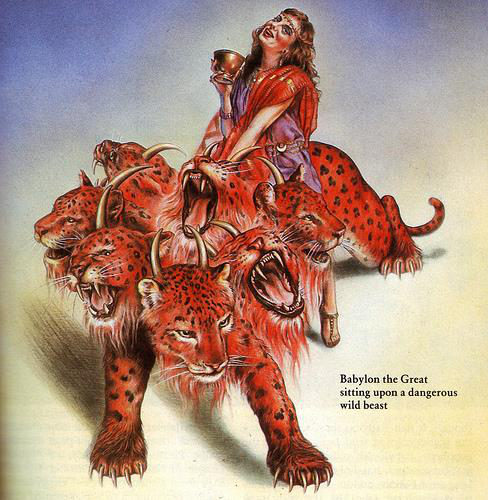
So he carries John into a wilderness, and there John says, “I saw a woman sit upon a scarlet beast, full of names of blasphemy...And the woman was arrayed in purple and scarlet color, and decked with gold and precious stones and pearls, having in her hand a golden cup full of abominations and filthiness of her fornication.”
The Great Amazement of the Apostle John
In the first part of the vision, John sees this woman with her name on her forehead, “Mystery, Babylon the Great, the Mother of Harlots and of the Abominations of the Earth.” In the interpretation which follows in the remainder of the
chapter, John writes his own personal reaction in language that is extremely strong. Verse 6: “I was amazed with a great amazement, I was filled with the wonder of a great wonder, and I was astonished with a great astonishment.” He did not write these words of amazement when he saw the beast, the course of the political empire and governments of this world. He did not write of that astonishment when he saw any other thing that God revealed to him concerning the future. But when John saw this scarlet woman, and came to understand what she represented, as he saw the development of the course of religion in this earth, he wondered with a great wonder.
The background of the development of this religious idolatry, this scarlet woman (whore), is seen in the very name written on her forehead. Idolatry began in the city of Babel, or Babylon.
The Babylonian system is both religious and political. The religious system paves the way for the political system. In the beginning, the religious system supports the political system, but in the end the political system supplants the religious one.
The historical drama of Babylon began on the plains of Shinar, where the first world dictator established the world's first religious center. The dictator's name was Nimrod, which means “we will revolt.” He is described literally as “a mighty hunter of men in defiance of the Lord.” The beginning of his kingdom was Babel, or Babylon (Genesis 10:8-10). Under this leader the first united religious act was performed – the building of a tower “whose top would reach into the heavens.” (Genesis 11:4). This tower was to aid them in a better observation of the stars. It was in essence an astrological observatory. Many centuries later, when God pronounced future judgment on Babylon, He said that, she had labored with sorceries and astrology from her youth,”
indicating that these were practiced in Babylon from her very beginning in history. (Isaiah 47: 12-13).
The Prophet Daniel in Babylon
In the 7th century B.C. the prophet Daniel, while captive in Babylon, was made a member of the king's special advisors. They were all steeped in the religion of Babylon, except Daniel. When the king had a nightmare one night, he called for his advisors to interpret what it meant. “Then the kind commanded to summon the magicians, the astrologers, the sorcerers, and the Chaldean, to reveal to the king his dreams.” (Daniel 2:2).
These magicians practiced black magic and performed various supernatural feats through contact with demon spirits. By calling on the spirits of the dead, they made contact with demons, who then impersonated the dead person being summoned. The sorcerer specialized in witchcraft. The Chaldean was the highest of all the advisors. He was a part of a special priestly caste which was perpetuated by inheritance. A Chaldean was a master of astrology!
Babylon and the Harlot
When the angel told John that he would tell him the mystery of the woman, he meant that this harlot, the false religious system, would have as its main teachings the same occultic practices as ancient Babylon. It would include black magic, demon contact, séance, miraculous materializations, witchcraft, astrology, and sorcery. Her luxurious external appearance of jewels and royal clothes meant that she would
have a great appeal to the sensual nature of men, but her gold cup filled with abominations represented her corrupt and perverse teachings.
The ancient city of Babylon was ruled by this occultic influence, but not many people are aware that the religion of Babylon passed from empire to empire until the days of ancient Rome. The mystery that John was seeking to unveil for his readers was that religious Babylon would be revived to control the last great world power in the last days of history. This religion will be an occultic amalgamation of all the world’s religious. For the first three and one-half years of the Tribulation, it will enjoy a position of great power and influence over the Revived Roman Empire and its leader, the Antichrist.
Babylon Becomes Prominent
Babylon became prominent under Hammurabi (1728- 1686 B.C.) who was the guiding light to the empire during the old Babylonian period. Babylon's greatest glory was achieved under Nebuchadnezzar, who lived during the Neo-Babylonian period about 600 years before Christ.
Of primary importance in the study of Babylon is its relation to religion as unfolded in Revelation 17. In addition to the historical records given in the Bible itself, ancient accounts indicate that the wife of Nimrod, who founded the city of Babylon, became the head of the so-called Babylonian mysteries, which consisted of secret religious rites which were developed as a part of the worship of idols in Babylon. She was known by the name of Semiramis. In Assyria and Nineveh, she was called Ishtar. In the Phoenician pantheon she was called Ashtoreth or Astarte. In Egypt she was called Isis. Among the Latins, the Romans, she was called Venus.
She became the first high priestess of an idolatrous system. In answer to the promise made to Eve that the seed of the woman would deliver Semiramis, when she gave birth to a son, she said he was miraculously conceived by a sunbeam, and she offered her son as the promised deliverer of the earth. His name was Tammuz. When he was grown, a wild boar slew him; but after forty days of the mother's weeping, he was raised from the dead. In this fabricated story of Semiramis and Tammuz began the cult of worship of the mother and child that spread throughout the whole world. In Assyria she is called Ishtar and her son, still Tammuz. In Phoenicia she was called Astarte or Ashtoreth, and her son, Baal or Tammuz. In Egypt she was called Isis, and her son was called Osiris or Horus. In Greece she was called Aphrodite, and her son was Eros. Among the Romans she was called Venus, and her son was called Cupid.
The cult of the worship of mother and child spread throughout the whole earth. She was worshiped by the offering of a wafer (a little cake) to her as the queen of heaven. And there were always forty days of Lent, of weeping of the destruction of Tammuz, before the feast of Ishtar, at which time his resurrection was celebrated.
The sign of Tammuz was an Ishtar egg, a symbol of his resurrection to life. The secret of the Babylonian mystery was to be found in priestly ablutions, in sacramental rites and rituals, in the dedication of virgins to the gods, in purgatorial fires, and in a thousand other rituals that are familiar to us today. The prophet Jeremiah bitterly rebuked against the mother and child cult. In chapter 44 of Jeremiah, Jeremiah described the idol worshipers among the children of Israel, who burned incense to the queen of heaven and who offered cakes in her name. In chapter 8 of Ezekiel, God takes the
prophet and shows him the inner life of the people of God who are idolatrous: Ezekiel 8:13 “And He said to me, 'Turn again, and you will see greater abominations that they are doing.' So He brought me to the door of the north gate of the Lord's house: and to my dismay, women were sitting there weeping for Tammuz.” Ezekiel was beholding the forty days of Lent in which they afflicted themselves and wept for Tammuz, the child that was slain by the wild boar. But after those forty days, in commemoration of the story of his being raised from the dead, the end of weeping was celebrated with the feast of Ishtar, in which the people exchanged Ishtar eggs.
As we have observed, that cult of the worship of mother and child spread throughout the whole world, from Babylon to Assyria, to Phoenicia, to Pergamos, and finally to Rome itself. There the Roman Emperor was elected Pontifex Maximums, the high priest of all of the idolatrous systems of the Roman Empire. And when the Roman Emperor passed away, that title of high priest of the rites and mysteries of the cult of mother and child, the Babylonian mystery of idolatry, was assumed by the Bishop of Rome.
There is no such thing in the Bible as the exaltation of a female deity, and least of all is there any hint or suggestion that Mary was other than what she is presented to be in the New Testament. The last time she is seen, she is a humble fellow, suppliant in the prayer meeting described in the first chapter of the Book of Acts. After that, she is never mentioned or seen again. This cult of the idolatrous worship of the mother and child is, purely and simply, Babylonian idolatry.
However further on, as the angel interprets this scarlet whore to the sacred seer, he writes: “And I saw the woman drunken”, a present active linear principle, meaning continuously drunk; not that just one time she made a mistake and slew God's servants, but continuously drunken.
“I saw the scarlet whore drunken with the blood of the saints, and with the blood of the martyrs of Jesus.” John could not believe his eyes, for in his day it was pagan Rome that was persecuting the Christians. But in this vision that God gave to John, the blood of the saints and the blood of the martyrs of Jesus is shed by that rich and scarlet idolatrous church. John wondered with a great wonder.
Who invented the Inquisition? Who invented the torture chamber and the rack? Who burned at the stake uncounted thousands and millions of God's servants in the earth? It has been estimated that she has slain more than fifty million of the servants of Jesus Christ.
There is a remarkable thing here. In chapter 18 of Revelation, it is God who destroys the city of Babylon; it is God who destroys the Beast and the false prophet. But do you notice here that it is not God who destroys the scarlet whore? It is man who destroys her. That is an astonishing thing.
The Destruction of the Idolatrous System of the World
When we read history and watch the course of this world, that is exactly what God has said and what God has done. We are not to think that God is peculiarly different here in the Revelation. The great eternal, spiritual principles and destiny are not different in the Revelation from what they were yesterday, or will be tomorrow, or are today. We can follow these things in history books; we can read these things in daily newspapers. God is ever true to the great principles by which He governs the world. We can herein follow the work of God as it is projected out to the end of time. The apocalypse says it is not the intervention of Christ; it is no appearing from God that destroys this scarlet whore.
Men Do It Let us see if this prophecy which was made two thousand years ago is demonstrated in history. God has said in the text that men shall destroy this whore, this idolatrous system. Do you remember reading in history of the ferocious onslaught of the terrible Islamic conquest? That terrible, bloody conquest began in the seventh century and still continues today as worldwide Jihad and terrorism. The Islamic conquest was against idolatry. In the fierce conquest of the Caliphs of Islam who overran the world, they destroyed idolatry. Whether the idol is named Krishna or Christ, whether that idol is named Minerva or Mary, whether that idol is named Jove or Joseph, it is an idol; and when the Mohammedan Caliph came with his sword in hand, he destroyed the idol temples, the Churches of Africa, of all Palestine, of all Asia Minor and Turkey and Istanbul, and thrust himself to the Philippine islands on the east. It was against idolatry that the Mohammedan religion arose as a fierce and terrible antagonist. The sweep of Islam was the sweep of the fierceness of the wrath and the judgment of Almighty God. Men destroyed the idolatrous whore in Africa and Asia.
And the prophecy is that the kingdom of the world, someday, is going to get weary of the same idolatrous church. The prophecy is that the kingdoms of the world shall hate the whore, make her desolate, rob her of all of her riches and make her naked, stripping her of her beautiful scarlet robe and her purple gowns and her bedecking pearls and precious stones. The world, these kingdoms, shall “eat her flesh” that is, they shall appropriate all of her riches.
Revelation 17:8
The angel first gives a detailed description of the beast in his general character. The beast is explained chronologically as that which was, is not, and is about to ascend from the abyss and go into perdition. The bottomless pit in Greek, abyssos, meaning, “Bottomless” or the “abyss” is the home of Satan and the demons, and indicates that the
power of the political is satanic in its origin, as is plainly stated in 13:4.
There is a confusing similarity between the descriptions afforded Satan who was apparently described as the king over the demons in the abyss (9:11, 11:7, and 13:3), and the beast of 17:8. The solution to this intricate problem is that there is an identification of the world ruler with his world government.
Each of the three entities is described as a beast. Only Satan himself actually comes from the abyss. The world government which he promotes is entirely satanic in its power and to this extent is identified with Satan. It is the beast, as the world government, which is revived. The man who is the world ruler, however, has power and great authority given to him by Satan. The fact that Satan and the world ruler are referred to in such similar terms indicates their close relationship one to the another.
While many have attempted to demonstrate from this verse that the final world ruler is some resurrected being such as Judas Iscariot, Nero, or one of the more recent world rulers, it would seem preferable to regard the “eighth” beast as the political power of the world government rather than its human ruler. What is revived is an imperial government, not an imperial ruler (Rev. 13:3). That which seemingly went out of existence in history never to be revived is thus miraculously resuscitated at the end of the age.
The Seven Heads of the Beast
(Rev.17:9-11) The explanation of the beast introduced by the unusual phrase “Here is the mind which has wisdom:” anticipates the difficulty and complexity of the Revelation to follow. The reader is warned that spiritual wisdom is required to understand that which is unfolded.
The first key to the revelation is in the statement “The seven heads are seven mountains on which the woman sits.”
Many expositions refer this to Rome. Seven Hills formed the nucleus of the ancient city of the left bank of the Tiber. These hills received the names of Palatine, Aventine, Caelian, Esquiline, Viminal, Quirinal, and Capitoline. As Rome grew, however, the hill Janiculum on the other side of the river Tiber was often included among the seven. Later the hill Pincian to the north of the ancient city was also included in the hills of Rome, as the city developed and moved north. This passage in Revelation is taken, therefore, to indicate that the seat of the ecclesiastical power will be in Rome, geographically, rather than in Babylon. Throughout its history Rome has been described as the city of seven hills, as indicated in coins which refer to it in this way and in countless allusions in Roman literature.
The seven heads of the beast, however, are said to be symbolic of seven kings described in verse 10. Five of these are said to have fallen, one is in contemporary existence, that is, in John's lifetime, the seventh is yet to come and will be followed by another described as the eighth, which is the beast itself. In the Greek there is no word for “there,” thus translated literally, the phrase is “and are seven kings.” The seven heads are best explained as referring to seven kings who represent seven successive forms of the kingdom. Because the seven heads are identified with kings in verse 10, some prefer to divorce the meaning from the city of Rome entirely and center the ultimate fulfillment in a rebuilt Babylon on the site of ancient Babylon.
John tells us that the seven heads also represent seven kingdoms; five have fallen, one is, and the other is still to come. Here he is referring to those great world empires from the time of the original Babylon of Nimrod's day, which have been dominated by the false occultic religion of Babylon.
“Babylonish” Influence Over Empires
The first kingdom was Assyria, with its occult-made capital city of Nineveh (Nahum 3:4). The second was Egypt, which devoted much of its total wealth to the construction of the pyramids, all built according to astrological specifications. Egypt was also given to black magic (see Exodus 7:11, 22, 8:7, 18; 2 Timothy 3:9). The third was the neo-Babylonian empire of Daniel's day, which really perfected the black arts. The fourth was Medo-Persia, which conquered Babylon but was in turn enslaved by the Babylonian religion. The fifth was the Greek empire. One visit to Greece and her ancient temple sites will convince you of the sway which idolatrous religions held there!
Running through the culture of all these great past empires was an underlying belief in astrology. This was the cohesive force which found together all the witchcraft, sorcery, and magic. Kings would seldom make a move without consulting advisors steeped in the ancient art of Babylonian religion. The ancient priests enjoyed royal stature and power, especially in Egypt. When John speaks of the “five kingdoms that have fallen,” he means the five above mentioned empires. But then he says, “one is.” This has to refer to the great empire of his day, Rome, which was filled with the same occultic beliefs that had originated on the plains of Shinar in ancient Babylon. This was the sixth kingdom of John's vision.
John looks to the future when he says of the seventh head (kingdom) that “the other is not yet come, and when it comes, it must continue a short while.” (Revelation 17:10). This refers to the future revival of the Roman Empire.
The seventh head is different from all the other six because it has ten horns on it. This indicates that this seventh kingdom will be made up of ten nations from the old Roman Empire (the sixth head) which will have confederated. This entity may be the current European Union. The revived Roman Empire will become dominated by the same Babylonian religious system.
After having given John a panoramic view of all the past world powers and their seduction by the Harlot of Babylon, the angel now narrows his focus to the 'beast' in its final form. Looking from this perspective, he says the beast was and is not, and then will exist again and be destroyed. He must be referring to the fact that Rome existed in his day, but that a day was coming, when it would no longer exist. Then it would rise again and be destroyed.
If you review the history of Rome, you will see that it was never conquered by anyone; it fell from within because of its own decadence. For nearly fifteen centuries Rome has not existed as a viable world political power. But the European Union has become a resurrected Roman Empire in its rudimentary form. All the nation, who are banding together in the European Union have roots in the old Roman culture and civilization. This is the 'beast' that will rise up and then be destroyed.
Although the beast has only seven heads, John says that it briefly sprouts another, an eighth head, but this head is only an outgrowth of the seventh (Revived Roman empire) and is quickly destroyed.