Chapter 4 of 26
Revelation Chapter 3
Sardis


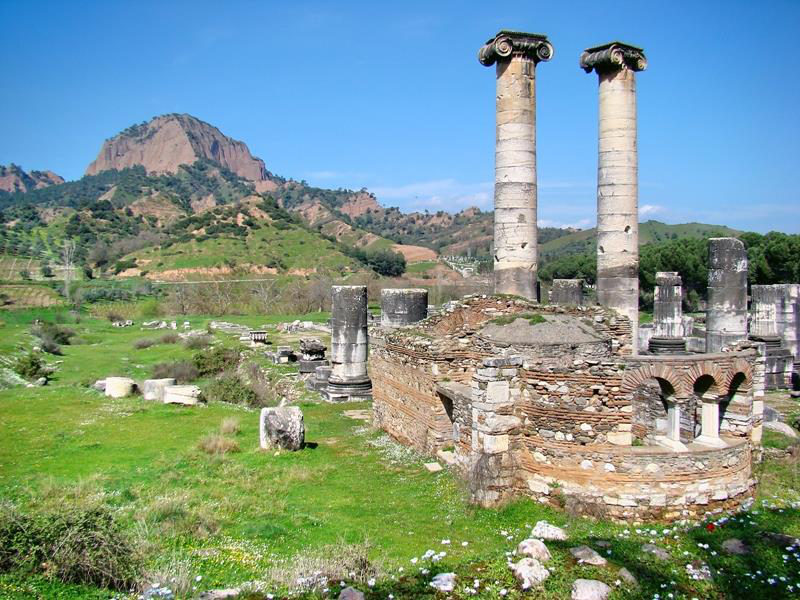
Sardis. Artemis Temple and 5th century A.D. Church. Photo
©Leon Mauldin.
Sardis - (Revelation 3:1-6)
Sardis is the fifth Church of the seven. In the great circle of the seven churches in Asia, the messenger carried the letter to Ephesus, then north to Smyrna, then further north to Pergamos; there, he turned south and somewhat east to Thyatira and so down to Sardis. Sardis is about 30 miles from Thyatira, about 60 miles from Pergamos and east of Smyrna about 50 miles. It was an important and wealthy city located on the commercial trade route running east and west through Lydia. An ancient city with a long history, Sardis has come back into prominence under Roman rule. One time it was the capital of the kingdom of Lydia. Much of its wealth came from its textile manufacturing and dye industry and its jewelry trade. Most of the city practiced pagan worship, and there were many mystery cults or secret religious societies. The magnificent temple of Artemis, dating from the fourth century BC, was one of its points of interest and still exists as an important ruin. The Church to which the letter was addressed continued its existence until the fourteenth century, but it never was prominent. Today, only a small village known as Sart, exists amid the ancient ruins.
The Church has a name, is alive, but dead. The church was contaminated with the world, inward decay, spiritual disintegration and dry rot. In Museums of natural history certain animal which are lifelike in their natural habitat, and mounted exactly as they lived, but they are dead. Like the letter to Laodicea, it is an unmixed message of rebuke and censor. It is almost devoid of any word of commendation, such as that characterized the word of Christ to the other churches. The reason for the sad condition in Sardis was that the people were surrounded by a severe form of idolatry.
In relation to Sardis, Christ is introduced in verse one as the one that has the seven spirits of God, and is similar to the description given in Revelation 1:4. In both verses, however, the Holy Spirit is in view. Here there is an apparent allusion to the sevenfold character of the Holy Spirit as resting upon Christ according to the prophecy of Isaiah 11:2-5. There the Holy Spirit is described thus, "the Spirit of the Lord." "The Spirit of wisdom and understanding, the spirit of counsel and might, the spirit of knowledge and of the fear of the Lord." There also He is described as coming from God and resting upon Christ. A similar description is found later in Revelation 5:6. In addition to having the sevenfold spirit of God, Christ is revealed as the One who has the seven stars, interpreted in 1:20 as the angels or messengers of the seven churches. The fact that the leaders of the church represented by these messengers belong to Christ makes their leadership and transmission of the message all the more authoritative and responsible. The same description of Christ as holding the seven stars in His right hand was given in relation to the letter to the church at Ephesus in 2:1 to make clear that the leaders of the church are responsible to no human representative of Christ and must give account directly to the Lord Himself.
The church at Sardis evidently had a reputation among the churches in that area, and was considered a spiritual church and one that had an effective ministry and testimony for God. From the divine standpoint, however, it is considered as a church that had only a name of being alive, yet actually was dead as far as spiritual life and power were concerned. The searching judgment of Christ as it relates to the church of Sardis is one to be pondered by the modern church, which often is full of activity, even though there is little that speaks of Christ, spiritual life, and power.
Warning
Though the church at Sardis was classified as being dead in the sight of God, it is obvious from verse two that there were some in the church who still had true life and spirituality.
The previous history of Sardis should have warned them concerning the possibility of sudden and unexpected judgment. Although the situation of the city was ideal for defense, as it stood high above the valley of Hermus, and was surrounded by deep cliffs almost impossible to scale, Sardis had twice before fallen because of overconfidence and failure to watch. In 549 B.C., Persian king Cyrus had ended the rule of Croesus by scaling the cliffs under the cover of darkness. In 214 B.C., the armies of Antiochus the Great (III) captured the city by the same method. The city of Sardis, at the time it received this letter, was in fact, in a period of decline as compared to its former glory.
On October 31, 1517, Martin Luther nailed his "Ninety-Five Theses" on the church door at Wittenberg, Germany. The spiritual history of the church was to correspond to the political history of the city. Their works are also declared to be not perfect, literally not fulfilled, that is, not achieving the full extent of the will of God. Their works were short, either in motive or in execution, and they are exhorted to fill to the full the opportunity of service and testimony.
Prophetic Application - (1517-1750)
The church of Sardis symbolized the Reformation Era. During this period of history, the church was reformed, but not revived. Some essential doctrines were reclaimed, such as the truth that people can be justified by faith, but the changes did not shake loose the elaborate rituals and human traditions of the medieval church. Complacency and new
legislation set in, and only a few tasted the power of the Holy Spirit for Christian living.
Not only are they exhorted to be watchful and strengthen the things which remain, but they are also warned to remember the truth that they have received, heard, and held fast to, and to turn away from any defection from it. If they refuse to heed the exhortation, Christ promises that He will come upon them unexpectedly with devastating suddenness and living judgment upon the church at Sardis. However, it is going to be just as unexpected, sudden, and irrevocable as that which is related to the Second Coming.
Promise to Godly Remnant
To those individuals in the Sardis church who overcame, the promise is given that they shall be clothed in white raiment. This means that the fidelity of character and service shall presently have its outward manifestation.
Further, it is promised, "I will not blot out his name out of the Book of Life." This book contains the names of all the individuals ever born. If a person does not receive Jesus Christ as Savior by the time he dies, his name is blotted out of the Book of Life.
The message is, therefore, a series of exhortations, not only to the church of the first century, but to those who need the same exhortations in every century. To such, the commands are given to be watchful, to strengthen the things which remain that are ready to die, to remember the truth and experience of the past, to hold fast that which remains, and to repent in mind and heart. As in the other churches, the message deals with the individual invitation, "He that has an ear to hear, let him hear what the Spirit says to the churches."
Philadelphia
Philadelphia - (Revelation 3:7-13)
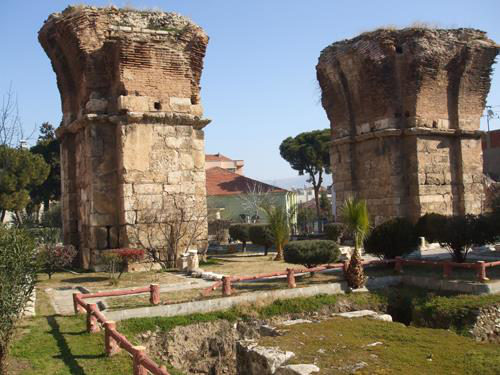
Philadelphia was about thirty miles southeast of Sardis. It was destroyed in 17 A.D. by the same earthquake that toppled Sardis. Tiberius Caesar, the great builder of cities, reestablished it. This city was founded in 140 B.C. by the king of Pergamos, Attalus II, whose other name was Philadelphus. The city was named Philadelphia after him. It is interesting how much the letter of our Lord to this sixth Asian church reflects the topography, the history, and the situation of the city. Philadelphia means brotherly love.
Philadelphia was the last bastion of Christianity when Asia Minor was overrun by Islamic Turks. One of the most interesting commentaries upon prophecy and the Word of God is to be found in the works of the famous historian Edward Gibbon: "In the loss of Ephesus, the Christians deplored the fall of the first angel and the extinction of the first candlestick of the Revelation. The desolation is complete and the temple of Diana, or the church of Mary, will equally elude the search of the curious traveler. The circus and the three stately theaters of Laodicea are now peopled with wolves and foxes. Sardis is reduced to a miserable village. The god of Mohammed, without a rival or a son, is invoked in the mosques of Thyatira and Pergamos. The populousness of Smyrna is supported by the foreign trade of the Franks and Armenians. Philadelphia alone has been saved by prophecy or courage. Among the Greek colonies and churches of Asia, Philadelphia is still erect, a column in the scene of ruins."
It is to this day largely a Christian town. Our Lord had nothing but words of commendation for Smyrna and for this missionary church of Philadelphia. The Philadelphian church is: the church of the missionaries, the church of the evangelists, the church of the Bible societies, the church of the soul winners, and the church of world-wide preaching of the gospel of the Son of God.
Open Door Rev.7-13
7 “And to the angel of the church in Philadelphia write, ‘These things say He who is holy, He who is true, “He who has the key of David, He who opens and no one shuts, and shuts and no one opens”: “I know your works. See, I have set before you an open door, and no one can shut it;] for you have a little strength, have kept My word, and have not denied My name. 9 Indeed I will make those of the synagogue of Satan, who say they are Jews and are not, but lie—indeed I will make them come and worship before your feet, and to know that I have loved you. 10 Because you have kept My command to persevere, I also will keep you from the hour of trial which shall come upon the whole world, to test those who dwell on the earth. 11 Behold, I am coming quickly! Hold fast what you have, that no one may take your crown. 12 He who overcomes, I will make him a pillar in the temple of My God, and he shall go out no more. I will write on him the name of My God and the name of the city of My God, the New Jerusalem, which comes down out of heaven from My God. And I will write on him My new name.
13 “He who has an ear, let him hear what the Spirit says to the churches.”’
Rev.3:7. "And the 'key of the house of David' will I lay upon His shoulder; so He shall open, and none shall shut; and He shall shut, and none shall open." This quotation is from Isaiah 22:20-22, which itself is a characterization of Eliakim, the steward of King Hezekiah. The noble, trusted man was given the key to the palace. No one came to approach the king except through Eliakim. So it is with us in Christ. There is an open door to God in our Savior and no man can shut it. In the time of Philadelphia, many famous preachers were raised. In 1792, William Carey went to India.
Philadelphia has developed outside of the Reformation from the spiritually dead state churches. Although there always have been Philadelphian believers, a Philadelphian movement is another matter. From the addresses of the Lord to the seven churches, everyone must ask himself where he
fits into this. If I don't belong to the group of Thyatira, and if I don't belong to the state churches of reformation or these churches similarly constituted, then I must find my place either in Philadelphia or Laodicea. The Lord will lead Christians to seek out their own company of brethren - the meaning of the word Philadelphia.
Philadelphia stands for a well-defined movement in the history of the professing church. J. N. Darby spoke of the historical churches: "Outside of Scripture, the historical church never was, as a system, the institution of God or what God had established, but at all times, from its first appearance in ecclesiastical history, the departure as a system from what God established and nothing else. And as to doctrines, it is quite certain that neither a full redemption nor a complete possessed justification by faith, as Paul teaches it, a perfecting forever by Christ's one offering, a known personal acceptance in Christ, is ever found in any ecclesiastical writings after the Scriptures, for long centuries."
Out of the deadness of the state churches, over and over again came forth companies of believers energized by the Holy Spirit (The Brethren Movement). It is a complete return to the first principles. The message makes this clear. They receive only praise, for they pleased the Lord. It is a revival and turning back to their first love. The Lord Jesus Christ is once more the all-absorbing object before their heart. Philadelphia repudiates all that dishonors Him. It is a faithful remnant gathering in His name, around the table. The unity of believers and brotherly love was established. They walk in the path of separation in self-judgment and in lowliness of mind. They have a little strength, which means weakness; they are a feeble few. Twice, the Lord speaks of obedience to His word. Thou hast kept My word. Thou hast kept the word of my patience, and the Philadelphian does not deny His name. These are the two characteristics of this phase of Christianity during the closing days of Christianity.
Obedience to His Word and Devotion to His name The Word and the name are denied in the last days. The apostasy of Christendom exists in the rejection of the written Word and the living Word.
Christ's Word and His Name
The Lord speaks of Himself in a distinct way from that in which He spoke of Himself before.
The Holy and True One
The way the Lord presents Himself in these epistles is always in accordance with the state of those to whom He speaks. It is for warning or encouragement, or perhaps both, as in the address to Smyrna. He that lives and was dead, enforced by the words, be thou faithful unto death, and I will give thee the crown of life. Here, He that is holy and He that is true is a solemn admonition, and yet it surely has its blessed comfort too. This personal title in conjunction with the whole epistle seems to show the final breakup of the ecclesiastical system, with an individual Christian walk becoming the whole matter. Holiness and truth have seldom been the attributes of bodies of men.
Features of Philadelphia
(1) Thou hast kept My word (2) and hast not denied My name. (3) Thou hast kept the word of My patience.
(1) My word in opposition to all other. Everywhere through this writing, "My" is remarkably emphasized, and the person of the Lord is exceedingly prominent. Today, the Word of God
is in special question everywhere. Modern world organizations and philosophies try to lower and take away the authority of this word. The voice of the church (clergy) is substituted for Christ's voice. Religion is an earth born thing - not heaven born, an aspiration, but not an inspiration. What an immense thing it is to be keepers of Christ's word. Philadelphians are exemplifying a spirit of true obedience.
(2) Thou hast not denied My name. Names in Scripture have significant meanings. They are not as in the present day, put upon people for their prettiness, or because they run in the family. God did not think it an unworthy thing often Himself to interfere and change or give a name, and so the Lord did with His disciples. There was a reason for the name. It was the expression of what the person was, most generally, or would be, as in Abraham, Israel, Peter, and such like, especially with the names of God or of Christ.
When God took the special name of Jehovah with Israel, it meant that He was going to approve Himself to them in that character, as the immutable God, the "I AM" upon whom they could rely upon to keep the covenant. So Christ is Immanuel, "God is with us" and in order that that prophecy may be or shown to be fulfilled, He is called 'Jesus,' His people's Savior from their sins. God could not be with us except our sins were met, and none but a divine person could meet them - salvation must be of God, and this is all expressed in the name "Jesus."
Christ is the Greek form of the Hebrew "Messiah," which speaks of Him as the one anointed of God to be the deliverer in three necessary ways: a prophet to bring out of error, a priest to open the way to God, and a king to govern for God.
Thus, Christ's name is a remarkably explicit declaration of Himself. And this name of His, with the facts which it implies, is what is committed to His people to hold fast and maintain as His, in the midst of a world which has rejected Him. To confess His name involves thus the confession: of His absolute deity, His true humanity, His salvation of His people, and His being their only and sufficient Teacher, Intercessor and Lord. The name of Christ expresses what He is. The truth of what He is, is what is committed to us, what we have to confess in the face of the world.
Christ is the truth; Satan is the liar from the beginning. By a lie of his, man was first seduced and fell. By the truth, he is brought back to God and sanctified. Satan's effort is therefore by counteracting lies to destroy the power of the truth. And his most successful method is not so much direct denial as perversion of the truth, knowing man's heart but too well by long experience. He knows how to combine truth and error so skillfully, that the truth shall give only the mere speciousness to the error, while the error in the guise of truth shall appeal to the lusts and passion and enlist them upon its side. (For example, a mere 10% of cyanide in a glass of milk can kill you.)
Thus Satan seduces as an angel of light, and Christendom, with its profession of Christ's Lordship, can worship many lords under the profession. Not denying His name, may, in this way, be given as a signal mark of approbation in the midst of Christendom, even more than in the midst of heathenism.
If we look further into Scripture for the association in which we find the name of Christ, we shall soon see that it is connected with the whole standing and walk of the individual
believer, as well as with the practical gathering together of His people. We are justified in the name of the Lord Jesus. Our prayers are to be presented in His name, our every word and work is to be done in His name. Our gathering as Christians is to be "to His name." Jesus represents us in heaven; we represent Him on earth. We represent Him before the world. Whatever we do in word or deed, we are to "do all in the name of the Lord Jesus" (Colossians 3:17). Are not these truths which God has been graciously restoring to us in those days (Brethren Movement) afresh? No doubt the revival of justification by faith is as old as the Reformation, and was then brought out with simplicity and power. There was one thing to which the Reformation did not attain, and of which the common evangelical doctrine, so called, has fallen entirely short.
Even the full manhood of the Lord, as a present thing in heaven, has become misty and indistinct, and the resurrection side of the gospel is nearly absent from the evangelical systems. They stop short with Christ's death for us.
The word Philadelphia means "brotherly love." Not association merely, as brothers, but having brotherly love. So it is to be with us: love, wherever there are "brothers," love to all children of the Father as His children, but a love which consists, with deed full maintenance, of what is due to the Father. "This commandment have we from Him that he who loves God loves his brother also." In II Peter 1:5-7, we find the order of divine growth. "Brotherly love" comes in a very different place from what we should naturally imagine. From "faith," the beginning of everything is in us. Brotherly love is the sixth stage on towards perfection, and only short of the full maturity of "love" itself. We are first of all to add to our faith "virtue." For as faith's walk is against nature and through a hostile world, the very first requisite for it, next to faith itself, is courage.
In Philadelphia, there is a revival of prophetic truth, an earnest waiting for the coming of the Lord. Philadelphia is a description of a loyal remnant. In the mid-1800's, Scripture has been opened to us more as a whole than at any former time since the apostles. Furthermore, this has been in connection with a movement that has all the features of Philadelphia. Certain great truths, having been recovered to the church, have helped to open up in a new way both the Old and New Testaments. The dispensations have been distinguished. The gospel has been cleared from Galatian error (law keeping). Our place in Christ as we learned, is in connection with our participation in His death and resurrection. The real nature of eternal life and the present seal and baptism of the Holy Spirit, in contrast with all former or other spiritual operations and gifts, has been learned, and the Rapture has been distinguished from His appearing.
"For where two or three are gathered together in My name, there am I in the midst of them" (Matthew 18:20). What is His name? His name is above all names; Wonderful. The main test for a Philadelphian movement would be the confession or denial of the name of Christ as the center of gathering. Philadelphia is mentioned seven times in the Bible, but only as a city: Romans 12:10, I Thessalonians 4:9, Hebrews 13:1, I Peter 1:22, I Peter 1:7(twice), and Revelation 3:7.
In the winter of 1827-1828, four Christian men came together on the Lord's Day for the breaking of bread as the early Christians did. They were J.N. Darby, Dr. A.J. Cronin, Mr. Bellett, and Mr. Hutchinson. The first meeting was held in Dublin. They had been studying the Scriptures and comparing what they found in the Word of God with the existing state of
things around them. But they could find no expression of the nature and character of the church of God, either in the national establishment, or in the various forms of dissenting bodies. This brought them into the place of separation from all these ecclesiastical systems, and led them to come together in the name of the Lord Jesus, owning the presence and sovereign action of the Holy Spirit in their midst (Matthew 18:20; Ephesians 4:3,4).
Prophetical teaching, especially the teaching of the rapture, electrified the whole Christian world, and great revivals were started. The church, with little strength, will be blessed and made strong when He appears. The true church suffered. You are weak now, but you are going to be His in heaven.
The Lord's Promises to Overcome
Because thou hast kept the word of My patience, I also will keep thee from the hour of trial (temptation) that is coming upon the entire world. "I will make him a pillar in the temple of God." This of course is a figure of speech. The entire heavenly city is considered a temple. In keeping with the symbolism, the Philadelphian Christians will be permanent, like a pillar in the temple, and speaking figuratively, they will stand when all else has fallen. This perhaps had peculiar significance to those who were in Philadelphia because of their historic experiences with earthquakes, which frequently had ruined their buildings and left only the pillars standing.
The church is called the pillar and ground of the truth. Peter, John, and James (the Lord's brother) in Galatians two were called "pillars of the church." So, in the New Jerusalem, we are the adornment of God forever. "We are to be pillars and we shall go no more out." In the courses of the Old Testament priests, death took them out of their ministries. Even our first "parents" were driven out, beyond Eden to water the ground with their tears and their sweat and to be buried beneath its sod. But in the New Jerusalem, we shall "go no more out."
"And I will write upon him the name of my God, and the name of the city of my God, which is the New Jerusalem." In the Revelation, as he looked on the saints in glory, John said, "And His name was written in their foreheads." Like the high priest of old, we also shall have the dignity of His high office, carrying with it the right of access to God forever. We shall see His face and live. And we shall be citizens of the New Jerusalem. In the eleventh chapter of the book of Hebrews, Abraham saw the city, which has foundations whose builder and maker is God. And in the same chapter we are told, "Therefore God is not ashamed to be called their God, for He has prepared a city for them" (Hebrews 11:16).
"And I will write upon him My new name." He has many names: "And His name shall be called Wonderful, Counselor, the Mighty God, the Everlasting Father, the Prince of Peace" (Isaiah 9:6). In the glory that is to come, the Lord does not lay these names aside. He will continue to be known by His old names (Philippians 2:9). We see "therefore God also has highly exalted Him and given Him the name which is above every name." John sees the Christ as conqueror and calls Him "the True and Faithful" (Revelation 19:11). Verse 12: He had a new name written that no one knew except Himself. Verse 13: And His name is called "the Word of God." Verse 16: And His name is written KING OF KINGS, AND LORD OF LORDS. "And he will be given each a white stone, and in the stone a new name written, which no man knoweth except he himself" (Revelation 2:17).
There are worlds and universes and infinite areas in which our Lord Jesus Christ shall live and reign triumphantly beyond
anything that man can imagine. These conquests are also ours. We are hidden with Christ in God, from grace to grace and from glory to glory, until the fullness of our Lord becomes the fullness of His people, and He and we are one, a world without end. Oh the blessedness of it all. Amen.
Laodicea
The Laodicean Church - (Revelation 3:14-22)
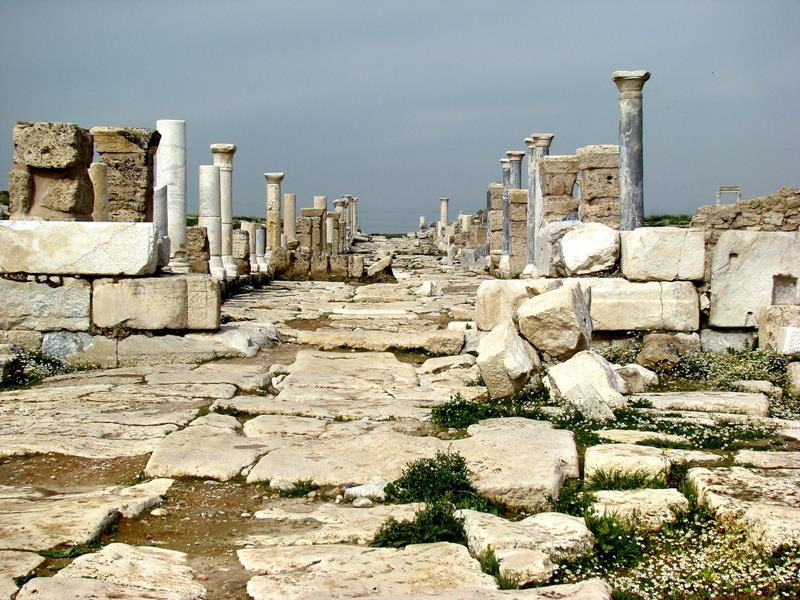
In the great circle by which the messenger carried these seven letters from our Lord to each one of the separate congregations, we have come to the last, the most southeasterly. The background, the topography and the history of the city are most evident in this letter. The very name "Laodicea" is rich in meaning. It was founded by Antiochus II, who named it after his wife, Laodicea. It was founded because it controlled the entrance into the interior province of Phrygia. At the end of Colossians, we can see the name of this church mentioned. So this assembly and the valley in which it was located belong to a famous group of ancient Christian churches.
The City Reflected in the Church
Our Lord draws from the topography of the country when He says, "You are neither cold nor hot, because you are tepid (lukewarm). I will spew you out of my mouth." In the district around Laodicea and Hierapolis were hot mineral springs. Lukewarm mineral water is very nauseating and ill tasting. So our Lord uses the background of those hot mineral springs, cooled off and making the drinker sick. Then He says, "You say I am rich, have become wealthy, and have need of nothing, and do not know that you are wretched, miserable, poor, blind and naked."
From the beginning, Laodicea was a success story. Jewish merchants made this province very rich. Laodiceans had a breed of sheep raised in that district that was different from any other in the world. The wool of the sheep was black and its glossy, raven-colored beauty was superior to any other to be found in the world. Laodicea manufactured four different kinds of garments, one being an outer garment. One other thing our Lord refers to in the background of the city. "Anoint your eyes with eye salve that you may see." There was a medical center in Laodicea, and one of the things manufactured and exported among other medicinal products was a "tephra Phrygia," which was a tablet bought all over the Roman Empire. The users crushed it and put it on their eyes in order to heal any eye ailment.
In 62 A.D., a Roman governor prohibited the export of gold. They were running out of gold and they needed to keep it in order to bolster their currency. Once a year, every male Jew above 21 years of age sent half a shekel to the temple in Jerusalem to support the worship of Jehovah there. In order not to have too heavy a package, the money was sent across the sea in gold. However, the Jews in Laodicea proposed to
disregard the ban of the governor against the export of gold and to send their contributions in gold anyway. The governor promptly seized it and confiscated it. It weighed 20 pounds.
Christ the Eternal and Faithful Witness
“And to the angel of the church of the Laodiceans[a] write, ‘These things say the Amen, the Faithful and True Witness, the Beginning of the creation of God" (Revelation 3:14). As in His introduction to other churches of Asia, Christ describes Himself in an unusual way as the "Amen" in addressing the angel of the church in Laodicea. The frequent use of Amen, meaning, "so be it," is a feature of the declarations of Christ, and is usually translated "verily," or used as an ending to a prayer. As a title of Christ, it indicates His sovereignty and the certainty of the fulfillment of His promises. As Paul wrote the Corinthians, "For all the promises of God are in Him, yes, and in Him Amen, to the glory of God through us" (II Corinthians 1:20). When Christ speaks, it is the final word, and His will is always effected. Christ is called the faithful and true witness in contrast to the church in Laodicea which was neither faithful nor true. Christ had been earlier introduced as the faithful witness in 1:5 and as He that is true in 3:7.
Laodicea means the "judging or rights of people." It is the opposite of Nicolaitanism. In Protestantism, the people (the laity) arise and claim their rights and do the judging. This condition was also foreseen by Paul in II Timothy 4:3. We see in Laodicea the final religious and apostate conditions of Protestant Christendom and the complete rejection of the professing body.
Not Cold, not Hot, but Lukewarm
The Laodicean church is a lukewarm church, not cold, not hot, but lukewarm. It is vastly indifferent. It is indifferent to doctrine, to truth, and to the teaching of God. To the Laodiceans, one church was about as good as another. For them, Christianity was a sort of civic betterment program, a sort of "pay your debt and don't kill anyone," etc. Such Christians are lukewarm and indifferent to the great fundamental truths that God reveals in His Book.
The Laodicean Church was not only lukewarm and indifferent about the great truths and doctrines of God, but its members did not even know the truths and the doctrines of God. So today, ask any so-called Christians some simple questions about God, about the Bible and about the revelation of Christ, and he has no idea what to answer. The Laodiceans were untaught and mostly did not care. What does the church believe? What does it stand for? What is its teaching? What is its goal? They worshiped Baal and Jehovah at the same time. They worshiped God and mammon at the same time. Today, men try to worship Christ and the world at the same time. The lukewarm church lives in the world, is a part of the world, worships and loves the same things that the world does. One cannot tell the difference between such a church and the world. Another characteristic of the Laodicean Church is that it was self-deceived. They said, "We are rich." Christ said, "You are poor." They said, "We don't need anything." Christ said, "You are wretched." They were filled with self-contentment and self-satisfaction. Today's Humanism and the New Age teach these philosophies; that we can do without God.
Christ Outside
The Philadelphian Christian, who is separated from the Laodicean state, whose heart is filled with the love of Christ, can learn a lesson here. If our Lord stands outside and yet knocks and waits in patience, we too with Him outside of the
camp, where He is disowned, can try to gain admittance into the Laodicean hearts. Epaphras did this (Colossians 4:12-13). Laodicea consists in a proudly boasting spirit with total indifference to the Lord Jesus Christ and to His name. It is religiousness without any truth, nor the power of the Holy Spirit. He is on the outside, what a tragedy and sadness.
When the Lord makes an appeal, it is always addressed in the singular, to the individual. "If any man hears my voice..." It is the duty of the individual Christian to hear. We cannot cover ourselves or hide ourselves under the great blanket of the vast congregations of Christendom. The faith is individual. That fact is the very genius of the Christian religion. What is said to the churches and what is addressed to the congregations must be individually heard by the people.
Promise
To him who overcomes, I will grant to sit with Me on My throne, as I also overcame and sat down with My Father on His throne. There are two thrones. First, there is the Father's throne, the throne of the invisible. Christ as God and coregent with the Father is sat down in the Father's throne, unapproachable, awesome and removed. But there is another throne. There is Christ's throne, the throne of our Lord. He shall be our visible King, our reigning Lord, and all the power of the kingdom and empire will be in His hands. And in that day, we shall reign with Him, according to the Word of God (Revelation 22:3).
Taken as a whole, the messages to the seven churches of Asia constitute a comprehensive warning from Christ Himself as embodied in the exhortations to each of the churches. In summary, there is a warning for the churches of today to "hear what the Spirit says unto the churches." The church at Ephesus represents the danger of losing our first love (2:4).
The church at Smyrna representing the danger of the fear of suffering, was exhorted (2:10). "Do not fear any of those things which you are about to suffer." The church at Pergamos illustrates the constant danger of doctrinal compromise (2:14, 15). The church at Thyatira is a monument to the danger of moral compromise (2:20). The church today may well take heed to the departure from moral standards, which has invaded the church itself. The church at Sardis is a warning against the danger of spiritual deadness (3:1, 2), of orthodoxy without life, a mere outward appearance of being like the Pharisees, white sepulchers. The final message to the church at Laodicea is the crowning indictment, a warning against the danger of Luke warmness (3:15, 16), of self-sufficiency, and of being unconscious of desperate spiritual need.
