Chapter 3 of 26
Revelation Chapter 2
The City of Ephesus - (Revelation 2:1-7)


Ephesus was a large city with an excellent harbor, and it was known at that time as the marketplace of Asia. Ephesus was a tremendously important political center. Above all, Ephesus was a religious city. The temple of Diana, or Artemis as the Greeks called her, was considered one of the seven wonders of the ancient world. It was also a banking center because of its great vault in the temple of Diana, which was considered the safest place in Asia Minor. The goddess of Diana was the patron of all the prostitutes, and represented fertility and sexuality. Many writers in ancient times described the immorality of the city. One pillar in the Ephesian economy was the production of silver images of Diana by the many silversmiths. They sold little gods, and people fastened them on their chariots, placed them in their houses, hung them upon the walls and carried them around their necks, arms, and ankles. The Roman church copied this by making images of saints and hanging them around their necks. Black magic was also widely practiced in Ephesus. Paul met these occultists and led some of them to Christ (Acts 19:13-19, 23- 27).
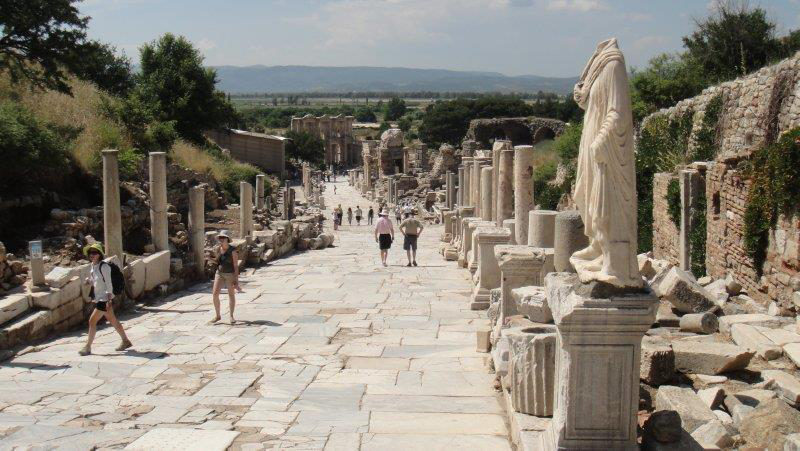
The Christian assembly of Ephesus was extremely well taught, having had Paul, Apollos, Timothy, and John as elders. Paul wrote the book of Ephesians in the New Testament to the Ephesian saints while he was in prison in Rome in approximately 60 A.D. First, there was a word of congratulation. Second, there was a word of complaint. Third, there was a word of counsel.
Commendation
His word of commendation comprises seven things. As the Lord walks among the assemblies, He is intimately aware of their thoughts and attitudes. There was much in this assembly to commend and praise. It was an active and energetic assembly. It was a soul winning assembly. Soul winning begets more soul winners. The believers were
zealous of good works and service for the Lord. Twice, the letter speaks of how they labored for the name of Christ. These saints knew how to trust the Lord consistently under trial, which is the meaning of the word patience. Patience does not mean passively bearing anything. No matter how the Ephesian Christians were beaten down, discouraged, or persecuted, they did not quit. They stayed with the work.
They were also sensitive to the presence of evil. They could identify the "bad apples." Doctrinally, they were competent and militant in their stand against false teaching. They examined and expelled the false apostles. A lot of so-called scholars have infiltrated the church today and they have been received. Furthermore, a present day assembly has many ministries. It is important to support and participate in our assembly activities. The little Ephesian assembly said, “We don’t want numbers if they are not holy numbers. We don’t want growth at the expense of holiness”.
Complaint
Jesus walks among His churches with eyes as a flame of fire. He sees everything among His people. Our eyes are covered with the smoke of the world. After all these compliments, He finds a fault. The penetrating eye of the Lord found a fatal fault. "You have left your first love." The old abounding joy, gladness and the old enthusiasm was altered. It was beginning to wane. Their services became mechanical, their devotion, routine. They did not have that old flame and fire. They have become cold and regular. If prolonged activities don't produce a greater love for Christ, then they are unprofitable. Formalism crept into Ephesus.
Counsel or Exhortation - Remember and Repent
He says that the Ephesian believers are fallen because they do not have a deep devotion, love, and commitment in their hearts to Him any longer. Today, our heart is often in the world. We used to love prayer meetings and Bible studies, but now we are too busy. We are not content with just the things of God. O Lord come and probe our hearts.
Prophetic Application - 33-100 A.D. The Ephesian church was a prophetic picture of the apostolic church. Eventually they opened the door for legalism.
Here in seven typical Churches we see the predominant characteristics of seven successive eras of church history. The seven churches represent historical periods in the history of Christ. The prophetic aspects were never understood clearly until much of church history had unfolded, but now as we look back, we can see striking similarities between the characteristics of each church in Revelation and the various periods of church history up until today.
Seven Churches in Every Age
Those periods also co-exist throughout all the ages. In every year, age, country, and denomination, there are Ephesian churches that cool off, who once had a fire and a flame and an evangelistic zeal, but have become apathetic in their drive for the souls of men. There are Ephesian churches in this age and Ephesian members in every Church. All seven churches co-exist in almost every church today.
Smyrna
Smyrna - (Revelation 2:8-11)
This is one of the ancient cities of the world. Today, it is a large metropolis in Asia Minor. It has at present, a population of 400,000 people. The name of it is Izmir, the Turkish corruption of Smyrna. Ephesus, Miletus, and other cities ceased to exist, but Smyrna has lived through the centuries.
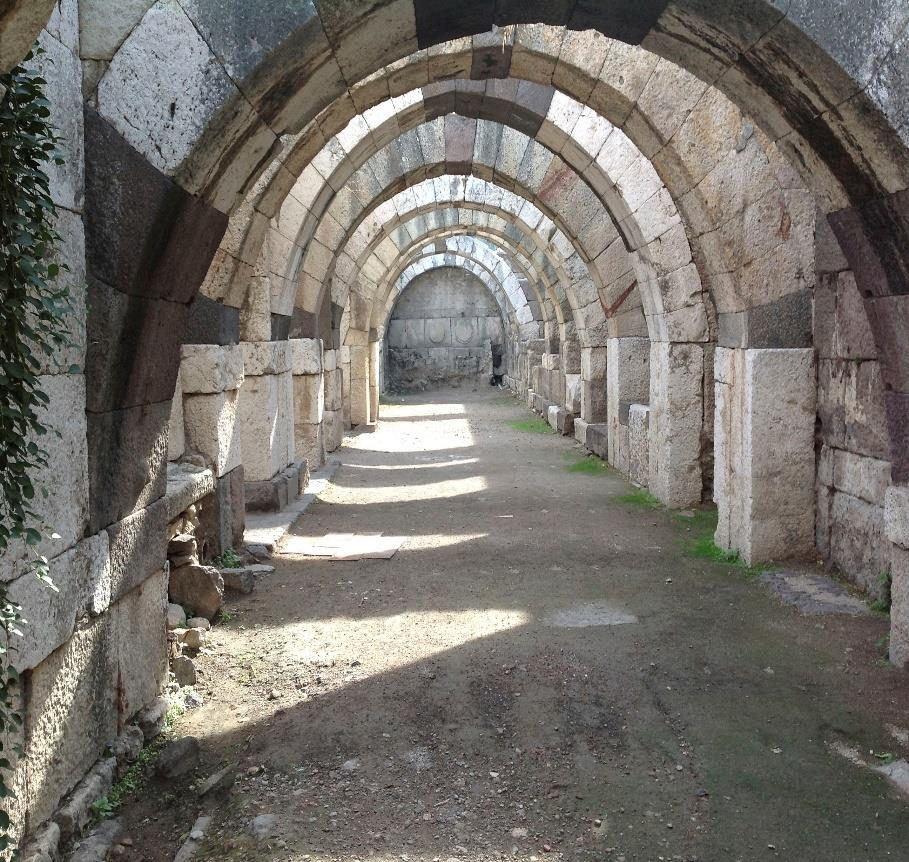
In Roman times, it was a great city. The harbor was one of the finest in the world. The gulf of Smyrna reaches back into the inland of Asia Minor about thirty-five miles. It was beautiful and spacious.
Smyrna was a great political center and it was always on the winning side. The city never lost a cause; it was always right. The conquering Romans made Smyrna a free city. It had its own government. It was the proudest of all of the cities of Asia. It was the birthplace of the great Greek Poet Homer. For them, God was not supreme. To Smyrna, worldly things were the first and the last. The Lord introduced Himself here as being the first and the last. To Smyrna, the first and the last were glories of Greek culture. Alexander wanted to make it a model city. After his death, Lysimachus, his general, built it and made it a model city. Streets were wide and spacious.
One of the Meaningful Messages in the New Testament
Three times Smyrna is used in the New Testament. The first time is in Matthew two when three wise men coming from the East, opened their treasures and presented before the young king gold and frankincense and Smyrna. The second time is in Mark 15 at the crucifixion of our Lord. He was offered wine mixed with Smyrna in order to help alleviate, anesthetically, the sufferings He bore. And the third place is in John 19. When Jesus dies, Nicodemus came with Joseph of Arimathea, and the two men, after carefully taking down the body of our Lord from the cross, wrapped it in long linen cloth in the folds of which they placed a hundred-pound weight of aloes and Smyrna. In each of these instances, the word is translated in the King James Version as myrrh. The city received its name from the trade of Smyrna. It was the port of the fragrance and perfume of myrrh. In the providence of God, the name came to symbolize that era in the story of the Christian church when it entered severe and terrible persecution. Myrrh pictures suffering, and was used
in the embalming of the dead. They brought unto Him gifts: gold, frankincense, and Smyrna. The gold is a picture of the deity of our Lord. The frankincense is a picture of His great mediatorial office, interceding for us in heaven. Myrrh typifies the suffering of our Lord for our sins. This is the church of great trial, tribulation, and martyrdom. The Lord has only commendation for this church. He has no complaint against them.
There are three things our Lord states. First, "I know thy tribulation." The word contains the idea of pressure that forces the blood out of the grapes; the pressure of persecution, sorrow, and death. Secondly, "I know thy tribulation and thy poverty." The actual word is ptocheia meaning “beggary." It means absolute and utter destitution. Why were these Christians at Smyrna so destitute in the richest city? Scribes and Pharisees called the disciples, unlearned, untaught, and unschooled men of poor and deprived lives. God does not need extraordinary personalities for His work. They were plain ordinary people. They were plundered and deprived of the right to work and make a living. And thirdly, "I know the blasphemy of them which say they are Jews and are not, but are the synagogue of Satan." False Jews and false Christians wanted to practice Judicial laws. Jews encouraged authorities also to persecute the Christians. One of the most famous martyrdoms in the entire world happened in this city of Smyrna. Polycarp was the leader of the Christians in the city. Upon a festival day, when the crowds were inflammable and excitable, the cry went out from the mob about Polycarp, and they brought him before the Roman governor. He was given the choice of saying "Caesar is Lord" or "Jesus is Lord." He refused to say that Caesar is Lord. The governor urged him saying, "Swear! I will set thee at liberty. Reproach Christ." Polycarp answered with one of the famous avowals in all history, "Eighty and six years have I served Him and He never did me harm. How then can I blaspheme my King and my Savior?" The people, led by the Jews, (it was on their Sabbath day and in contradiction of their law,) gathered the wood and burned the faithful servant. In the flames, he prayed, "I thank Thee that Thou have graciously thought me worthy of this day and of this hour that I may receive a portion in the number of Thy martyrs in the cup of Thy Christ."
Lord's Words of Encouragement
Encouragement is found even in the way that He introduces Himself. The first and the last, who was dead, and came to life. Satan shall cast you into prison for ten days. The word ten refers to a fierce and intense persecution, like the ten plagues in the land of Egypt. The Lord did not promise an escape, but said, "You are to have more of the same." Some say the ten days of persecution were under ten diabolical Caesars, which dated from Nero (64-312 A.D.).
Faithful unto Death
James was beheaded by the sword of Herod Agrippa, John was exiled, and Peter was crucified. When the Lord called Paul, He said, "I will show him how many things he must suffer for my name's sake." What an amazing thing (Acts 9:16).
The Lord never said we would have the abundance of all the things that this life has to offer; about being rich, healthy, etc. (Romans 8:38, 39). Fortunately, death or anything else cannot separate us from the love of God.
Prophetic Application - (100-312 A.D.) The suffering of the church at Smyrna was prophetic of the great era of persecution under the ten Caesars. The motives
of the church were purified during this long and difficult period. Millions of Christians met cruel martyrs' deaths rather than renounce Christ or swear allegiance to Caesar as Lord. This was a period of tremendous witness and heroic faith. Even the wicked Roman Empire was finally shaken by the testimony of these Christians.
Pergamos
The temple of Aesculapius in the ancient city of Pergamos and home to the
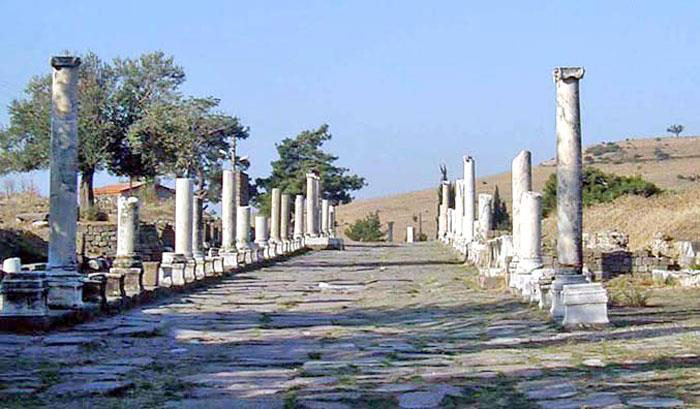
physician Galen (131-210 CE)
Pergamos - A Compromise with the World System - (Revelation 2:12-17)
On the ancient site of Pergamos, there is today a village called Bergama, which is a Turkish corruption of this Greek name, Pergamos. The original Pergamos was a beautiful and illustrious city. It was the capital of Asia Minor. The Attalid kings beautified the city. The library contained more than 200,000 books. The use of parchment, of skins of animals, as writing materials was invented in Pergamos. The name "parchment" comes from this town of Pergamos.
The letter of our Lord begins with a grim tone. The word "seat" in Greek is thronos. He is referring to the fact that these Christians live where Satan has great authority and great power. What was Satan's throne? In this capital city, there were temples to the four greatest Greek gods: Zeus (Latin - Jupiter), Dionysius (Bacchus), Athena (Minerva), and Aesculapius. Zeus was the head of all the gods. Dionysius was the god of wine and of drama. Athena was the god of wisdom. Aesculapius was the god of healing. His emblem was a serpent. Snakes roamed around in the temple. Another wonder of the ancient world was the magnificent altar to Zeus. Emperor worship (Caesar) was also prevalent. There were another three temples dedicated to Roman emperors.
Notice the word “you have not denied my faith”. It refers to a thing in the past, a great persecution. In that angry day, Antipas was martyred. In his faithfulness to Christ and in protest against Caesar worship, Antipas laid down his life. The Lord says, "I know where you live. You cannot escape. You cannot run away." It is a description of our state in this present wicked world. We cannot run away. We have to stay like Antipas.
The Doctrine of Balaam
With verse fourteen, the tone of our Lord changes. The doctrine of Balaam was the teaching and counsel of a shrewd
sage. He was hired by Balak to curse Israel. He could not curse Israel. God would not let Him. But he did something worse to corrupt God's people. He introduced them to strange Moabite women. Those strange Moabite women did the work. They corrupted Israel, a thing Balaam himself could not do. But they did it. That is the method of Balaam
One of the most astonishing things in the Greco-Roman world was this: With all of their magnificent philosophy and ethics and their achievements in every realm of art and science and literature, they looked upon prostitution as a needful and acceptable way of life. But believers in the church did not go along with the crowd. The doctrine of Balaam is the same today as it was then. What Christians faced concerned things sacrificed to idols, like "Halaal" meat for Muslims. The social customs of idolatry were a threat to the Christian faith on every side. So, a Christian was cut off from social intercourse with the world and the pattern of life in which he lived.
When Lucifer fell, he kept his brilliance. When he came down to this earth, he set up his throne on this planet. In the previous letter, the Lord addressed Smyrna. There, the opposition to the church was in the synagogue. In the period of ecclesiastical history represented by Smyrna, the opposition to the church was veiled under the cloak of religion. But in Pergamos, the opposition to the church takes an altogether different turn. Satan invites the church and the people of God to share with him the glamour and the glitter of all things that mammon have to offer of worldly greatness and glory. There is evil in our country and all over the world. Satan's throne is in the city where mammon dwells.” You cannot serve God and mammon”. False doctrine is found in the cities far more than in rural areas. What a trying, perilous, difficult place to locate God's house. But that is where it needs to be. How do we deny the faith in the city where Satan's throne is? We deny the faith by refusing to confess it. The Lord mentions His faithful martyr Antipas.
Many Christians were persecuted in one part of India. A Christian could live in that place without any trouble if they remained a silent Christian, not disclosing their faith to others. We also deny the faith by preaching the wrong gospel. There is no different salvation for the first century and the 15th century Christians. Jesus Christ weeps over the great cities of the world. The population everyday presses more and more toward the cities. The Lord said, "I understand the trial of the Church in the heart of the city and I know her peril and the difficulty."
The Doctrines of Nicolaitane - Doctrine of Balaam
The reference to Balaam is an allusion to the experience of Balaam recorded in Numbers 22-25 when he was hired by the kings of the Midianites and the Moabites to curse the children of Israel for not exterminating the women of the Midianites. Here we learn for the first time that the prophet Balaam had advised King Balak to corrupt Israel by tempting them to sin through intermarriage with their women and the resulting inducement to worship idols (Numbers 1:15-16). The doctrine of Balaam therefore was the teaching that the people of God should intermarry with the heathen and compromise in the matter of idolatrous worship. This is in contrast to "the way of Balaam." That is, selling his prophetic gift for money (II Peter 2:15) and the "error of Balaam," his assumption that God would curse Israel (Jude 11).
Undoubtedly, intermarriage with the heathen and spiritual compromise, were real issues in Pergamos where civic life and religious life were so entwined. It would be most difficult for Christians in this city to have any kind of social contact
with the outside world without becoming involved with the worship of idols or in the matter of intermarriage with non- Christians. Practically, all meat was offered to idols before it was consumed, and it was difficult for Christians to accept social engagements or even to buy meat in the marketplace without, in some sense, compromising in respect to the meat offered to idols. Intermarriage with the heathen was also a real problem. Social relations with the heathen world would lead in some instances to partaking of the heathen feasts which in turn led to heathen immorality which was a part of the idolatrous worship. Christ's absolute condemnation of the doctrine of Balaam as it related to the church of Pergamos is a clear testimony to the fact that Christians must at all costs remain pure and separate from defilement with the world and its religion and moral standards.
The Doctrine of Nicolaitans - (Revelation 2:14, 15)
What is this doctrine? There are even many strange explanations about them. One of them says that the Nicolaitane were the apostatizing followers of Nicholas of Antioch, who was one of the seven deacons in the assembly of Jerusalem. There is no basis, no substantiation for such a theory, either in profane or in sacred history. The doctrine of Nicolaitane was connected with the doctrine of Balaam, which included carnality, lust, fornication, and sensuality. However, the doctrine of Nicolaitane was different from the doctrine of Balaam. Twice in this chapter, the Lord speaks, concerning this doctrine. We can find the answer in two areas. The first area is in the name itself. Names have great significance in the Word of God. The second area is in the Pergamean period of church history. Consider the name itself. The word "Nicolaitane" is composed of two simple Greek words. The first is Nike, the Greek word for "victory." The other is Laos, the simple word of the Greeks for "people."
The word "laity" is derived from the Greek word laos. When these words are put together, Nike and Laos, we have in English, "Nicolaos" or "Nicolaitane." The word refers to a group, or a class, that exalt themselves above the people. They subjugate the people. They are oppressors of and conquerors of the people, "Nicolaitans."
The other area in which we can learn the meaning of the doctrine of Nicolaitans is to be found in the Pergamean period of the church. Prophetical application is from 312-590 AD. This is the church of the establishment. This is the day when the church is married to the world. Look at the name Pergamos. The Greek word for "marriage" is gamos; the word gamos also appears in polygamy and bigamy. This is the day when the church has become wealthy, popular, and lifted up. This is when the church enters the great field of power and political aggrandizement. The Church is married to the Roman government. Nico-laos, means the conquerors, the subjugators of the people of Pergamos. This movement is a rising up of a class separate, apart and exalted over the great mass of God's people. They had the power to forgive sins, and to excommunicate. They alone had the power to interpret and to mediate the word and the will of God. The Nicolaitans entered the political, imperial and governmental arena of the world. Both the Church and the government became pawns in a game of political power, and the two were married together. "The friendship of the world is enmity with God" (James 4:4).
The Early Growth
The doctrine of the Nicolaitans began early (Revelations 2:6) with the deeds of Nicolaitans. By the time of the Pergamean period of the church, however, those "deeds" had become a system and a theology.
The law of degeneration works in all areas of life, apart from the presence of power of God. Corruption, corrosion, rust, and disintegration are the common lot of all created things. The Sun, the rain and even the air itself are arms of destruction and disintegration. So it is with spiritual life. Spiritual life has a tendency to degenerate, to go down, and to lose its fresh thrust and spiritual power. Look at the life of Noah (Genesis 6:8). But Noah found grace in the eyes of the Lord. Noah was a just man, perfect in his generations. Noah walked with God. He begot three sons. Then God remembered Noah (8:1).
After the Flood
Noah built an altar to the Lord (Genesis 8:20) and God blessed Noah (Genesis 9:1). "Noah began to be a farmer and he planted a vineyard. Then he drank of the wine and was drunk and became uncovered in his tent." (Genesis 9:20, 21)
The Curse on Canaan
This was so in the churches of our Lord. They began in a miraculous and heavenly way, but fell into the hands of Satan.
Priestly Class - (III John verse 9)
Diotrephes lifts himself above his brethren and will not receive the messengers. Such, even in the apostolic days, were the deeds of the Nicolaitans. In the Pergamean period, those deeds had become a great system, a great teaching, held by churches themselves. Priest-craft was supplanting the preacher of the word of God; ceremony was taking the place of the regenerating power of the Holy Spirit; and the church had opened its heart to the love and the power and the wages of the world. This was the doctrine of the Nicolaitans.
All of these things came to pass in the days of the Pergamean church after 300 A.D. The class distinction between clergy and laity grew ever wider. The assembly was no longer a company of believers, of saved, regenerated souls; but the church became a channel through which a sacramental and hypothetical salvation was offered.
In the Old Testament in Exodus 19:5, 6, the Lord said, "If you obey me and keep My words, then you shall be a peculiar treasure unto Me above all people: for all the earth is Mine: And ye shall be unto Me a kingdom of priests, and holy nation. These are the words which thou shalt speak unto the children of Israel." What was conditionally offered to Israel was actually realized in the Christian assembly. Everyone became a priest of God, mediating the truth of the Lord. Peter said two things that undermined forever priest-craft and salvation by ritual and ceremonialism. The old day of the priest is gone. The veil is rent from the top to the bottom, and any man can go to God for himself anywhere (I Peter 2:5). That is the true Christian faith. But, in a short time, less than 300 years, the shadow had become the substance. Gone were all of the spiritual liberties and endowments of the Christian household. The church was led back to ceremonialism, the salvation by ritual that had developed in the judaistic system of the Old Testament dispensation.
The State Church
The establishment of the church, not upon the Rock of Christ, but upon governmental power and worldly favor under the oppressive hand of the ruling hierarchy was an amazing thing. It happened suddenly when Emperor Constantine became an unconverted and unbaptized Christian. Immediately, like a clap of thunder, like a meteor, like the snap of your finger, the Christians were no longer persecuted.
They became popular. The pagans turned their idol-temples into churches and they said, "These are no longer images of Jupiter or Juno or the Saints." The same rituals by which they had worshiped Astarte, Aphrodite or Venus were now employed to worship the true Queen of heaven. They bowed down in the same way, in the same ceremony, in the same temples, before the same idols; only now, the idols were named after so called Christian saints. Even the days by which the priests honored their gods were made days on the calendar to honor these saints, like Easter and Christmas. The astonishing thing took place overnight. The persecution was a thing of the past. The rags of persecution were changed for the plush silk of the imperial palace. The Pergamean period of the church had begun. Constantine was a shrewd politician. He saw an opportunity to be Caesar of the Roman Empire by employing the great might of those who were Christians, who by that time had pervaded the whole-civilized world. Was he really saved, born again? Consider this - he kept all of his heathen and pagan superstitions. Second, he planned to combine the worship of Christ with the worship of Apollo. For example, on his coins, he would put the picture of Apollo and then the name of Christ. He became prince of the Church. This isn't an ancient story, but a monstrous system of error that girdles the globe to this day and to this hour. The Lord hates this doctrine of sacramental salvation. As you are born a citizen of the state, you are christened a member of the church. The world and the church become one and the same.
Some Important Parables
The parable of the mustard seed (Matthew 13:31, 32) - This gives us the outward as well as the inward spiritual reality of the present Christian world. Daniel 4:10-12 can explain this parable. It indicates worldly power and greatness. But the strange thing in Matthew thirteen is that "the least of all seeds" should grow into such a tree (verse 19). For the seed, here as elsewhere is the word of the kingdom. Today, professing Christianity has become a power in the world. Yes, the little seed has become indeed a tree, but the "birds of the air" are in its branches. Satan himself has got lodgment and shelter in the very midst of the tree of Christendom! "The Christian world is the world still; and the whole world lies in the wicked one”. (I John 5:19). The opposition to Christ and His truth is from within now instead of from outside.
Successor to the tree like power is the power of old Babel. She is called "Babylon the Great" (Revelation 17:6). This is the full ripe result. The beginning of it is already seen in Corinth even in the apostle's day. Thus early was the little seed developing. Even in Paul's day, divergence started. Paul says, "All that are in Asia have departed me."
Thyatira
Ruins of Thyatira, home of Lydia. Photo by Leon Mauldin
Thyatira: The Great Counterfeit - (Revelation 2:18-29)
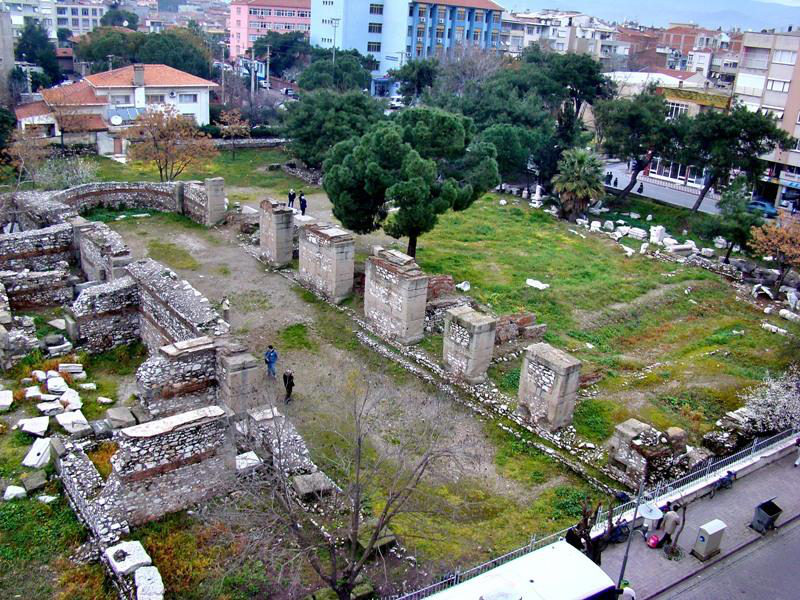
This city was about thirty miles away from Pergamos. It is amazing that the longest letter of the seven was written to the church in the least important of the cities. Pliny dismisses Thyatira with these contemptuous words: "Thyatira and other unimportant communities." In ancient days, it was the center of a dying wool industry. It is remarkable that Christ should single out a very small Church in a relatively obscure city for such an important letter. However, the message reaches far beyond the immediate circumstances in the church at Thyatira. One other mention is found in Acts 16:14, 15 where we read of the conversion of Lydia, a seller of purple, in the city of Thyatira. Lydia must have been a wealthy merchant princess indeed, dealing in one of the costliest substances in the Roman Empire. Today, Thyatira is a little city of about forty-five thousand people, their means of sustenance was found in the weaving of oriental rugs. There was also a temple for fortune-tellers in Thyatira, with a powerful female oracle who presided over it at that time.
Introduction of the Lord
As the Lord introduces Himself to these churches, the description of Him is always pertinent. He introduces Himself to the Church at Ephesus as the one who is walking among the seven lampstands. Then he says to Ephesus, "Except thou repent, I will remove thy lampstand." He introduces Himself to Smyrna as the One who is the First and the Last, who was dead and is alive again. He speaks this to comfort those Smyrnian Christians in their great trial and agony of persecution. He had been through it Himself. He had been slain. He had been raised victorious. Then, in His address to the church at Pergamos, He introduces Himself as the One Who has a sharp two-edged sword. To the church of Thyatira, He introduces Himself in verse eighteen as "the Son of God who has eyes like a flame of fire, and His feet like fine brass." This letter is going to be a letter of wrath because brass is a symbol of the wrath of the judgment of God. He is named the Son of God in contrast to the designation in chapter one where He is called the Son of Man. His title here is in keeping with the character of the judgment pronounced upon the church. Their diversion from the true worship of Jesus Christ the Son of God was so serious that it called for a reiteration of His deity. The description of His eyes as a flame of fire speaks of burning indignation and purifying judgment. In a similar way, His feet are declared to be like fine brass.
Christ makes a commendation of works, faith, and love. "I know thy works and charity and service and faith, and thy patience and thy works; and the last to be more than the first" (Revelation 2:19). Christ commends the church at Thyatira in a remarkable way, considering the severe condemnation. It is remarkable that the church was commended first for its charity or love, especially when none of the three preceding churches were commended for this quality. In addition, mention is made of their service, their faith, and their patience, and for the fact that their last works were greater than the former works, in contrast for instance, to the case of the Ephesian Church. In spite of these most commendable features, the Church at Thyatira was guilty of terrible sin; and with this fact, Christ deals beginning in Revelation 2:20-23.
Who is Jezebel?
Her name immediately takes us back to Israel. Ahab, the king, married a daughter of the king of Sidon, whose name was Jezebel. When she came to live in the capital city of Samaria, she brought her heathen gods with her, and she introduced into Israel its worst days of apostasy. She was a brilliant woman, an able woman, and a zealous woman. She slew the prophets of Jehovah, swept Israel off its religious feet, and subverted the doctrine of God. Jezebel even brought the mighty prophet, Elijah, down to his knees as he fled before her face for his life and prayed that he might die. But who is this Jezebel of Thyatira who claims to be an oracle of God, a prophetess, and to deliver the infallible words of heaven and who teaches and seduces God's servants? There are those who say that since this commercial city of Thyatira was organized similar to (AFLCIO, American Trade Union) guilds, and since all of the commercial people belonged to a patron god or goddess, there was opportunity for an influential woman, an able woman in that assembly, to teach the people that for them to belong to the guilds and to enter into the sacrifices and orgies that went along with oriental pagan, idolatrous worship, was altogether acceptable. A Christian could compromise and do both.
Here God is speaking of a development in the church, in the age of the Thyatiran history of His people (590-1517 A.D.). The Ephesian period was the day of the apostles, the apostolic church. The Smyrnian period represented the Church of persecution and tribulation, the Church of catacombs, when the heavy iron hand of the Roman Empire was upon it. The Pergamean Church was the Church of the establishment, when the church was married to the Roman government, no longer persecuted and no longer hated and despised, but now exalted and lifted up. Then follows the age of the Church of Thyatira. She is dressed in purple and silk, with golden chains around her neck, and she speaks as the infallible prophetess of God, subverting the Word of the Lord Himself. Thyatira is the apostate Church, who looks upon herself as the infallible oracle of the Almighty. Prophetically, the major characteristics of Thyatira fit the Church era (590- 1517) that spanned the Middle Ages. During this time, the dominant Church fabricated a system that, like Jezebel, bound the people to image worship, superstition and priestcraft. These Scripture verses indicate this Church still has some adherents and some power into the great tribulation (Revelation 2:22).
There are many reasons for identification with Jezebel. The Church is always represented by a woman. The Church is always referred to as a "she" or as a "her," never as a "he" or a "him." The Him in Christianity is the great God and Savior, Jesus Christ. The Church is always described as the Bride of Christ, espoused to Christ, and subject to Christ. When we
see a woman here, we see a figure of the Church, and when that woman is called Jezebel, we immediately know that the Lord is speaking of an apostate church.
The third parable in Matthew thirteen is identical in meaning to Christ's letter to the fourth church. They are one and the same. Here, the meal offering represents our Lord. He is the bread of life. He is the food from heaven, the meal offering, and the fine flour, which represents the Word of God, the bread of life, the true manna from heaven. Leaven corrupted the great truths of the doctrine of the Son of God. The leaven represents evil doctrine and teaching. This prophetess delivers not the true message of God, but her own evil, corrupt doctrine. All Christendom became corrupt, outside of the few who remained true to the faith.
The Corruption of the Woman
The dream that the gospel of the Son of God will ever convert the world is a fantastic thing out of man's imagination. It is not revealed in the Bible. In the thirteenth chapter of the gospel of Matthew, there were four kinds of soil, and it was only one of them that produced fruit for God. There we see the tares grow with the wheat, and the leaven grows in the lump until the time of the end. There is never a time without tares. It is only in the end days when God's judgment comes, that God separates the tares from the wheat and burns up the tares with unquenchable fire. They are both together until the end. There is never a time when the gospel converts the world. This, the parable of the leaven teaches. Corruption and men's false doctrine enter into the truth of God and pervade it. The kingdom of Heaven, in the thirteenth chapter, refers to the kingdom here in this world as it is administered by men. It is what we call "Christendom," the great nations of the world who are called Christian nations. This corruption works and it is furthered by this woman Jezebel. God refers to what she teaches as "the depths of Satan." She, of course, would call what she teaches "the depths of God." "You cannot learn this book by yourself," she says, "You must come to me and let me teach you the deep things of God." Man cannot read the simple gospel for himself. He cannot listen to the Word of God and repent of his sins and trust Jesus and be saved. He must come and be instructed by lectures and classes in the deep things of God.
One stands in awe before the unfolding of prophecy as it has been written by the finger of God in this amazing book. This woman subverts almost all Christendom. But there are a few, there is a minority, there are some who are faithful to the Lord and He says, " And he shall rule them with a rod of iron; as the vessels of a potter shall they be broken to shivers: even as I received of my Father" (Revelation 2:27). This is a quotation from the second Psalm: "Ask of me, and I shall give thee the heathen for thine inheritance, and the uttermost parts of the earth for thy possession. Thou shalt break them with a rod of iron; thou shalt dash them in pieces like a potter's vessel" (Psalm 2:8, 9).
There is a limit beyond which false doctrine and false teaching cannot go. Someday, God Himself shall destroy that system (Revelation 17:1-6, 16). God will not put up forever with Jezebel and the seduction of His people. God will judge her. God will give His people a great victory, a victory that is minutely delineated in the book of Revelation.
But God has a second reward to the faithful. "And I will give him the morning star" (Revelation 22:16). The Lord describes Himself: "I am the bright and morning star." When Christ gives us the morning star, we have Him. The morning star is also the announcement of the dawn. If we have Christ, then
we will have been caught away unto Him and shall appear with Him in glory. Caught away with our Lord, the morning star! There, when the day dawns, with our Savior, announcing the glorious consummation of the age. "He, who has an ear, let him hear what the Spirit says to the Churches”.
