Chapter 11 of 14
NRI Deposits to State Crosses Rs 1-trillion Mark
By Rajesh Abraham Published: 13th April 2015 06:04 AM Last Updated: 13th April 2015 06:04 AM
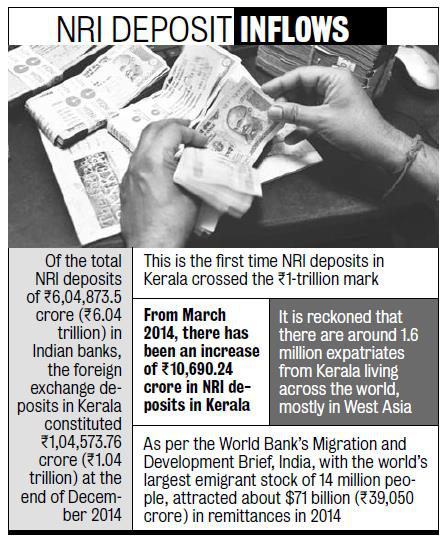
KOCHI: One in six rupees in foreign exchange deposits in the country’s banks is in Kerala, making it the state with the largest amount of NRI deposits. Out of the total NRI deposits of Rs 6,04,873.5 crore (Rs 6.04 trillion) in Indian banks, the foreign exchange deposits in Kerala alone constituted Rs 1,04,573.76 crore (Rs 1.04 trillion) at the end of December 2014. This is the first time NRI deposits to Kerala crossed the Rs 1-trillion mark. The NRI deposits in Gujarat, which has a comparatively larger number of people placed in better jobs (or doing business) in developed countries like the US and Canada, are much less. At the end of December 2014, the NRI deposits in Gujarat banks stood at Rs 49,722 crore, a decline of Rs 9,890 crore from the September 2014 figure of Rs 59,612 crore.
Surprisingly, the NRI deposits in the banks in Kerala rose by Rs 7,107.72 crore from Rs 97,466.04 crore in September 2014, notwithstanding the fact that several hundreds of Keralites had returned from the war-torn countries, including Iraq, Libya and Yemen, in the last several months. From March 2014, there has been an increase of Rs 10,690.24 crore in NRI deposits in Kerala.
According to S Irudaya Rajan, professor at the Centre for Development Studies in Thiruvananthapuram and author of publications on labor migration from Kerala to the Gulf, the NRIs from Gujarat and Punjab do not send money to their native place, while expatriates from Kerala diligently send money back home as the families are dependent on them for daily expenses. “Most of the NRIs from Gujarat and Punjab are settled in countries like the US, Canada and Australia. Perhaps, they may be making investments in India, but that is reflected as business investment,” he explained. It is reckoned that there are about 1.6 million expatriates from Kerala living across the world, mostly in West Asia.
In addition to the NRI deposits, there are remittances coming to Kerala through various foreign exchange money transfer companies such as UAE Exchange, Western Union and commercial banks. “A large section of the people doing low skilled jobs in the Gulf also sends money back home through their friends and relatives. There is no data on such money coming into the state,” Rajan pointed out.
“The high rate being charged for sending money is forcing them to do such an exercise,” he said. As per the World Bank’s Migration and Development Brief, India, with the world’s largest emigrant stock of 14 million people, attracted about $71 billion (Rs 39,050 crore) in remittances in 2014. A major chunk of this amount came to Kerala, though there are no official figures available. The G20, at its meeting in Australia in November last year, had decided to bring down the cost of remittances to 5 per cent from as high as 10 per cent in some countries.
M V George, of UAE Exchange, said the cost of transaction was much less than 5 per cent. “We charge per transaction and not based on the amount,” he said. According to World Bank, the average cost of sending money from the UAE, which has the highest number of employed Keralites, was 2.91 per cent in the January-March 2015 period. The cost of money transfers from Saudi Arabia, which also has a large number of Keralites employed there, is 4.88 per cent. “It’s high time the banks conduct ed a study to find out the exact volume of remittance made to Kerala and the cost involved,” said Rajan.
Indiatimes|The Times of India|The Economic Times
Sign In
NRI
Remittances by NRIs to Kerala cross Rs 1 lakh crore
Viju B | TNN | Jun 7, 2015, 01.33 AM IST Representative image)
THIRUVANANTHAPURAM: Everyone knows about the large-scale migration of Malayalees to the Gulf region and the significant role their remittances have played in Kerala's economy. But here's a really big piece of news: NRI deposits in Kerala have now crossed the magic mark of Rs 1 lakh crore, soaring by more than 17% from Rs 93,884 crore to Rs 1.1 crore (at the end of 2014-15) in the space of just one year, according to data collected by the state level bankers’ committee (SLBC). This includes money from all parts of the world. What's noteworthy is that the growth has come in spite of an uncertain job scenario in West Asia, especially in Saudi Arabia, which has been trying to replace foreign workers with its own.
Reserve Bank of India (RBI) data shows that there was a little over $115 billion in NRI accounts in India, which is about Rs 7 lakh crore. Kerala, thus accounts for roughly a sixth of all the money deposited in NRI accounts. India is the largest recipient of remittance flows in the world receiving about $70 billion (roughly Rs 4.2 lakh crore) from this source in 2014, according to World Bank data. A Kerala government survey showed that remittances sent by the diaspora support at least 50 lakh people in the state, which has a population of 3.15 crore. The Muslim-dominated Malappuram district has the highest number of people living off remittances, around 2.9 lakh. Around 58,500 women from Kerala today work as nurses and Kottayam district has the maximum number of women working abroad.
State government data shows that of the 16.3 lakh non-resident Keralites (the Centre for Development Studies puts the figure at a much higher 24 lakh), 88% live in West Asia. The maximum number of Keralites, around 5.73 lakh, reside in the UAE and around 4.50 lakh in Saudi Arabia. Many have been migrating to the US and Europe in the last decade thanks to the boom in InfoTech and fast-growing opportunities in healthcare. The same government data shows that in the US, there are over 78,000 Keralites, while in Europe there are nearly 53,000. Canada has close to 10,000 Keralites. Families have also migrated to the Africa with nearly 7,000 Keralites residing in different parts of the continent. Kerala's NRIs seem to prefer public sector banks to private sector banks when depositing their money. NRI deposits in public sector banks total Rs 64,700 crore, compared to Rs 44, 900 crore in the private sector banks.
Top Comment
First elected communist government started ruling Kerala in 1957. That was the beginning of labor problems and strikes. No big businesses came to Kerala to provide jobs. The exodus began in the early seventies with the Gulf boom when unemployment rates touched an all-time high with youngsters, though highly literate, having to migrate in search of semiskilled jobs. Since then there has been no looking back. Remittances from the Gulf region are still a key growth engine for the state, which has seen agriculture in decline till recently and negligible growth in manufacturing while neighboring states like Tamil Nadu and Karnataka have surged ahead.
