Chapter 3 of 5
Tattoos
A tattoo is a permanent ink pigmentation injected just under the skin’s surface to create an image, words, or other decorative graphic. Tattoos existed in all cultures from time immemorial. Tattoos have become a fashion and a lifestyle for many. You can see a Tattoo parlor in every shopping strip in America.
Tattoos have outgrown its bad reputation. The American Media changed the fabric of American society and all types of evils are celebrated as a normal life style. We no longer live in a world where tattoos are only seen on mobsters, prostitutes, and criminals.
All the statistics indicate that tattoos have become a mainstay in our society. That is the reason that the industries are providing services in this area are on the rise. More advanced tattoo technologies are available for those who are willing to pay more money. The popularity of getting tattoos is on the rise and it is penetrating wider demographics.
The Origin of Tattooing
The phenomenon of tattooing was once widespread. In “The Descent of Man” (1871) Charles Darwin wrote that there was no country in the world that did not practice tattooing or some other form of permanent body decoration.
The Nineteenth century German ethnologist and explorer Karl von den Steinen believed that tattooing in South America evolved from the custom of decorating the body with scars. Plant sap rubbed into the wounds to prevent bleeding caused discoloration of the scar. The resulting discoloration could be regarded as a tattoo. In his book “Missionary Travels and Research in South Africa (1857), David Livingston wrote that many Africans tattooed themselves by introducing a black substance under the skin to cause a raised scar. The North American Apache and Comanche warriors rubbed earth into battle wounds to make scarring more visible and flaunt them within the tribe, while the pygmies of New Guinea treated infections by rubbing herbs into incisions in the skin, causing permanent scaring. Such tales suggests that tattooing probably arose at various locations through bloodletting practices, scarification rituals, medical treatment or by chance.
What is Scarification?
Scarification is a form of permanent body modification that involves cutting or burning a pattern or design onto the skin.
Traditionally, within indigenous cultures, people perform scarification for ritualistic purposes, such as rites of passage, or to prepare children for adulthood. The procedure may involve repeatedly using a wooden hook, thorn, or razor blade on the skin to create a design. The artists may then pack the wound with ash or mud to prevent wound healing and to deepen scarring.
In other cultures, people may choose scarification for aesthetic reasons or self-expression.
A scarification artist will cut, burn, or brand a design into the skin with a scalpel, electric current, abrasion, or heated or frozen metal tools.
In early Greek and Roman times tattooing was associated with barbarians. The Greeks learned tattooing from the Persians and used it to make slaves and criminals so they could be identified if they tried to escape. The Romans in turn adopted this practice from the Greeks.
Body Piercings in Different Religions
The debate over tattoos and body piercings continues in the Christian community. Some people do not believe body piercing is a sin at all, that God allowed it, so it is okay. Others believe the Bible makes it quite clear that we need to treat our bodies as temples and not do anything to damage it. Yet we should look more closely at what the Bible says, what the piercings mean, and why we are doing it before we decide if a piercing is a sin in the eyes of God. If Christians cut or pierce their bodies they may not be possessed by demon, however demons can influence their lifestyle. When unbelievers cut their bodies, they are opening the door of their soul for demons to enter and possess them.
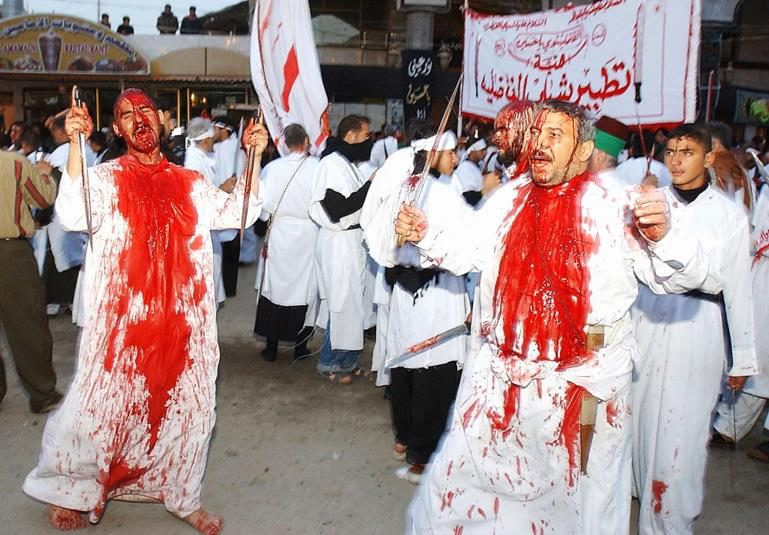
Shite Muslims take part in a bizarre bloodletting ceremony. Babies and children are included in the thousands of religious followers who inflict wounds on this day of Muharram.
Men use whips, kitchen knives, and even chains with blades attached to them to slice open their bodies in the ultimate display of faith. In many parts of India, Muslims whip themselves during a procession to mark Ashoura. Some children hold numerous blades and self-inflicted wounds on their backs.
(Iraqi Shiites - Muharram ceremony)
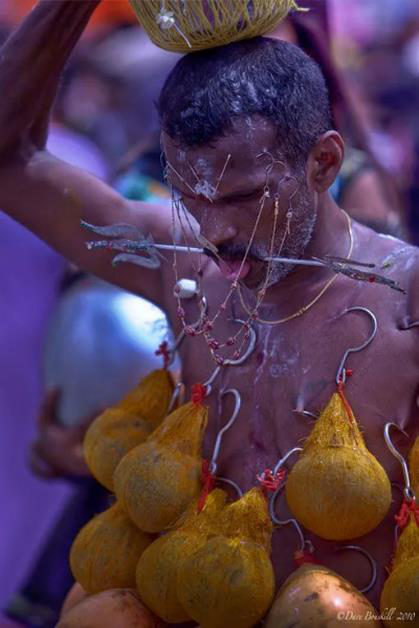
In South India, Hindu followers of the Hindu god Murugan pierce their bodies with hundreds of skewers and hooks to show their devotion. Many devotes will carry a Kavadi, a kind of ceremonial burden that can take many forms. Often, it is a frame festooned with peacock A Vel or cosmic spear, will pierce through one side and comes out to the other cheeks and flower garlands, with spikes or hooks piercing the body and face of the devotee.
Kavadi Dance
Kavadi is the ceremonial sacrifice to Lord Murugan or Subramanya which is celebrated in South India, Sri Lanka, Mauritius, Singapore, Malaysia, Reunion Island, and the largely Hindu diaspora in the western countries. Kavadi has its deep roots in Bhakti-Hatha-Raja Yogas from the
time of Adi Yogi, Shiva. The Kavadi bearer goes through strict austerities for self-purification of the mind and body.
In Canada, Kavadi is celebrated at the Sivavanda Ashram’s Ayyappa Subramanya temple in a small village of Val-Morin, Quebec.
Val-Morin Temple Kavadi Festival – Sivananda
Ashram July 6, 2018 By Prem Lee Prasannan
Migration
Tattooing may have disseminated from various places by way of migration and by nomadic peoples. The women of various gypsy tribes in India and the Middle East were specialized tattooists.
Just as relationships exist between languages and dialects over vast areas, so there are similarities between tattoo designs found in regions and cultures far removed from each other. For example, throughout South East Asia many men had a trouser tattoo that covered the area from the waist to knees. Among the people living in the artic and along the west coast of America, women tattooed their chin and cheeks with similar patterns. It is human nature to exchange customs upon meeting, whether out of friendship, respect, envy, or curiosity. The reciprocal imitation by European sailors and south sea islanders is a good example of this.
At a tribal level, tattoos can indicate age, marital status, power, and class, and outside the group, so they may distinguish friend from foe.
Modern Age
Tattoos are making a comeback in present day culture. They are appearing everywhere from teenagers to housewives and including some Christians. Tattoos are becoming more popular each year. Once tattoos were rare in law-abiding circles. Most Christians were united in their stance against tattoos. Recently many famous preachers are speaking in favor of tattoos.
Body modification, such as piercing, tattooing, scarring, branding, cutting and mutilation has been an increasing trend in recent years. The insertion of metals and jewelry in various body parts has spread from traditional ear lobe piercing and nose piercing to navels, nipples, tongues, eyebrows, cheeks etc.
As tattoos and body piercing continue to gain popularity within mainstream cultures, it is important for all believers to evaluate critically the morality of such actions.
An Impartial Evaluation
The Bible makes no specific reference to tattoos. Many Christians condemn all tattooing as immoral because God clearly forbids them in Leviticus 19:28. “Ye shall not make any cuttings in your flesh for the dead, nor print any marks upon you: I am the Lord.”
The Background
Moses gave this command shortly after the Israelites came out of Egyptian bondage. He was warning them against adapting forbidden practices of the pagan nations around them which included cutting their bodies in honor of the dead and marking their bodies with symbols of pagan gods. This is not directly applicable for Christians, but does reveal the mind of God against tattoos and other body markings.
In Canaan, evidence indicates that instead of marking the body with ink, more extreme scarification measures, like branding, slashing, or gashing the skin were used. Archeology, backed by biblical texts, indicates the Canaanites would customarily slash their bodies for ritualistic purposes (1 Kings 18:28), especially to mourn their dead and honor their gods.
Leviticus 19:28 seems to imply this when it says “You will not make cuttings in your flesh, for the dead, nor print marks on you.’ Considering this history from Egypt and Canaan, it is obvious that god was forbidding any body markings , including tattoos.
Example for Separation
In Indian culture, women typically wear ornaments more than any other women in the world. They wear jewelry from head to toe.
The traditional significance of jewelry in India, is evident from the fact that on auspicious occasions, jewelry forms a part of gifts and is customarily worn as a mark of auspiciousness to invite a good omen. Jewelry is a significant part of the dowry for a bride even today for Hindus and most Christian denominations. Having a superior collection does not only symbolize power, prosperity, status, and immense wealth of the owner, but also are an epitome of financial security at the time of economic turmoil, as it holds a great monetary value.
Not just used as an adornment but as stones endowed with mystical qualities, the ‘Navaratna or nine gems (each sacred to a planet) are still worn in specific order as a protection against evil forces to this day. From the maniratna (serpent stone) still being used as a talisman to special Rudraksha, Tulsi seeds & sandalwood beads worn during Hindu worship, the deep connection between Jewels and Indians, is prominent as its value lies not only in rituals and traditional beliefs, but also some outlook behind each jewelry piece.
When the Brethren Movement started in Kerala around 150 years ago the brethren wanted to show a separation from the Pagan craze of gold jewelry. Hence the Indian brethren went to the other extreme by not wearing any ornaments in order to display their separation. They even abandoned the ceremony of the wedding ring. If you observe the first-generation Kerala Brethren immigrant, 99 percent of them do not wear even wedding rings. The second generation is not following that custom. Unfortunately, Kerala Brethren have made this practice as an important doctrinal component.
Some Reasonings for Tattoos
Why do people get a Tattoo?
What is the motivation for getting a tattoo or body piercing? Our motives are in any decision we make, especially something permanent and lifechanging as a body piercing.
“All a person’s ways seem pure to them, but motives are weighed by the Lord.” (Proverbs 16:2)
What message do you want to communicate to the world by getting a tattoo? Tattoos are powerful messages, automatically conveying what you value. As you mature, you may regret your tattoos because you have outgrown their messages and changed your priorities and outlook of your life.
There are medical issues involved with tattoos. The Mayo Clinic warns, “Don’t take tattooing lightly.” They have resulted in severe allergic reactions, infections, unsightly scars, and blood-borne diseases like Hepatitis B and C. Tattooing deliberately opens skin and exposes the blood to unknown bacteria. Tattoo parlors are not medical clinics.
Why does someone need a tattoo? Is it because he or she wants attention every time someone sees them? Has it become a competition as to whose tattoo is better? Are you getting tattooed in response to a hurt, or out of emotional pain, or a break up?
Attention Seeking
If your tattoo is strategically placed on a sensual part of your body, it will naturally draw even more attention to that area, enticing someone to lust more. This can happen even if the message is a Christian message.
Tattoos and body piercings are in themselves neither moral nor immoral. In biblical cultures, tattoos and body piercings were symbols of ownership by, devotion to, identification with, and protection by a deity or master. Believers who are considering tattoos or body piercings first should be led by their consciences, then should consider the effects that such symbols will have on their physical bodies, interpersonal relationships, and spiritual lives. Temporary tattoos and ear piercings do not usually produce concern, yet permanent tattoos and unusual body piercings can produce a negative response.
As tattoos and body piercings continue to gain popularity within mainstream culture, it is important for the Christian community to evaluate critically the morality of such art works.
In Genesis 1:26 we read “And God said, let us make man in our image, after our likeness: and let them have dominion over the fish of the sea, and over the fowl of the air, and over the cattle, and over all the earth, and over every creeping thing that creepeth upon the earth.”
This verse indicates that humans resemble God and are like Him. This similarity and likeness are called the image of God. Traditionally, Christians have viewed tattoos as immoral on the basis that they desecrate the image of God. Tattoos desecrate the functional aspect of the image of God because they mutilate the body that is supposed to be nurtured and sustained, making it vulnerable to infection. Tattoos glorify the ungodly and vulgar, as well as convey narcissism, defiance, and arrogance.
Tattoos and body piercing are not mentioned in the New Testament.
A Christian Guideline
Tattoos, jewelry, makeup, hairdos, and clothing, all belong in the same category, and the Bible is clear concerning the conduct of a Christian. Jesus makes a difference on how you dress and how you do everything. Corinthians 10:31 “So whether you eat or drink, or whatever you do, do everything for the glory of God.”
Tattoos Focus on External Adornment
In view of Paul’s counsel against adornment, being minimally external and maximally internal, the adornment of the hair does not signify excessive preoccupation with looks, however, tattoos are more noticeable for others. One can change hairstyles anytime however, tattoos are permanent. It cost a significant amount to remove the tattoo and it is very painful also.
Cultural Changes
We will not look the same in twenty-five years. Our taste for food and our preferences changes. Tattooing is a shortsighted and naïve way of thinking. What is cool now will look silly in the future. In my four decades in a banking career, I happened to meet numerous people from all walks of life. One customer had a tattoo on his hand with the name of his girlfriend. He was so proud and happy because it was in a visible part of his body. He was deeply in love. After a few years, when I saw him and asked about the love of his life, he was really embarrassed and told me that they broke up.
She, in his opinion, was like a demon. He had been so naïve and fell in love with her outward beauty and outward nice behavior. When he knew her deeply, he understood his colossal blunder.
Christian Tattoos.
Tattooing is a self-imposed Christian branding. Some people use John 3:16 and other symbols like Jesus Loves You” etc. However, there is a much better way to brand yourself biblically, with love. John 13:35 “By this everyone will know that you are my disciples, if you have love for one another." Matthew 5:16 “In the same way, let your good deeds shine out for all to see, so that everyone will praise your heavenly Father.” This is a much better way to brand yourself biblically.
Tattoos to Evangelize Tattooed People
Some Christians get a tattoo to reach the tattooed people with the gospel, however, that same tattoo may be a huge stumbling block among Muslims and even tattooed people. God has given humans a conscience to know what is right from wrong. Human is wired in such a way even atheists expect a high standard from Christians.
Freedom in Christ
Christians are not required to keep the Old Testament Law. That does not mean it is all right to lie, cheat, and to steal. It means that we are not required to keep Old Testament Law in order to obtain our salvation. This is because we have died to the law and because of that, all things are lawful to us.
Two sections are useful regarding such subjects. Romans 7:1, 4, “Know ye not, brethren, (for I speak to them that know the law,) how that the law hath dominion over a man as long as he liveth?” 4) “Wherefore, my brethren, ye also are become dead to the law by the body of Christ; that ye should be married to another, even to Him who is raised from the dead, that we should bring forth fruit unto God.”
1 Corinthians 6:12 “All things are lawful for me,” but not all things are helpful. “All things are lawful for me,” but I will not be dominated by anything.”
If a person wants to maintain that a Christian should keep the Old Testament Law concerning tattoos, then do they also keep the Old Testament law concerning not shaving the beard? Also, what would they do with the scriptures that say we have died to the law and that all things are lawful? Would they require legalism?
Some tattoo supporters usually ask a question sarcastically. “Do you get a haircut or trim your beard?” God condemned getting a haircut or trimming the beard before forbidding the tattoo. The tattoo is the same as getting a haircut”, they argue. Here, God was not condemning haircuts or beard trims, but He was expressly forbidding hairstyles and beard styles that mimicked their pagan neighbors. The restriction on cutting the hair is based on the Canaanite practice of making an offering of hair to propitiate the spirits of the dead. (Deuteronomy 14:1)
First, we must retain the truth that we are not to violate any moral law of God. There are some universal moral principles laid down by God since the creation and those laws are applicable to all the time. Those principles are based on the character of God. It is always wrong to murder, lie, cheat and to steal. All the ten commandments except the sabbath are reiterated in the New Testament.
Why Does a Christian Need a Tattoo?
We must examine the principles of the word of God. What is my motivation for getting a body piercing or tattoo? Our motives are important in any decision we make (Proverbs 16:2), especially something as permanent and potentially life changing as tattoo and body piercing.
Are you trying to find identity in a subculture? As a believer our identity is in Christ. (Colossians 3:3) Are you trying to attract special attention to yourself? Any item of clothing, accessory, or ornaments worn simply as a fashion statement runs the risk of feeding pride in that it draws attention to the wearer. Exposing some body parts, pushing boundaries, or creating a flashy display is not a godly reason for a body piercing. Apostle Peter advises us to be clothed with humility. (1 Peter 5:5) . We are Christ’s ambassadors, delivering God’s message to the world. (2 Corinthians 5:20) We must consider what message the body piercing sends and whether it will aid or detract from representing Jesus and sharing the gospel.
Of course, we could also ask where we draw the lines on other, more socially acceptable body modifications such as breast implants, breast reduction surgeries, tummy tucks, facelifts, and other modifications. Some of the same questions about motivation and appearance need honest answers if we are to do for the glory of God.” (1 Corinthians 10:31)
Do the same principles apply to tattoos that are for a Christian nature, such as a cross, a Christian slogan, or even a Bible verse? Some Christians have found out that having tattoos gives them more credibility, and thereby more possibilities of evangelism.
Of course, a tattoo of a cross is better than a tattoo of naked girl, skull, or demon. Having a tattoo saying “Jesus saves” could be a conversation starter with some people who would never approach a preacher wearing a suit and tie.
Conclusion
Tattoos are socially problematic on several significant tiers. Even if God had no opinion on this matter, wisdom would dictate that Christians should stay away from tattoos. By their nature, tattoos violate the holiness principles of modesty and vanity. The entire purpose of a tattoo is to draw attention to a particular portion of the body. The desire and willingness to use the body as an attention-grabbing canvas violates the biblical commands of meekness and humility.
